

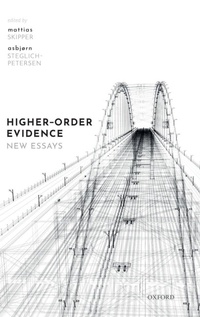
Higher-Order Evidence
New Essays
Published on 17. October 2019
Book
Hardback
336 pages
978-0-19-882977-5 (ISBN)
Description
We often have reason to doubt our own ability to form rational beliefs, or to doubt that some particular belief of ours is rational. Perhaps we learn that a trusted friend disagrees with us about what our shared evidence supports. Or perhaps we learn that our beliefs have been afflicted by motivated reasoning or by other cognitive biases. These are examples of higher-order evidence. While it may seem plausible that higher-order evidence should somehow impact our beliefs, it is less clear how and why. Normally, when evidence impacts our beliefs, it does so by virtue of speaking for or against the truth of theirs contents. But higher-order evidence does not directly concern the contents of the beliefs that they impact. In recent years, philosophers have become increasingly aware of the need to understand the nature and normative role of higher-order evidence. This is partly due to the pervasiveness of higher-order evidence in human life. But it has also become clear that higher-order evidence plays a central role in many epistemological debates, spanning from traditional discussions of internalism/externalism about epistemic justification to more recent discussions of peer disagreement and epistemic akrasia. This volume brings together, for the first time, a distinguished group of leading and up-and-coming epistemologists to explore a wide range of interrelated issues about higher-order evidence.
Reviews / Votes
The book provides rich historical context and compiles a huge wealth of data in one place. It will be of interest to any student of phonological development, especially those who are interested in a concrete framework for defining and measuring a childs phonological patterns from a larger lexical perspective. At the same time, with its references to exemplar theory (e.g. Jusczyk 1992) and Dynamic Systems Theory (Thelen & Smith 1994), the book is also relevant for those more broadly interested in cognitive development. Data from children learning a variety of languages, along with detailed appendices of childrens productions and adult templatic forms, will be tantalising for linguists who may want to do further analyses. * Ashley Farris-Trimble, Simon Fraser University, Phonology * This is the first volume to be entirely dedicated to issues concerning higher-order evidence, and it will go a long way in advancing and shaping these relatively new debates. Higher-Order Evidence is sure to be of great interest to anyone captivated with contemporary debates in epistemology, particularly those with an interest in formal epistemology. * Jonathan Matheson, Metascience *More details
Language
English
Place of publication
Oxford
United Kingdom
Target group
Professional and scholarly
Dimensions
Height: 240 mm
Width: 161 mm
Thickness: 22 mm
Weight
663 gr
ISBN-13
978-0-19-882977-5 (9780198829775)
Copyright in bibliographic data and cover images is held by Nielsen Book Services Limited or by the publishers or by their respective licensors: all rights reserved.
Schweitzer Classification
Other editions
Additional editions
E-Book
10/2019
1st Edition
OUP eBook
€58.99
Available for download
Persons
Mattias Skipper is a PhD Candidate in Philosophy at Aarhus University. He works mainly in epistemology, including formal and social epistemology, but also has interests in philosophical logic, philosophy of language and philosophy of science. His dissertation project aims to shed light on a number of issues concerning the normative role of higher-order evidence.
Asbjorn Steglich-Petersen is Professor of Philosophy at Aarhus University. He has published widely in epistemology, philosophy of mind, metaphysics, and philosophy of language, with a major strand of work devoted to epistemic normativity and the nature of belief. He is the co-editor of Reasons for Belief (Cambridge 2011).
Asbjorn Steglich-Petersen is Professor of Philosophy at Aarhus University. He has published widely in epistemology, philosophy of mind, metaphysics, and philosophy of language, with a major strand of work devoted to epistemic normativity and the nature of belief. He is the co-editor of Reasons for Belief (Cambridge 2011).
Content
Mattias Skipper and Asbjorn Steglich-Petersen: Introduction
1: David Christensen: Formulating Independence
2: Kevin Dorst: Higher-Order Uncertainty
3: Anna-Maria A. Eder and Peter Broessel: Evidence of Evidence as Higher-Order Evidence
4: Daniel Greco: Fragmentation and Higher-Order Evidence
5: Sophie Horowitz: Predictably Misleading Evidence
6: Klemens Kappel: Escaping the Akratic Trilemma
7: Maria Lasonen-Aarnio: Higher-Order Defeat and Evincibility
8: Ram Neta: The Puzzles of Easy Knowledge and of Higher-Order Evidence: A Unified Solution
9: Mattias Skipper: Higher-Order Defeat and the Impossibility of Self-Misleading Evidence
10: Asbjorn Steglich-Petersen: Higher-Order Defeat and Doxastic Resilience
11: Michael G. Titelbaum: Return to Reason
12: Daniel Whiting: Whither Higher-Order Evidence?
13: Timothy Williamson: Evidence of Evidence in Epistemic Logic
14: Alex Worsnip: Can Your Total Evidence Mislead About Itself?
1: David Christensen: Formulating Independence
2: Kevin Dorst: Higher-Order Uncertainty
3: Anna-Maria A. Eder and Peter Broessel: Evidence of Evidence as Higher-Order Evidence
4: Daniel Greco: Fragmentation and Higher-Order Evidence
5: Sophie Horowitz: Predictably Misleading Evidence
6: Klemens Kappel: Escaping the Akratic Trilemma
7: Maria Lasonen-Aarnio: Higher-Order Defeat and Evincibility
8: Ram Neta: The Puzzles of Easy Knowledge and of Higher-Order Evidence: A Unified Solution
9: Mattias Skipper: Higher-Order Defeat and the Impossibility of Self-Misleading Evidence
10: Asbjorn Steglich-Petersen: Higher-Order Defeat and Doxastic Resilience
11: Michael G. Titelbaum: Return to Reason
12: Daniel Whiting: Whither Higher-Order Evidence?
13: Timothy Williamson: Evidence of Evidence in Epistemic Logic
14: Alex Worsnip: Can Your Total Evidence Mislead About Itself?