

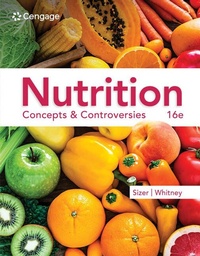
Nutrition
Concepts & Controversies
16th Edition
Published on 2. February 2022
Book
Paperback/Softback
880 pages
978-0-357-72761-4 (ISBN)
Description
Make better food choices and live a healthier life with NUTRITION: CONCEPTS AND CONTROVERSIES. More conversational than a pure-science text, this book explores the essentials of nutrition--including how the body breaks down and uses food, food safety, sports nutrition and special nutritional needs throughout the human life cycle--and asks you to weigh in on relevant debates, such as sustainable diets, the safety of supplements, genetically modified foods, how much is too much sugar, and "keto" and "paleo" diets. NUTRITION: CONCEPTS AND CONTROVERSIES is available with the MindTap learning platform, which offers self-quizzing and activities to propel your learning from memorization to mastery.
More details
Edition
16th edition
Language
English
Place of publication
CA
United States
Publishing group
Cengage Learning, Inc
Target group
College/higher education
Dimensions
Height: 274 mm
Width: 219 mm
Thickness: 30 mm
Weight
1428 gr
ISBN-13
978-0-357-72761-4 (9780357727614)
Copyright in bibliographic data and cover images is held by Nielsen Book Services Limited or by the publishers or by their respective licensors: all rights reserved.
Schweitzer Classification
Other editions
Previous edition
Book
01/2019
15th Edition
Brooks/Cole
€86.65
Article exhausted; check for reprint
Persons
Frances Sienkiewicz Sizer, M.S., R.D., F.A.D.A., attended Florida State University, where, in 1980, she received her BS and, in 1982, her M.S. in nutrition. She is certified as a charter Fellow of the American Dietetic Association and Fellow of the Academy of Nutrition and Dietetics. She is a founding member and vice president of Nutrition and Health Associates, an information and resource center in Tallahassee, Florida, that maintains an ongoing bibliographic database tracking research in more than 1,000 topic areas of nutrition. Her textbooks include "Life Choices: Health Concepts and Strategies"; "Making Life Choices"; "The Fitness Triad: Motivation, Training, and Nutrition" and others. She is a primary author of "Nutrition Interactive," an instructional college-level nutrition game-teaching resource. In addition to writing, she has lectured at universities and at national and regional conferences and serves in several local hunger and homelessness relief organizations in her community. Ellie Whitney grew up in New York City and received her B.A. and Ph.D. degrees in English and biology at Harvard and Washington Universities. She taught at both Florida State University and Florida A&M University, wrote numerous newspaper columns on environmental matters for the Tallahassee Democrat and co-authored almost a dozen college textbooks on nutrition, health and related topics, many of which repeatedly reappear in new editions. She spent three decades exploring outdoor Florida and studying its ecology, then co-wrote "Priceless Florida: Natural Ecosystems and Native Species." In her retirement, more concerned about climate change than any other issue, she volunteered full-time for the nonpartisan national nonprofit Citizens Climate Lobby.
Content
1. Food Choices and Human Health.
2. Nutrition Tools: Standards and Guidelines.
3. The Remarkable Body.
4. The Carbohydrates: Sugar, Starch, Glycogen, and Fiber.
5. The Lipids: Fats, Oils, Phospholipids, and Sterols.
6. The Proteins and Amino Acids.
7. The Vitamins.
8. Water and Minerals.
9. Energy Balance and Healthy Body Weight.
10. Performance Nutrition.
11. Nutrition and Chronic Diseases.
12. Food Safety and Food Technology.
13. Life Cycle Nutrition: Mother and Infant.
14. Child, Teen, and Older Adult.
15. Hunger and the Future of Food.
Appendix A: Chemical Structures of Carbohydrates, Lipids, Amino Acids, and Peptides.
Appendix B: World Health Organization Nutrition Intake Guidelines.
Appendix C: Aids to Calculations.
Appendix D: Food Lists for Diabetes and Weight Management.
Appendix E: Eating Patterns to Meet the Dietary Guidelines for Americans.
Appendix F: Reference Notes.
Appendix G: Answers to Chapter Questions.
Appendix H: Physical Activity Levels and Energy Requirements.
2. Nutrition Tools: Standards and Guidelines.
3. The Remarkable Body.
4. The Carbohydrates: Sugar, Starch, Glycogen, and Fiber.
5. The Lipids: Fats, Oils, Phospholipids, and Sterols.
6. The Proteins and Amino Acids.
7. The Vitamins.
8. Water and Minerals.
9. Energy Balance and Healthy Body Weight.
10. Performance Nutrition.
11. Nutrition and Chronic Diseases.
12. Food Safety and Food Technology.
13. Life Cycle Nutrition: Mother and Infant.
14. Child, Teen, and Older Adult.
15. Hunger and the Future of Food.
Appendix A: Chemical Structures of Carbohydrates, Lipids, Amino Acids, and Peptides.
Appendix B: World Health Organization Nutrition Intake Guidelines.
Appendix C: Aids to Calculations.
Appendix D: Food Lists for Diabetes and Weight Management.
Appendix E: Eating Patterns to Meet the Dietary Guidelines for Americans.
Appendix F: Reference Notes.
Appendix G: Answers to Chapter Questions.
Appendix H: Physical Activity Levels and Energy Requirements.