

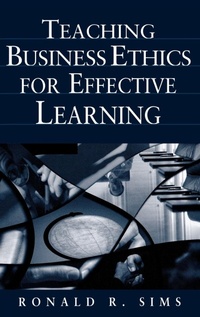
Teaching Business Ethics for Effective Learning
Published on 30. May 2002
Book
Hardback
312 pages
978-1-56720-482-7 (ISBN)
Description
The key to teaching business ethics successfully, says Sims, is to start with clear goals and a sensible expectation of outcomes, and with a true knowledge and appreciation of how people actually learn. Seems obvious enough, he says, but the surprise is that so few understand this. Thus, the teaching of business ethics is often an unproductive, frustrating exercise in futility. Sims hopes to change that. Proceeding with the conviction that open communications between teacher and student before, during, and after the teaching experience is vital, Sims identifies key teaching processes, gives practical advice on designing and planning the curriculum, and offers guidance on how to develop a climate conducive to effective learning. He highlights the importance of creating a classroom climate that encourages open dialogue, good moral conversation, and conversational learning. And throughout he emphasizes that learning styles and experiential learning theory are cornerstones of teaching business ethics, thus taking an approach unlike any in the literature. An important guide for those who are new to teaching this essential subject, Sims' book will also be helpful for more experienced teachers who are wondering why their own methods do not always work, or do not work as well as they believe they should.
Sims identifies important processes that must be managed if business ethics is to be taught and learned successfully-processes such as creating stakeholder commitment to the goals, purposes, and outcomes of the teaching effort, and curriculum design and planning that are attuned to individual differences in learning styles, motivation, and values. Also included in Sims' processes are the development of individual school outcomes, and expectations, and the assessment procedures that can measure them. He discusses the importance of incorporating debriefing into an experiential learning exercise or discussion, and goes on to give an in-depth discussion of the pedagogical approaches that allow teachers to teach the practical and theoretical components of the subject simultaneously. Well illustrated with examples, such as an interdisciplinary approach to teaching and a way to institutionalize outcomes assessment by means of total quality management, Sims' book returns constantly to his major theme: that to teach business ethics effectively the teacher must first create a climate of trust and sharing within and between students, and between students and teacher, and that the teacher must have a concrete way to measure the impact of the teaching effort's results.
Sims identifies important processes that must be managed if business ethics is to be taught and learned successfully-processes such as creating stakeholder commitment to the goals, purposes, and outcomes of the teaching effort, and curriculum design and planning that are attuned to individual differences in learning styles, motivation, and values. Also included in Sims' processes are the development of individual school outcomes, and expectations, and the assessment procedures that can measure them. He discusses the importance of incorporating debriefing into an experiential learning exercise or discussion, and goes on to give an in-depth discussion of the pedagogical approaches that allow teachers to teach the practical and theoretical components of the subject simultaneously. Well illustrated with examples, such as an interdisciplinary approach to teaching and a way to institutionalize outcomes assessment by means of total quality management, Sims' book returns constantly to his major theme: that to teach business ethics effectively the teacher must first create a climate of trust and sharing within and between students, and between students and teacher, and that the teacher must have a concrete way to measure the impact of the teaching effort's results.
More details
Language
English
Place of publication
United States
Publishing group
Bloomsbury Publishing Plc
Target group
College/higher education
Professional and scholarly
Interest Age: From 7 to 17 years
Dimensions
Height: 240 mm
Width: 161 mm
Thickness: 21 mm
Weight
631 gr
ISBN-13
978-1-56720-482-7 (9781567204827)
Copyright in bibliographic data and cover images is held by Nielsen Book Services Limited or by the publishers or by their respective licensors: all rights reserved.
Schweitzer Classification
Other editions
Additional editions
Ronald R. Sims
Teaching Business Ethics for Effective Learning
E-Book
05/2002
1st Edition
Praeger Publishers Inc
€82.49
Available for download
Person
RONALD R. SIMS is the Floyd Dewey Gottwald Senior Professor of Business Administration in the Graduate School of Business, College of William and Mary. He holds a doctorate in organizational behavior and consults widely with organizations in the private, public, and not-for-profit sectors. Sims is author or coauthor of more than 75 scholarly and professional articles and more than 20 books. Among his more recent ones are Organizational Success Through Effective Human Resource Management (2002), The Challenge of Front-Line Management (2000), and Keys to Employee Success in Coming Decades (1999, with John G. Veres III).
Content
Preface
Teaching Business Ethics for Effective Learning
What Should Be Taught in Business Ethics Efforts
The Environment for Teaching Business Ethics: Obstacles and Issues
Who Should Teach Business Ethics
Teaching Business Ethics for Effective Learning: Experiential Learning
Learning Environments and Experiential Learning Processes
Structuring and Delivering Teaching Business Ethics Efforts
Practical Approaches to Teaching Business Ethics
Moving into the Classroom: Developing the Climate for Teaching and Learning Business Ethics
Teaching Business Ethics: Dialogue, Good Moral Conversation, and Conversational Learning
Debriefing: Completing the Learning Process in Experiential Learning Exercises
Assessing the Impact of Teaching Business Ethics Efforts: A Total Quality Management (TQM) and Student Outcomes Assessment Approach
Outcomes Assessment: Why Evaluate Your Teaching Business Ethics Efforts
Successfully Teaching Business Ethics for Effective Learning
Teaching Business Ethics for Effective Learning
What Should Be Taught in Business Ethics Efforts
The Environment for Teaching Business Ethics: Obstacles and Issues
Who Should Teach Business Ethics
Teaching Business Ethics for Effective Learning: Experiential Learning
Learning Environments and Experiential Learning Processes
Structuring and Delivering Teaching Business Ethics Efforts
Practical Approaches to Teaching Business Ethics
Moving into the Classroom: Developing the Climate for Teaching and Learning Business Ethics
Teaching Business Ethics: Dialogue, Good Moral Conversation, and Conversational Learning
Debriefing: Completing the Learning Process in Experiential Learning Exercises
Assessing the Impact of Teaching Business Ethics Efforts: A Total Quality Management (TQM) and Student Outcomes Assessment Approach
Outcomes Assessment: Why Evaluate Your Teaching Business Ethics Efforts
Successfully Teaching Business Ethics for Effective Learning