

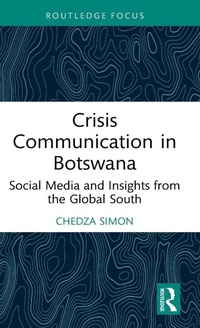
Crisis Communication in Botswana
Social Media and Insights from the Global South
1st Edition
Will be published approx. on 12. June 2026
Book
Hardback
136 pages
978-1-032-94324-4 (ISBN)
Description
Centred around the case of Botswana, this book explores organisational crisis communication from the Global South, providing insights and empirical evidence from the region to challenge Western-centric views on crisis communication.
Emphasising the importance of integrating indigenous practices by highlighting the significance of the kgotla system, the book explores the potential for public relations practitioners in Botswana to harness the power of the kgotla system by integrating it with digital platforms, creating a holistic and culturally relevant crisis communication approach that can be adopted globally. The author examines the crisis response tactics that public relations professionals in Botswana use to safeguard corporate reputation and reveals how they use language to influence and manipulate social media users, particularly on Facebook, to prevent them from questioning organisations in crises, and shares insights on the relationship between social media and cultural platforms. He develops a new Cross Cloverleaf Relationship Model to offer clear applications for crisis communication across the globe.
The book provides fresh insights on crisis communication, digital technology, and culture from non-Western contexts, making it appealing to scholars across public relations and various disciplines, such as public health, risk studies, climate change, psychology, and cultural studies.
Emphasising the importance of integrating indigenous practices by highlighting the significance of the kgotla system, the book explores the potential for public relations practitioners in Botswana to harness the power of the kgotla system by integrating it with digital platforms, creating a holistic and culturally relevant crisis communication approach that can be adopted globally. The author examines the crisis response tactics that public relations professionals in Botswana use to safeguard corporate reputation and reveals how they use language to influence and manipulate social media users, particularly on Facebook, to prevent them from questioning organisations in crises, and shares insights on the relationship between social media and cultural platforms. He develops a new Cross Cloverleaf Relationship Model to offer clear applications for crisis communication across the globe.
The book provides fresh insights on crisis communication, digital technology, and culture from non-Western contexts, making it appealing to scholars across public relations and various disciplines, such as public health, risk studies, climate change, psychology, and cultural studies.
More details
Series
Language
English
Place of publication
London
United Kingdom
Publishing group
Taylor & Francis Ltd
Target group
Professional and scholarly
College/higher education
Academic, Postgraduate, and Undergraduate Advanced
Illustrations
1 s/w Zeichnung, 3 s/w Tabellen, 1 farbige Abbildung
3 Tables, black and white; 1 Line drawings, black and white; 1 Illustrations, color
Dimensions
Height: 216 mm
Width: 138 mm
ISBN-13
978-1-032-94324-4 (9781032943244)
Copyright in bibliographic data and cover images is held by Nielsen Book Services Limited or by the publishers or by their respective licensors: all rights reserved.
Schweitzer Classification
Other editions
Additional editions
E-Book
06/2026
Routledge
€31.49
Available for download
E-Book
06/2026
Routledge
€31.49
Available for download
Person
Chedza Simon is a Lecturer in Public Relations and Digital Communications at the University of Salford, Manchester, UK.
Content
1 Introduction: Unveiling Botswana: Rethinking crisis communication 2 Botswana's historical context 3 The 2011 Botswana Development Corporation scandal 4 The 2019 Botswana Railways train accident 5 Attempted solutions: Western theories and the BDC and BR crises 6 Introducing the Cross Cloverleaf Relationship Model 7 Application and implications of the Cross Cloverleaf Relationship Model for other contexts 8 Conclusion