

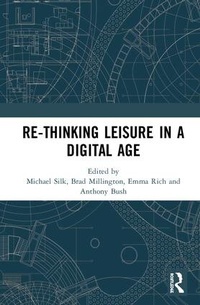
Re-thinking Leisure in a Digital Age
1st Edition
Published on 9. October 2018
Book
Hardback
132 pages
978-1-138-32541-8 (ISBN)
Description
Digital worlds and cultures-social media, web 2.0, youtube, wearable technologies, health and fitness apps-dominate, if not order, our everyday lives. We are no longer 'just' consumers or readers of digital culture but active producers through facebook, twitter, Instagram, youtube and other emerging technologies. This book is predicated on the assumption that out understanding of our everyday lives should be informed by what is taking place in and through emerging technologies given these (virtual) environments provide a crucial context where traditional, categorical assumptions about the body, identity and leisure may be contested. Far from being 'virtual', the body is constituted within and through emerging technologies in material ways. Recent 'moral panics' over the role of digital cultures in teen suicide, digital drinking games, an endless array of homoerotic images of young bodies being linked with steroid use, disordered eating and body dissatisfaction, facebook games/fundraising campaigns (e.g. for breast cancer), movements devoted to exposing 'everyday sexism' / metoo, twitter abuse (of feminists, of athletes, of racist nature to name but a few), speak to the need for critical engagement with digital cultures. While some of the earlier techno-utopian visions offered the promise of digitality to give rise to participatory, user generator collaborations, within this book we provide critical engagement with digital technologies and what this means for our understandings of leisure cultures.
The chapters originally published in a special issue in Leisure Studies.
The chapters originally published in a special issue in Leisure Studies.
Reviews / Votes
"Collectively, the contributions in this anthology provide refreshing new insights and perspectives on the digital shift that international leisure studies are confronted with. The topics addressed here will be important to examine in other sports-related scholarly fields in the coming years. The individual chapters in the book are far-sighted, creative and valuable contributions to the advancement of sport and leisure as academic fields."- Anne Tjonndal, Nordic Sport Science Forum
More details
Language
English
Place of publication
London
United Kingdom
Publishing group
Taylor & Francis Ltd
Target group
College/higher education
Dimensions
Height: 246 mm
Width: 174 mm
Weight
400 gr
ISBN-13
978-1-138-32541-8 (9781138325418)
Copyright in bibliographic data and cover images is held by Nielsen Book Services Limited or by the publishers or by their respective licensors: all rights reserved.
Schweitzer Classification
Other editions
Additional editions
Michael Silk | Brad Millington | Emma Rich
Re-thinking Leisure in a Digital Age
Book
06/2020
1st Edition
Routledge
€64.60
Shipment within 15-20 days
Michael Silk | Brad Millington | Emma Rich
Re-thinking Leisure in a Digital Age
E-Book
05/2020
1st Edition
Routledge
€59.49
Available for download
Michael Silk | Brad Millington | Emma Rich
Re-thinking Leisure in a Digital Age
E-Book
05/2020
1st Edition
Routledge
€59.49
Available for download
Persons
Michael Silk is a Professor and Deputy Dean (Research & Professional Practice) in the Faculty of Management. His research and scholarship is interdisciplinary and focuses on the relationships between sport & physical activity (physical culture), the governance of bodies, mediated (sporting) spectacles, identities and urban spaces.
Brad Millington is a Lecturer in the Department for Health at the Univesity of Bath. His research is focussed on how technology has helped shape sporting practices in different historical eras, in sport and physical activity policy, and in the meanings people ascribe to their sport and physical activity experiences.
Emma Rich is a Reader in the Department for Health at the University of Bath. Her research examines sport, physical activity and physical/health education with a specific interest in digital health technologies (e.g. mobile and digital health, big data, wearable technologies).
Anthony Bush is a Senior Lecturer in the Department for Health at the University of Bath. He is an interdisciplinary scholar specialising on issues concerning the physically active body in a myriad of spaces and sites including, but not limited to, the elite sporting context.
Brad Millington is a Lecturer in the Department for Health at the Univesity of Bath. His research is focussed on how technology has helped shape sporting practices in different historical eras, in sport and physical activity policy, and in the meanings people ascribe to their sport and physical activity experiences.
Emma Rich is a Reader in the Department for Health at the University of Bath. Her research examines sport, physical activity and physical/health education with a specific interest in digital health technologies (e.g. mobile and digital health, big data, wearable technologies).
Anthony Bush is a Senior Lecturer in the Department for Health at the University of Bath. He is an interdisciplinary scholar specialising on issues concerning the physically active body in a myriad of spaces and sites including, but not limited to, the elite sporting context.
Content
Foreword: lively devices, lively data and lively leisure studies Deborah Lupton 1. (Re-)thinking digital leisure Michael Silk, Brad Millington, Emma Rich and Anthony Bush 2. Young people, digital media making and critical digital citizenship D. McGillivray, G. McPherson, J. Jones and A. McCandlish 3. Video games and the political and cultural economies of health-entertainment Brad Millington 4. Exploring online fitness culture and young females Stephanie T. Jong and Murray J. N. Drummond 5. Be who you are and be proud: Brittney Griner, intersectional invisibility and digital possibilities for lesbian sporting celebrity Megan Chawansky 6. Towards typologies of virtual maltreatment: sport, digital cultures & dark leisure Emma Kavanagh, Ian Jones and Lucy Sheppard-Marks 7. (Re)constructing the tourist experience? Editing experience and mediating memories of learning to dive Stephanie Merchant 8. Immaterial labour in spaces of leisure: producing biopolitical subjectivities through Facebook Jeff Rose and Callie Spencer Afterword: a new digital Leisure Studies for Theoretical Times Steve Redhead