

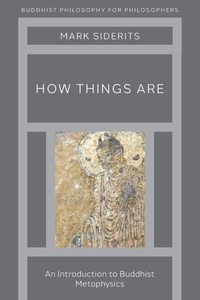
How Things Are
An Introduction to Buddhist Metaphysics
Published on 31. March 2022
Book
Paperback/Softback
212 pages
978-0-19-760691-9 (ISBN)
Description
It is widely known that Buddhists deny the existence of the self. However, Buddhist philosophers defend interesting positions on a variety of other issues in fundamental ontology. In particular, they have important things to say about ontological reduction and the nature of the causal relation. Amidst the prolonged debate over global anti-realism, Buddhist philosophers devised an innovative approach to the radical nominalist denial of all universals and real resemblances. While some defend presentism, others propound eternalism. In How Things Are, Mark Siderits presents the arguments that Buddhist philosophers developed on these and other issues. Those with an interest in metaphysics may find new and interesting insights into what the Buddhists had to say about their ideas.
This work is designed to introduce some of the more important fruits of Buddhist metaphysical inquiry to philosophers with little or no prior knowledge of that tradition. While there is plenty of scholarship on the Indian Buddhist philosophical tradition, it is primarily concerned with the historical details, often presupposes background knowledge of the major schools and figures, and makes ample use of untranslated Sanskrit technical terms. What has been missing from this area of philosophical inquiry, are studies that make the Buddhist tradition accessible to philosophers who are interested in solving metaphysical problems. This work fills that gap by focusing not on history and texts but on the metaphysical puzzles themselves, and on ways of trying to solve them.
This work is designed to introduce some of the more important fruits of Buddhist metaphysical inquiry to philosophers with little or no prior knowledge of that tradition. While there is plenty of scholarship on the Indian Buddhist philosophical tradition, it is primarily concerned with the historical details, often presupposes background knowledge of the major schools and figures, and makes ample use of untranslated Sanskrit technical terms. What has been missing from this area of philosophical inquiry, are studies that make the Buddhist tradition accessible to philosophers who are interested in solving metaphysical problems. This work fills that gap by focusing not on history and texts but on the metaphysical puzzles themselves, and on ways of trying to solve them.
Reviews / Votes
This book provides a multidimensional interpretation of the metaphysical teachings put forth by different schools of Indian Buddhism. It will not only be greatly appreciated by scholars of Indian Buddhist studies,but it also makes an important contribution to the study of metaphysical theories in general. * Yufei Han, Central China Normal University, Religious Studies Review * How Things Are is a tour de force of Buddhist metaphysics from an analytic philosopher so steeped in both traditions so as to be able to present Buddhist metaphysics' dialectical progressions and interrelationships in Western analytic terms at both the fine-grained level of analysis and the "big picture" level on the many ways these arguments stack up against each other and contemporary Western philosophical puzzles. * Rick Repetti, City University of New York, Philosophy East and West * This book provides a multidimensional interpretation of the metaphysical teachings put forth by different schools of Indian Buddhism. It will not only be greatly appreciated by scholars of Indian Buddhist studies, but it also makes an important contribution to the study of metaphysical theories in general. * Religious Studies Review *More details
Series
Language
English
Place of publication
New York
United States
Target group
Professional and scholarly
Dimensions
Height: 234 mm
Width: 156 mm
Thickness: 12 mm
Weight
330 gr
ISBN-13
978-0-19-760691-9 (9780197606919)
Copyright in bibliographic data and cover images is held by Nielsen Book Services Limited or by the publishers or by their respective licensors: all rights reserved.
Schweitzer Classification
Other editions
Additional editions
Book
03/2022
Oxford University Press Inc
€129.50
Shipment within 15-20 days
E-Book
11/2021
OUP eBook
€16.49
Available for download
E-Book
11/2021
OUP eBook
€16.49
Available for download
Person
Mark Siderits works primarily in analytic Asian philosophy. He retired from Seoul National University in 2012, but now lectures occasionally at Kyoto University. His research interests lie in the intersection between classical Indian philosophy on the one hand, and analytic metaphysics and philosophy of language on the other. Among his more recent publications are: Personal Identity and Buddhist Philosophy: Empty Persons, 2nd edition, and, together with Shoryu Katsura, Nagarjuna's Middle Way: Mulamadhyamakakarika. A collection of his papers on Buddhist philosophy, Studies in Buddhist Philosophy, was published by Oxford in 2016.
Content
Chapter 1: Introduction
Chapter 2: Non-Self I
Chapter 3: Non-Self II
Chapter 4: Fundamental Ontology
Chapter 5: Causation
Chapter 6: Buddhist Nominalism
Chapter 7: Time
Chapter 8: The External World
Chapter 9: The Internal World
Chapter 10: Anti-realisms Local and Global
References
Chapter 2: Non-Self I
Chapter 3: Non-Self II
Chapter 4: Fundamental Ontology
Chapter 5: Causation
Chapter 6: Buddhist Nominalism
Chapter 7: Time
Chapter 8: The External World
Chapter 9: The Internal World
Chapter 10: Anti-realisms Local and Global
References