


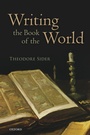
Writing the Book of the World
Published on 24. November 2011
Book
Hardback
334 pages
978-0-19-969790-8 (ISBN)
Description
In order to perfectly describe the world, it is not enough to speak truly. In this ambitious and ground-breaking book, Theodore Sider argues that for a representation to be fully successful, truth is not enough; the representation must also use the right concepts-concepts that 'carve at the joints'-so that its conceptual structure matches reality's structure. There is an objectively correct way to 'write the book of the world'.
Sider's argument begins from the assertion that metaphysics is about the fundamental structure of reality. Not about what's necessarily true; not about what properties are essential; not about conceptual analysis; and not about what there is. While inquiry into necessity, essence, concepts, or ontology might help to illuminate reality's structure, the ultimate goal is insight into this structure. Sider argues that part of the theory of structure is an account of how structure connects to other concepts. For example, structure can be used to illuminate laws of nature, explanation, reference, induction, physical geometry, substantivity, conventionality, objectivity, and metametaphysics. Another part is an account of how structure behaves. Since structure is a way of thinking about fundamentality, Sider's account implies distinctive answers to questions about the nature of fundamentality. These answers distinguish his theory of structure from other recent theories of fundamentality, including Kit Fine's theory of ground and reality, the theory of truthmaking, and Jonathan Schaffer's theory of ontological dependence.
Sider's argument begins from the assertion that metaphysics is about the fundamental structure of reality. Not about what's necessarily true; not about what properties are essential; not about conceptual analysis; and not about what there is. While inquiry into necessity, essence, concepts, or ontology might help to illuminate reality's structure, the ultimate goal is insight into this structure. Sider argues that part of the theory of structure is an account of how structure connects to other concepts. For example, structure can be used to illuminate laws of nature, explanation, reference, induction, physical geometry, substantivity, conventionality, objectivity, and metametaphysics. Another part is an account of how structure behaves. Since structure is a way of thinking about fundamentality, Sider's account implies distinctive answers to questions about the nature of fundamentality. These answers distinguish his theory of structure from other recent theories of fundamentality, including Kit Fine's theory of ground and reality, the theory of truthmaking, and Jonathan Schaffer's theory of ontological dependence.
Reviews / Votes
Two issues have been heavily debated in recent metaphysics: a revival of the old meta-question concerning the substantivity of (at least some) metaphysical debates, and the first-order question of what we might or should mean by metaphysical 'fundamentality.' Theodore Sider addresses these and related matters with great care, sophistication, clarity, and originality. . . . a terrific achievement: profound, rigorously systematic, and full of clarifying insights and arguments. * Timothy O'Connor and Nickolas Montgomery, Notre Dame Philosophical Reviews * Sider works through an impressie list of philosophical problems and shows in each case how the idea of basic structure can help us address them ... there is much to applaud in this fascinating book. * A.W. Moore, London Review of Books * Siders book is a great and important milestone in contemporary metaphysics. I highly recommend it to all metaphysicians, although the reader has a mountain to climb. The book is rich in complex arguments requiring careful study, whether you are a realist or a deflationist. * Laszlo Kocsis, Philosophy in Review XXXIII *More details
Language
English
Place of publication
Oxford
United Kingdom
Target group
Professional and scholarly
Scholars and advanced students of metaphysics.
Dimensions
Height: 240 mm
Width: 161 mm
Thickness: 23 mm
Weight
666 gr
ISBN-13
978-0-19-969790-8 (9780199697908)
Copyright in bibliographic data and cover images is held by Nielsen Book Services Limited or by the publishers or by their respective licensors: all rights reserved.
Schweitzer Classification
Other editions
Additional editions
Theodore Sider
Writing the Book of the World
Book
11/2013
Oxford University Press
€61.50
Shipment within 15-20 days

Theodore Sider
Writing the Book of the World
E-Book
11/2013
1st Edition
OUP eBook
€30.49
Available for download

Theodore Sider
Writing the Book of the World
E-Book
11/2011
1st Edition
OUP eBook
€30.49
Available for download
Person
Theodore Sider is Frederick J. Whiton Chair of Philosophy at Cornell University. He completed his PhD at the University of Massachusetts, Amherst, and has held positions at New York University, Rutgers University, Syracuse University, and the University of Rochester. He is the co-author of Riddles of Existence: A Guided Tour of Metaphysics (OUP, 2005) with Earl Conee, and the author of Four-Dimensionalism: An Ontology of Persistence and Time (OUP, 2001), and a textbook: Logic for Philosophy (OUP, 2010).
Content
1. Structure ; 2. Primitivism ; 3. Connections ; 4. Substantivity ; 5. Metametaphysics ; 6. Beyond the predicate ; 7. Questions ; 8. Rivals ; 9. Ontology ; 10. Logic ; 11. Time ; 12. Modality ; 13. A Worldview ; References