

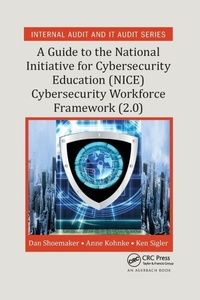
A Guide to the National Initiative for Cybersecurity Education (NICE) Cybersecurity Workforce Framework (2.0)
1st Edition
Published on 30. September 2020
Book
Paperback/Softback
540 pages
978-0-367-65862-5 (ISBN)
Description
A Guide to the National Initiative for Cybersecurity Education (NICE) Cybersecurity Workforce Framework (2.0) presents a comprehensive discussion of the tasks, knowledge, skill, and ability (KSA) requirements of the NICE Cybersecurity Workforce Framework 2.0. It discusses in detail the relationship between the NICE framework and the NIST's cybersecurity framework (CSF), showing how the NICE model specifies what the particular specialty areas of the workforce should be doing in order to ensure that the CSF's identification, protection, defense, response, or recovery functions are being carried out properly.
The authors construct a detailed picture of the proper organization and conduct of a strategic infrastructure security operation, describing how these two frameworks provide an explicit definition of the field of cybersecurity. The book is unique in that it is based on well-accepted standard recommendations rather than presumed expertise. It is the first book to align with and explain the requirements of a national-level initiative to standardize the study of information security. Moreover, it contains knowledge elements that represent the first fully validated and authoritative body of knowledge (BOK) in cybersecurity.
The book is divided into two parts: The first part is comprised of three chapters that give you a comprehensive understanding of the structure and intent of the NICE model, its various elements, and their detailed contents. The second part contains seven chapters that introduce you to each knowledge area individually. Together, these parts help you build a comprehensive understanding of how to organize and execute a cybersecurity workforce definition using standard best practice.
The authors construct a detailed picture of the proper organization and conduct of a strategic infrastructure security operation, describing how these two frameworks provide an explicit definition of the field of cybersecurity. The book is unique in that it is based on well-accepted standard recommendations rather than presumed expertise. It is the first book to align with and explain the requirements of a national-level initiative to standardize the study of information security. Moreover, it contains knowledge elements that represent the first fully validated and authoritative body of knowledge (BOK) in cybersecurity.
The book is divided into two parts: The first part is comprised of three chapters that give you a comprehensive understanding of the structure and intent of the NICE model, its various elements, and their detailed contents. The second part contains seven chapters that introduce you to each knowledge area individually. Together, these parts help you build a comprehensive understanding of how to organize and execute a cybersecurity workforce definition using standard best practice.
More details
Series
Language
English
Place of publication
London
United Kingdom
Publishing group
Taylor & Francis Ltd
Target group
Professional and scholarly
Academic and Professional Practice & Development
Dimensions
Height: 234 mm
Width: 156 mm
Thickness: 30 mm
Weight
846 gr
ISBN-13
978-0-367-65862-5 (9780367658625)
Copyright in bibliographic data and cover images is held by Nielsen Book Services Limited or by the publishers or by their respective licensors: all rights reserved.
Schweitzer Classification
Other editions
Additional editions
Dan Shoemaker | Anne Kohnke | Ken Sigler
A Guide to the National Initiative for Cybersecurity Education (NICE) Cybersecurity Workforce Framework (2.0)
E-Book
09/2018
Auerbach
€65.99
Available for download
Dan Shoemaker | Anne Kohnke | Ken Sigler
A Guide to the National Initiative for Cybersecurity Education (NICE) Cybersecurity Workforce Framework (2.0)
E-Book
09/2018
1st Edition
Auerbach
€65.99
Available for download
Dan Shoemaker | Anne Kohnke | Ken Sigler
A Guide to the National Initiative for Cybersecurity Education (NICE) Cybersecurity Workforce Framework (2.0)
A Guide to the National Initiative for Cybersecurity Education (NICE) Framework (2.0)
Book
02/2016
1st Edition
Auerbach Publishers Inc.
€127.50
Shipment within 15-20 days
Persons
Daniel P Shoemaker, PhD, is principal investigator and senior research scientist at the University of Detroit Mercy's Center for Cyber Security and Intelligence Studies. Dan has served 30 years as a professor at UDM with 25 of those years as department chair. He served as a co-chair for both the Workforce Training and Education and the Software and Supply Chain Assurance Initiatives for the Department of Homeland Security, and was a subject matter expert for the NICE Cybersecurity Workforce Framework 2.0. Dan has coauthored six books in the field of cybersecurity and has authored more than one hundred journal publications. Dan earned his PhD from the University of Michigan.
Anne Kohnke, PhD, is an assistant professor of IT at Lawrence Technological University and teaches courses in both the information technology and organization development/change management disciplines at the bachelor through doctorate levels. Anne started as an adjunct professor in 2002 and joined the faculty full time in 2011. Her IT career started in the mid-1980s on a help desk, and over the years, Anne developed technical proficiency as a database administrator, network administrator, systems analyst, and technical project manager. After a decade, Anne was promoted to management and worked as an IT director, vice president of IT and chief information security officer (CISO). Anne earned her PhD from Benedictine University.
Ken Sigler is a faculty member of the Computer Information Systems (CIS) program at the Auburn Hills campus of Oakland Community College in Michigan. His primary research is in the areas of software management, software assurance, and cloud computing. He developed the college's CIS program option entitled "Information Technologies for Homeland Security." Until 2007, Ken served as the liaison for the college to the International Cybersecurity Education Coalition (ICSEC), of which he is one of three founding members. Ken is a member of IEEE, the Distributed Management Task Force (DMTF), and the Association for Information Systems (AIS).
Anne Kohnke, PhD, is an assistant professor of IT at Lawrence Technological University and teaches courses in both the information technology and organization development/change management disciplines at the bachelor through doctorate levels. Anne started as an adjunct professor in 2002 and joined the faculty full time in 2011. Her IT career started in the mid-1980s on a help desk, and over the years, Anne developed technical proficiency as a database administrator, network administrator, systems analyst, and technical project manager. After a decade, Anne was promoted to management and worked as an IT director, vice president of IT and chief information security officer (CISO). Anne earned her PhD from Benedictine University.
Ken Sigler is a faculty member of the Computer Information Systems (CIS) program at the Auburn Hills campus of Oakland Community College in Michigan. His primary research is in the areas of software management, software assurance, and cloud computing. He developed the college's CIS program option entitled "Information Technologies for Homeland Security." Until 2007, Ken served as the liaison for the college to the International Cybersecurity Education Coalition (ICSEC), of which he is one of three founding members. Ken is a member of IEEE, the Distributed Management Task Force (DMTF), and the Association for Information Systems (AIS).
Content
Introduction: Defining the Cybersecurity Workforce. Creating Standard Competencies for Cybersecurity Work. Implementing Standard Cybersecurity. Securely Provision General Knowledge Area. Operate and Maintain General Knowledge Area. Protect and Defend General Knowledge Area. Investigate General Knowledge Area. Collect and Operate and Analyze General Knowledge Areas. Oversee and Govern General Knowledge Area. Applying the NICE Cybersecurity Workforce Model to the Real World.