

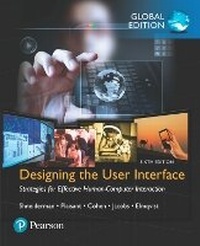
Designing the User Interface: Strategies for Effective Human-Computer Interaction, Global Edition
6th Edition
Published on 27. June 2017
Book
Mixed media product
624 pages
978-1-292-15391-9 (ISBN)
Description
For courses in Human-Computer Interaction
The Sixth Edition of Designing the User Interface provides a comprehensive, authoritative, and up-to-date introduction to the dynamic field of human-computer interaction (HCI) and user experience (UX) design. This classic book has defined and charted the astonishing evolution of user interfaces for three decades. Students and professionals learn practical principles and guidelines needed to develop high quality interface designs that users can understand, predict, and control. The book covers theoretical foundations and design processes such as expert reviews and usability testing.
By presenting current research and innovations in human-computer interaction, the authors strive to inspire students, guide designers, and provoke researchers to seek solutions that improve the experiences of novice and expert users, while achieving universal usability. The authors also provide balanced presentations on controversial topics such as augmented and virtual reality, voice and natural language interfaces, and information visualisation.
Updates include current HCI design methods, new design examples, and totally revamped coverage of social media, search and voice interaction. Major revisions were made to EVERY chapter, changing almost every figure (170 new colour figures) and substantially updating the references.
The Sixth Edition of Designing the User Interface provides a comprehensive, authoritative, and up-to-date introduction to the dynamic field of human-computer interaction (HCI) and user experience (UX) design. This classic book has defined and charted the astonishing evolution of user interfaces for three decades. Students and professionals learn practical principles and guidelines needed to develop high quality interface designs that users can understand, predict, and control. The book covers theoretical foundations and design processes such as expert reviews and usability testing.
By presenting current research and innovations in human-computer interaction, the authors strive to inspire students, guide designers, and provoke researchers to seek solutions that improve the experiences of novice and expert users, while achieving universal usability. The authors also provide balanced presentations on controversial topics such as augmented and virtual reality, voice and natural language interfaces, and information visualisation.
Updates include current HCI design methods, new design examples, and totally revamped coverage of social media, search and voice interaction. Major revisions were made to EVERY chapter, changing almost every figure (170 new colour figures) and substantially updating the references.
More details
Edition
6th edition
Language
English
Place of publication
Harlow
United Kingdom
Target group
College/higher education
Professional and scholarly
Dimensions
Height: 230 mm
Width: 190 mm
Thickness: 20 mm
Weight
957 gr
ISBN-13
978-1-292-15391-9 (9781292153919)
Copyright in bibliographic data is held by Nielsen Book Services Limited or its licensors: all rights reserved.
Schweitzer Classification
Other editions
Additional editions
Ben Shneiderman | Catherine Plaisant | Maxine Cohen
Designing the User Interface: Strategies for Effective Human-Computer Interaction, Global Edition
Strategies for Effective Human-Computer Interaction, Global Edition
E-Book
10/2018
6th Edition
Pearson Higher Education;Pearson
from
€60.69
Available for download
Previous edition

Ben Shneiderman | Catherine Plaisant | Maxine Cohen
Designing the User Interface: Pearson New International Edition
Strategies for Effective Human-Computer Interaction
Book
07/2013
5th Edition
Pearson Education Limited
€75.51
Article exhausted; check for reprint
Content
Part 1. Introduction
1. Usability of Interactive Systems
2. Universal Usability
3. Guidelines, Principles, and Theories
Part 2. Design Processes
4. Design
5. Evaluation and the User Experience
6. Design Case Studies
Part 3. Interaction Styles
7. Direct Manipulation and Immersive Environments
8. Fluid Navigation
9. Expressive Human and Command Languages
10. Devices
11. Communication and Collaboration
Part 4. Design Issues
12. Advancing the User Experience
13. The Timely User Experience
14. Documentation and User Support (a.k.a. Help)
15. Information Search
16. Data Visualization
1. Usability of Interactive Systems
2. Universal Usability
3. Guidelines, Principles, and Theories
Part 2. Design Processes
4. Design
5. Evaluation and the User Experience
6. Design Case Studies
Part 3. Interaction Styles
7. Direct Manipulation and Immersive Environments
8. Fluid Navigation
9. Expressive Human and Command Languages
10. Devices
11. Communication and Collaboration
Part 4. Design Issues
12. Advancing the User Experience
13. The Timely User Experience
14. Documentation and User Support (a.k.a. Help)
15. Information Search
16. Data Visualization