

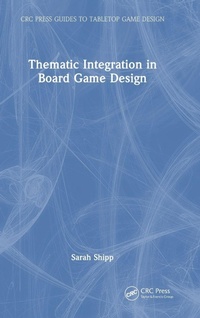
Thematic Integration in Board Game Design
1st Edition
Published on 29. January 2024
Book
Hardback
146 pages
978-1-032-59244-2 (ISBN)
Description
Theme is often described as the "why" of a game. Themes help with rules comprehension by giving reasons for the mechanics. Themes can help set players' expectations for what kind of experiences or emotions the game provides. Themes can also help to create the experience and provide atmosphere to the gameplay.
Thematic Integration in Board Game Design examines the design and integration of theme from the standpoints of technical structure, narrative building, and the design process. This book presents multiple approaches to designing theme as well as developing and replacing themes in existing projects.
The focus is on developing the design skill of mechanical integration of theme rather than developing creative writing skills. Multiple guides and exercises are included that designers can reference at various points in the design process.
Key Features:
Fills a void in board game design theory by discussing theory-craft relating to theme in board game design
Presents practical theory for working designers or students
Focuses on developing the design skill of mechanical integration of theme rather than developing creative writing skills
Thematic Integration in Board Game Design examines the design and integration of theme from the standpoints of technical structure, narrative building, and the design process. This book presents multiple approaches to designing theme as well as developing and replacing themes in existing projects.
The focus is on developing the design skill of mechanical integration of theme rather than developing creative writing skills. Multiple guides and exercises are included that designers can reference at various points in the design process.
Key Features:
Fills a void in board game design theory by discussing theory-craft relating to theme in board game design
Presents practical theory for working designers or students
Focuses on developing the design skill of mechanical integration of theme rather than developing creative writing skills
More details
Series
Language
English
Place of publication
London
United Kingdom
Publishing group
Taylor & Francis Ltd
Target group
Professional and scholarly
Professional Practice & Development
Illustrations
9 s/w Abbildungen, 9 s/w Zeichnungen
9 Line drawings, black and white; 9 Illustrations, black and white
Dimensions
Height: 235 mm
Width: 157 mm
Thickness: 14 mm
Weight
395 gr
ISBN-13
978-1-032-59244-2 (9781032592442)
Copyright in bibliographic data and cover images is held by Nielsen Book Services Limited or by the publishers or by their respective licensors: all rights reserved.
Schweitzer Classification
Other editions
Additional editions
Sarah Shipp
Thematic Integration in Board Game Design
Book
01/2024
1st Edition
CRC Press
€74.90
Shipment within 10-20 days
Sarah Shipp
Thematic Integration in Board Game Design
E-Book
01/2024
1st Edition
Taylor & Francis
€67.49
Available for download
Sarah Shipp
Thematic Integration in Board Game Design
E-Book
01/2024
1st Edition
Taylor & Francis
€67.49
Available for download
Person
Sarah Shipp is a freelance theatre technician, board game designer, and blogger. She designed Deadly Dowagers and (upcoming) Monsters Love Vegas!. Her blog, ShippBoard Games, has received recognition as the best board game design blog of 2022 by Cardboard Edison. In 2021, she presented a talk at the virtual Game Developers Conference on Thematic Resonance. She has also presented at Metatopia Online and Nonepub. In 2023, she became a regular segment contributor to the podcast Ludology. Sarah has an MFA in design and technical production for theatre. She lives in North Texas with her husband, dog, and several dozen mason bees.
Content
Section One Principles of Theme, 1. What is Theme?, 2. Modes of Thematic Expression, 3. Thematically Structuring Games, Section Two Theme-Building, 4. Connecting Story to Gameplay, 5. Narrative Structure, 6. Building Characters, 7. Fleshing Out Characters, 8. Setting, 9. Putting It All Together, Section Three Thematic Design Process, 10. Ideas and Research, 11. Editing for Resonance, 12. Design Reference Guides, 13. Conclusion