

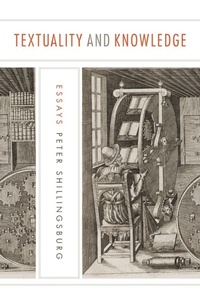
Textuality and Knowledge
Essays
Will be published approx. on 11. June 2018
Book
Paperback/Softback
240 pages
978-0-271-08107-6 (ISBN)
Description
In literary investigation all evidence is textual, dependent on preservation in material copies. Copies, however, are vulnerable to inadvertent and purposeful change. In this volume, Peter Shillingsburg explores the implications of this central concept of textual scholarship.
Through thirteen essays, Shillingsburg argues that literary study depends on documents, the preservation of works, and textual replication, and he traces how this proposition affects understanding. He explains the consequences of textual knowledge (and ignorance) in teaching, reading, and research-and in the generous impulses behind the digitization of cultural documents. He also examines the ways in which facile assumptions about a text can lead one astray, discusses how differing international and cultural understandings of the importance of documents and their preservation shape both knowledge about and replication of works, and assesses the dissemination of information in the context of ethics and social justice. In bringing these wide-ranging pieces together, Shillingsburg reveals how and why meaning changes with each successive rendering of a work, the value in viewing each subsequent copy of a text as an original entity, and the relationship between textuality and knowledge.
Featuring case studies throughout, this erudite collection distills decades of Shillingsburg's thought on literary history and criticism and appraises the place of textual studies and scholarly editing today.
Through thirteen essays, Shillingsburg argues that literary study depends on documents, the preservation of works, and textual replication, and he traces how this proposition affects understanding. He explains the consequences of textual knowledge (and ignorance) in teaching, reading, and research-and in the generous impulses behind the digitization of cultural documents. He also examines the ways in which facile assumptions about a text can lead one astray, discusses how differing international and cultural understandings of the importance of documents and their preservation shape both knowledge about and replication of works, and assesses the dissemination of information in the context of ethics and social justice. In bringing these wide-ranging pieces together, Shillingsburg reveals how and why meaning changes with each successive rendering of a work, the value in viewing each subsequent copy of a text as an original entity, and the relationship between textuality and knowledge.
Featuring case studies throughout, this erudite collection distills decades of Shillingsburg's thought on literary history and criticism and appraises the place of textual studies and scholarly editing today.
Reviews / Votes
"There are big issues at stake in this restless symposium of a book, for it is brave and honest. Every research library serving the humanities needs to order a copy of it, and textual scholars will want to do so as well."-Paul Eggert Textual Cultures "Records the thinking of one of our strongest editorial theorists as the study of the book bent-or did not bend-to the winds of change during the first decade of the millennium."
-The Library "Shillingsburg's insistence that we insist on the importance of provenance in our classrooms and editions is timely, urgent and - as we would expect - supported by the soundest available textual evidence."
-Barbara Cooke The Journal of the European Society for Textual Scholarship
More details
Series
Language
English
Place of publication
University Park
United States
Target group
Professional and scholarly
Product notice
Paperback (trade)
Illustrations
17 Halftones, black and white
Dimensions
Height: 229 mm
Width: 152 mm
Thickness: 14 mm
Weight
393 gr
ISBN-13
978-0-271-08107-6 (9780271081076)
Copyright in bibliographic data and cover images is held by Nielsen Book Services Limited or by the publishers or by their respective licensors: all rights reserved.
Schweitzer Classification
Person
Peter Shillingsburg was the first Martin J. Svaglic Professor of English and Textual Studies at Loyola University Chicago. He is the author of five books, most recently From Gutenberg to Google: Electronic Representations of Literary Texts.
Content
Contents
Introduction and Acknowledgements
1 The Evidence for Literary Knowledge
2 Textual Criticism, the Humanities, and J. M. Coetzee
3 The Semiotics of Bibliography
4 Some Functions of Textual Criticism
5 Long Distance Revision
6 Text as Communication
7 The Archive and the Critical Edition: Intentions Revisited
8 How Literary Works Exist
9 Convenient Scholarly Editions
10 Scholarly Editing as a Cultural Enterprise
11 Work and Text in Non-Literary Text-Based Disciplines
12 Publishers' Records and the History of Book Production
13 Cultural Heritage, Textuality, and Social Justice
Bibliography
Introduction and Acknowledgements
1 The Evidence for Literary Knowledge
2 Textual Criticism, the Humanities, and J. M. Coetzee
3 The Semiotics of Bibliography
4 Some Functions of Textual Criticism
5 Long Distance Revision
6 Text as Communication
7 The Archive and the Critical Edition: Intentions Revisited
8 How Literary Works Exist
9 Convenient Scholarly Editions
10 Scholarly Editing as a Cultural Enterprise
11 Work and Text in Non-Literary Text-Based Disciplines
12 Publishers' Records and the History of Book Production
13 Cultural Heritage, Textuality, and Social Justice
Bibliography