

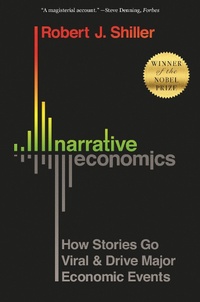
Narrative Economics
How Stories Go Viral and Drive Major Economic Events
Published on 1. September 2020
Book
Paperback/Softback
408 pages
978-0-691-21026-1 (ISBN)
Description
From Nobel Prize-winning economist and New York Times bestselling author Robert Shiller, a groundbreaking account of how stories help drive economic events-and why financial panics can spread like epidemic viruses
Stories people tell-about financial confidence or panic, housing booms, or Bitcoin-can go viral and powerfully affect economies, but such narratives have traditionally been ignored in economics and finance because they seem anecdotal and unscientific. In this groundbreaking book, Robert Shiller explains why we ignore these stories at our peril-and how we can begin to take them seriously. Using a rich array of examples and data, Shiller argues that studying popular stories that influence individual and collective economic behavior-what he calls "narrative economics"-may vastly improve our ability to predict, prepare for, and lessen the damage of financial crises and other major economic events. The result is nothing less than a new way to think about the economy, economic change, and economics. In a new preface, Shiller reflects on some of the challenges facing narrative economics, discusses the connection between disease epidemics and economic epidemics, and suggests why epidemiology may hold lessons for fighting economic contagions.
Stories people tell-about financial confidence or panic, housing booms, or Bitcoin-can go viral and powerfully affect economies, but such narratives have traditionally been ignored in economics and finance because they seem anecdotal and unscientific. In this groundbreaking book, Robert Shiller explains why we ignore these stories at our peril-and how we can begin to take them seriously. Using a rich array of examples and data, Shiller argues that studying popular stories that influence individual and collective economic behavior-what he calls "narrative economics"-may vastly improve our ability to predict, prepare for, and lessen the damage of financial crises and other major economic events. The result is nothing less than a new way to think about the economy, economic change, and economics. In a new preface, Shiller reflects on some of the challenges facing narrative economics, discusses the connection between disease epidemics and economic epidemics, and suggests why epidemiology may hold lessons for fighting economic contagions.
Reviews / Votes
"Shiller's thesis subsequently offers a predicative power that many contemporaneous studies lack. . . . [and] is timely because it exposes earlier studies on contagious phenomena."---Tony D. Sampson, American Literary HistoryMore details
Language
English
Place of publication
New Jersey
United States
Target group
College/higher education
Professional and scholarly
Product notice
Paperback (trade)
Illustrations
18 b/w illus.
Dimensions
Height: 205 mm
Width: 140 mm
Thickness: 30 mm
Weight
398 gr
ISBN-13
978-0-691-21026-1 (9780691210261)
Copyright in bibliographic data and cover images is held by Nielsen Book Services Limited or by the publishers or by their respective licensors: all rights reserved.
Schweitzer Classification
Other editions
Additional editions
E-Book
10/2020
1st Edition
Princeton University Press
€21.49
Available for download
Person
Robert J. Shiller is a Nobel Prize-winning economist and the author of the New York Times bestseller Irrational Exuberance (Princeton), among many other books. He is Sterling Professor of Economics at Yale University and a regular contributor to the New York Times. Twitter @RobertJShiller