

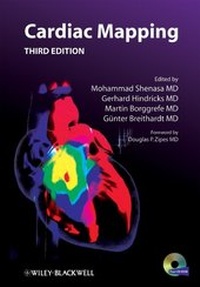
Cardiac Mapping
3rd Edition
Published on 5. December 2008
Book
Hardback
544 pages
978-1-4051-7572-2 (ISBN)
Description
Cardiac Mapping, Third Edition
Edited by
Mohammad Shenasa MD
Department of Cardiovascular Services, O'Connor Hospital, San Jose, California
Gerhard Hindricks MD
Department of Electrophysiology, University Leipzig - Heart Center, Leipzig, Germany
Martin Borggrefe MD
1st Department of Medicine-Cardiology, University Hospital of Mannheim, Mannheim, Germany
Günter Breithardt MD
Department of Cardiology and Angiology, Hospital of the University of Münster, Münster, Germany
Since the publication of the second edition of Cardiac Mapping, substantial achievements and breakthroughs have been made in the field of interventional electrophysiology and imaging technologies. Today mapping technology is no longer an investigational research tool, rather an essential part of the clinical electrophysiology laboratory. Mapping of complex arrhythmias such as atrial and ventricular fibrillation is emerging as a new era in the management of these arrhythmias.
This thoroughly updated third edition focuses on new developments in the field such as mapping of complex arrhythmias, navigation systems, and image integration, with information on the strengths and limitations of each mapping technology. New to this edition is the inclusion of a CD-ROM illustrating real time data from actual cases. Cardiac Mapping remains an integral part of the science and practice of complex rhythm management, and a central resource for the interventional electrophysiologist, rhythmologist and all those interested in understanding the mechanisms of cardiac arrhythmias.
Titles of related interest
Electroanatomical Mapping: An Atlas for Clinicians; Al-Ahmad, Callans, Hsia and Natale; 9781405157025
Practical Intracardiac Echocardiography in Electrophysiology; Ren, Marchlinski, Callans and Schwartsman; 9781405135009
Edited by
Mohammad Shenasa MD
Department of Cardiovascular Services, O'Connor Hospital, San Jose, California
Gerhard Hindricks MD
Department of Electrophysiology, University Leipzig - Heart Center, Leipzig, Germany
Martin Borggrefe MD
1st Department of Medicine-Cardiology, University Hospital of Mannheim, Mannheim, Germany
Günter Breithardt MD
Department of Cardiology and Angiology, Hospital of the University of Münster, Münster, Germany
Since the publication of the second edition of Cardiac Mapping, substantial achievements and breakthroughs have been made in the field of interventional electrophysiology and imaging technologies. Today mapping technology is no longer an investigational research tool, rather an essential part of the clinical electrophysiology laboratory. Mapping of complex arrhythmias such as atrial and ventricular fibrillation is emerging as a new era in the management of these arrhythmias.
This thoroughly updated third edition focuses on new developments in the field such as mapping of complex arrhythmias, navigation systems, and image integration, with information on the strengths and limitations of each mapping technology. New to this edition is the inclusion of a CD-ROM illustrating real time data from actual cases. Cardiac Mapping remains an integral part of the science and practice of complex rhythm management, and a central resource for the interventional electrophysiologist, rhythmologist and all those interested in understanding the mechanisms of cardiac arrhythmias.
Titles of related interest
Electroanatomical Mapping: An Atlas for Clinicians; Al-Ahmad, Callans, Hsia and Natale; 9781405157025
Practical Intracardiac Echocardiography in Electrophysiology; Ren, Marchlinski, Callans and Schwartsman; 9781405135009
Reviews / Votes
"Although it is often said that electrophysiology textbooks are several years behind the current literature, this book has an 'up to date' feel about it and will be a relevant text for years to come. Senior cardiac physiologists working in electrophysiology would also find this book extremely valuable. Although GBP125 may seem expensive to many I think the book offers value for money. I shall certainly be keen to purchase one or two for the electrophysiology library at our institution." (Cardiology News, February 2010) "This text provides a comprehensive, in-depth insight into current electrophysiological mapping techniques and is written by eminent specialists in the field... Very well written and has clear explanations along with excellent illustrations." (British Journal of Cardiac Nursing, April 2009)More details
Edition
3., Auflage
Language
English
Place of publication
Chicester
United Kingdom
Publishing group
John Wiley and Sons Ltd
Target group
Professional and scholarly
Edition type
Revised edition
Illustrations
Illustrations
Dimensions
Height: 26.3 cm
Width: 18.8 cm
Thickness: 33 mm
Weight
1460 gr
ISBN-13
978-1-4051-7572-2 (9781405175722)
Schweitzer Classification
Other editions
New editions
Mohammad Shenasa | Gerhard Hindricks | David J. Callans
Cardiac Mapping
Book
05/2019
5th Edition
Wiley-Blackwell
€402.50
Article exhausted; check for reprint
Mohammad Shenasa | Gerhard Hindricks | Martin Borggrefe
Cardiac Mapping
Book
11/2012
4th Edition
Wiley
Unfortunately, price unknown
Article exhausted; check for reprint
Persons
EDITED BY:
Mohammad Shenasa, MD
Attending Physician
Department of Cardiovascular Services
O'Connor Hospital
San Jose, CA, USA
Gerhard Hindricks, MD
Professor of Medicine (Cardiology)
Department of Electrophysiology
Director, University Leipzig - Heart Center
Leipzig, Germany
Martin Borggrefe, MD
Professor of Medicine (Cardiology)
1st Department of Medicine - Cardiology
University Hospital of Mannheim
Mannheim, Germany
Günter Breithardt, MD
Professor of Medicine (Cardiology)
Head, Department of Cardiology and Angiology
Hospital of the University of Münster
Münster, Germany
FOREWORD BY:
Douglas P. Zipes, MD
Distinguished Professor
Krannert Institute of Cardiology
Indiana University School of Medicine
Indianapolis, IN, USA; and
Editor-in-Chief, Heart Rhythm Journal
Mohammad Shenasa, MD
Attending Physician
Department of Cardiovascular Services
O'Connor Hospital
San Jose, CA, USA
Gerhard Hindricks, MD
Professor of Medicine (Cardiology)
Department of Electrophysiology
Director, University Leipzig - Heart Center
Leipzig, Germany
Martin Borggrefe, MD
Professor of Medicine (Cardiology)
1st Department of Medicine - Cardiology
University Hospital of Mannheim
Mannheim, Germany
Günter Breithardt, MD
Professor of Medicine (Cardiology)
Head, Department of Cardiology and Angiology
Hospital of the University of Münster
Münster, Germany
FOREWORD BY:
Douglas P. Zipes, MD
Distinguished Professor
Krannert Institute of Cardiology
Indiana University School of Medicine
Indianapolis, IN, USA; and
Editor-in-Chief, Heart Rhythm Journal
Content
Dedication.
Acknowledgments.
Contributors.
Preface to the First Edition.
Preface to the Second Edition.
Preface to the Third Edition.
Foreword.
Part 1. Historical Perspectives.
Chapter 1: Historical Perspectives. Cardiac Activation Mapping: The Amsterdam Years.
Part 2. Methodological and Technical Considerations.
Chapter 2: Construction and Interpretation of Maps.
Chapter 3: Cardiac Anatomy for Interventional Electrophysiology and Mapping.
Chapter 4: Principles of Noncontact Endocardial Cardiac Mapping.
Chapter 5: Principles of Nonfluoroscopic Electroanatomical and Electromechanical Cardiac Mapping.
Chapter 6: Principles of NavX Mapping.
Chapter 7: Principles of Stereotaxis Mapping.
Chapter 8: CT Angiography Cardiac Anatomy for Mapping and Ablation of Arrhythmias.
Chapter 9: MRI Anatomy for Cardiac Mapping and Ablation.
Chapter 10: Challenges and Limitations of Electroanatomical Mapping Technologies.
.
Part 3. Mapping in Experimental Models of Cardiac Arrhythmias.
Chapter 11: Mapping of Atrial Neural Stimulation and Inhibition in Atrial Fibrillation.
Chapter 12: Mapping of Neurally Based Atrial Arrhythmias.
Chapter 13: Electrophysiological Mapping of the Right and Left Ventricle in Experimental Animals.
Part 4. Mapping of Supraventricular Tachyarrhythmias.
Chapter 14:Endocardial Catheter Mapping in Patients with Wolff-Parkinson-White Syndrome and Variants of Pre-excitation.
Chapter 15: Transcatheter Cryomapping in AV Nodal Reentrant Tachycardias.
Chapter 16: Mapping and Ablation of AV NRT and its subtypes.
Chapter 17: New Observations on Mapping and Ablation of Atrial Flutter.
Chapter 18: Mapping of Macroreentrant Right and Left Atrial Tachycardias.
Chapter 19: Mapping of Focal Atrial Tachycardias.
Chapter 20: Interpretation of atrial electrograms during atrial fibrillation.
Chapter 21: Different Mapping Approaches for Atrial Fibrillation Ablation.
Chapter 22: Integration of other Imaging Technologies into the Mapping of Atrial Fibrillation.
.
Part 5. Mapping of Ventricular Tachyarrhythmias.
Chapter 23: Substrate Mapping for Ablation of Ventricular Tachycardia in Coronary Artery Disease.
Chapter 24: Mapping of Unstable Ventricular Tachycardia.
Chapter 25: Endocardial and epicardial mapping of nonischemic right and left ventricular nonischemic cardiomyopathy.
Chapter 26: Role of Mapping in Right Ventricular Dysplasia.
Chapter 27: Mapping of Idiopathic Ventricular Tachycardias (RV and LV Outflow and Septal Tachycardias).
Chapter 28: Role of Different Stimulation Techniques (Pace Mapping, Entrainment Mapping) in Different Subset of Ventricular Tachycardias.
Chapter 29: Endocardial Catheter Pace Mapping of Ventricular Tachycardias.
Chapter 30: Electrical and Anatomical Mapping of Different Pathologies: Ischemic, Dilated, and Hypertrophic Cardiomyopathies.
Chapter 31: Mapping and Ablation of Tachyarrhythmias in Patients with Congential Heart Disease.
Chapter 32: Transthoracic Epicardial Mapping and Ablation of Ventricular Tachycardia.
Part 6. New Frontiers.
Chapter 33: Mapping of Ventricular Tachycardia and Fibrillation: Role of the Purkinje System.
Chapter 34: Mapping Rotors in Animals and Humans during Atrial Fibrillation.
Chapter 35: Role of Mapping in Channelopathies: Brugada Syndrome, Long-QT Syndrome and Idiopathic VF.
Chapter 36: Molecular Cardiovascular Imaging with SPECT and PET.
Chapter 37: Optical Mapping: It's Impact on Understanding Arrhythmia Mechanisms.
Chapter 38: The Kinetics of Intracellular Calcium and Arrhythmogenesis in Ischemia/Reperfusion. Calcium Centric Mechanism of Arrhythmia.
Chapter 39: Role of Body Surface Mapping.
Chapter 40: Cardiac Mapping in Patients with Cardiac Resynchronization.
Chapter 41: How to Better Map.
Index.
Color Appendix.
CD-ROM
Acknowledgments.
Contributors.
Preface to the First Edition.
Preface to the Second Edition.
Preface to the Third Edition.
Foreword.
Part 1. Historical Perspectives.
Chapter 1: Historical Perspectives. Cardiac Activation Mapping: The Amsterdam Years.
Part 2. Methodological and Technical Considerations.
Chapter 2: Construction and Interpretation of Maps.
Chapter 3: Cardiac Anatomy for Interventional Electrophysiology and Mapping.
Chapter 4: Principles of Noncontact Endocardial Cardiac Mapping.
Chapter 5: Principles of Nonfluoroscopic Electroanatomical and Electromechanical Cardiac Mapping.
Chapter 6: Principles of NavX Mapping.
Chapter 7: Principles of Stereotaxis Mapping.
Chapter 8: CT Angiography Cardiac Anatomy for Mapping and Ablation of Arrhythmias.
Chapter 9: MRI Anatomy for Cardiac Mapping and Ablation.
Chapter 10: Challenges and Limitations of Electroanatomical Mapping Technologies.
.
Part 3. Mapping in Experimental Models of Cardiac Arrhythmias.
Chapter 11: Mapping of Atrial Neural Stimulation and Inhibition in Atrial Fibrillation.
Chapter 12: Mapping of Neurally Based Atrial Arrhythmias.
Chapter 13: Electrophysiological Mapping of the Right and Left Ventricle in Experimental Animals.
Part 4. Mapping of Supraventricular Tachyarrhythmias.
Chapter 14:Endocardial Catheter Mapping in Patients with Wolff-Parkinson-White Syndrome and Variants of Pre-excitation.
Chapter 15: Transcatheter Cryomapping in AV Nodal Reentrant Tachycardias.
Chapter 16: Mapping and Ablation of AV NRT and its subtypes.
Chapter 17: New Observations on Mapping and Ablation of Atrial Flutter.
Chapter 18: Mapping of Macroreentrant Right and Left Atrial Tachycardias.
Chapter 19: Mapping of Focal Atrial Tachycardias.
Chapter 20: Interpretation of atrial electrograms during atrial fibrillation.
Chapter 21: Different Mapping Approaches for Atrial Fibrillation Ablation.
Chapter 22: Integration of other Imaging Technologies into the Mapping of Atrial Fibrillation.
.
Part 5. Mapping of Ventricular Tachyarrhythmias.
Chapter 23: Substrate Mapping for Ablation of Ventricular Tachycardia in Coronary Artery Disease.
Chapter 24: Mapping of Unstable Ventricular Tachycardia.
Chapter 25: Endocardial and epicardial mapping of nonischemic right and left ventricular nonischemic cardiomyopathy.
Chapter 26: Role of Mapping in Right Ventricular Dysplasia.
Chapter 27: Mapping of Idiopathic Ventricular Tachycardias (RV and LV Outflow and Septal Tachycardias).
Chapter 28: Role of Different Stimulation Techniques (Pace Mapping, Entrainment Mapping) in Different Subset of Ventricular Tachycardias.
Chapter 29: Endocardial Catheter Pace Mapping of Ventricular Tachycardias.
Chapter 30: Electrical and Anatomical Mapping of Different Pathologies: Ischemic, Dilated, and Hypertrophic Cardiomyopathies.
Chapter 31: Mapping and Ablation of Tachyarrhythmias in Patients with Congential Heart Disease.
Chapter 32: Transthoracic Epicardial Mapping and Ablation of Ventricular Tachycardia.
Part 6. New Frontiers.
Chapter 33: Mapping of Ventricular Tachycardia and Fibrillation: Role of the Purkinje System.
Chapter 34: Mapping Rotors in Animals and Humans during Atrial Fibrillation.
Chapter 35: Role of Mapping in Channelopathies: Brugada Syndrome, Long-QT Syndrome and Idiopathic VF.
Chapter 36: Molecular Cardiovascular Imaging with SPECT and PET.
Chapter 37: Optical Mapping: It's Impact on Understanding Arrhythmia Mechanisms.
Chapter 38: The Kinetics of Intracellular Calcium and Arrhythmogenesis in Ischemia/Reperfusion. Calcium Centric Mechanism of Arrhythmia.
Chapter 39: Role of Body Surface Mapping.
Chapter 40: Cardiac Mapping in Patients with Cardiac Resynchronization.
Chapter 41: How to Better Map.
Index.
Color Appendix.
CD-ROM