

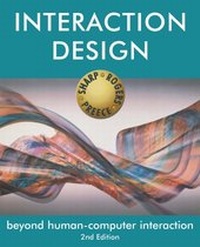
Interaction Design
Beyond Human-Computer Interaction
2nd Edition
Published on 12. January 2007
Book
Paperback/Softback
800 pages
978-0-470-01866-8 (ISBN)
Description
There has never been a greater need for interaction designers and usability engineers to develop current and next-generation interactive technologies. To be successful they will need a mixed set of skills drawn from psychology, human-computer interaction, web design, computer science, information systems, and entertainment.
Interaction Design: beyond human-computer interaction, 2nd edition covers a wide range of issues, topics, and paradigms that go beyond the traditional scope of human-computer interaction (HCI). Using state-of-the-art examples, it covers psychological and social aspects of users, interaction styles, user requirements, design approaches, usability and evaluation, traditional and future interface paradigms, and the role of theory in informing design. Topics are grounded in the design process and presented in an integrated and coherent way. The book focuses on how to design interactive products that enhance and extend the way people communicate, interact, and work.
Now in full colour, this thoroughly revised second edition includes:
* new chapters on data gathering, interfaces and interactions, and data analysis, presentation and interpretation
* practical case studies which are summarized in the text and expanded on the Web site
* new examples of evolving technologies and devices throughout
* updated interviews with HCI visionaries and practitioners.
Interaction Design is hugely popular with students and professionals alike. It is an ideal resource for learning the interdisciplinary skills needed for interaction design, human-computer interaction, information design and Web design.
Accompanying the text is an extensive Web site which contains hands-on interactive design and evaluation activities, annotated links to other sites, and additional teaching and learning materials. http://www.ID-Book.com
"In the field of interaction design one book stands out, a book that has established itself at the core of the discipline. With this new edition, the authors have successfully strengthened that position. The new structure and the timely content make the book highly relevant and much needed. Anyone who wants to learn the fundamentals of interaction design should read this book." - Eric Stolterman, Director, Human-Computer Interaction Design, Indiana University
"Interaction Design has been my textbook of choice for general HCI courses at both undergraduate and masters level for several years. It is authoritative while also being eminently readable and thought-provoking for students." - Ann Blandford, Director of UCL Interaction Centre and Professor of Human-Computer Interaction, University College London
"An exceptional book that helps bring design thinking and a human perspective to the conceptualization and development of technology-based products and systems." - Bill Buxton, Principal Researcher, Microsoft Research
Reviews / Votes
"The best basis around for user-centered interaction design, both as a primer for students as an introduction to the field, and as a resource for research practitioners to fall back on. It should be labelled 'start here'."Pieter Jan Stappers, ID-StudioLab, Delft University of TechnologyIn the field of Interaction Design one book stands out, a book that has established itself at the core of the field. With this new edition, the authors have successfully strengthened that position. The new structure and content makes the book highly relevant and needed in the field. Anyone who wants to learn about the basics of interaction design should make this book their first stop!"Erik Stolterman, Ph.D., Indiana University, USAThis new edition of Interaction Design is a welcome and timely support for those of us teaching and researching in the field. It fills in the gaps that were emerging in the first edition as new interactive technologies become available and older ones change so much. I value this text for the way it is so grounded in real examples and actual human practices, and for its strong design focus. It is a most useful and usable book.Dr Toni Robertson, Interaction Design and Work Practice Lab, University of Technology, Sydney"The first edition of Interaction Design has been my text book of choice for general HCI courses at both undergraduate and Masters level for several years. It is authoritative, eminently readable and thought-provoking for students. It achieves a good balance between the human, computing and design aspects of the subject. The second edition strengthens the treatment of data gathering and analysis and approaches to evaluation, and introduces a welcome focus on affective aspects of interaction, reflecting recent research developments in the discipline. I am looking forward to working with this new edition."Ann Blandford, Director of UCL Interaction Centre and Professor of Human-Computer Interaction"An exceptional book that helps bring design thinking and a human perspective to the conceptualization and development of technology-based products and systems."Bill Buxton, Principal Researcher, Microsoft ResearchMore details
Edition
2., Auflage
Language
English
Place of publication
Chichester
United Kingdom
Publishing group
John Wiley and Sons Ltd
Target group
Professional and scholarly
Edition type
Revised edition
Illustrations
col. ill
Dimensions
Height: 23.5 cm
Width: 18.9 cm
Thickness: 37 mm
Weight
1654 gr
ISBN-13
978-0-470-01866-8 (9780470018668)
Schweitzer Classification
Other editions
Previous edition
Book
01/2002
1st Edition
Wiley
€57.90
Article exhausted; check for reprint
Persons
Helen Sharp: Responsible for developing distance education courses in software engineering, co-founder of the International Pedagogical Patterns project, she is also a Senior Visiting Fellow at the Centre for Human-Computer Interaction Design at City University. Her main research interest focus on the overlap between Interaction Design and Software Engineering, in particular, how to ensure that good HCI design principles are incorporated into the design of interactive products.
Jenny Preece: Professor of Information Systems at UMBC, Regular keynote and invited speaker at SIGCHI and other conferences, prolific author and commentator. Her research focuses on online communities and social computing.
Yvonne Rogers: Professor of Informatics and Cognitive Science at Indianna University and teaches mainly in the areas of HCI, CSCW, ubiquitous computing. Her research focuses on augmenting and extending everyday learning and work activities with interactive activities that move "beyond the desktop".
Content
Chapter 1: What is interaction design?
Chapter 2: Understanding and conceptualizing interaction.
Chapter 3: Understanding users.
Chapter 4: Designing for collaboration and communication.
Chapter 5: Affective aspects.
Chapter 6: Interfaces and interactions.
Chapter 7: Data Gathering.
Chapter 8: Data analysis, interpretation and presentation.
Chapter 9: The process of interaction design.
Chapter 10: Identifying needs and establishing requirements.
Chapter 11: Design, prototyping and construction.
Chapter 12: Introducing evaluation.
Chapter 13: An evaluation framework.
Chapter 14: Usability testing and field studies.
Chapter 15: Analytical evaluation.