

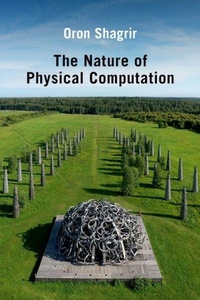
The Nature of Physical Computation
Published on 29. April 2022
Book
Hardback
320 pages
978-0-19-755238-4 (ISBN)
Description
This is an open access title available under the terms of a CC BY-NC-ND 4.0 International license. It is free to read at Oxford Scholarship Online and offered as a free PDF download from OUP and selected open access locations.
Computing systems are ubiquitous in contemporary life. Even the brain is thought to be a computing system of sorts. But what does it mean to say that an organ or a system computes? What is it about laptops, smartphones, and nervous systems that they are deemed to compute-and why does it seldom occur to us to describe stomachs, hurricanes, rocks, or chairs that way? These questions are key to the conceptual foundations of computational sciences, including computer science and engineering, and the cognitive and neural sciences.
Oron Shagrir here provides an extended argument for the semantic view of computation, which states that semantic properties are involved in the nature of computing systems. The first part of the book provides general background. Although different in scope, these chapters have a common theme-that the linkage between the mathematical theory of computability and the notion of physical computation is weak. The second part of the book reviews existing non-semantic accounts of physical computation. Shagrir offers an in-depth analysis of three influential accounts, and argues that none of these accounts is satisfactory, but each of them highlights certain key features of physical computation that he eventually entwines into his own account of computation. The last part of the book presents and defends an original semantic account of physical computation, with a phenomenon known as 'simultaneous implementation' (or 'indeterminacy of computation') at its core.
Computing systems are ubiquitous in contemporary life. Even the brain is thought to be a computing system of sorts. But what does it mean to say that an organ or a system computes? What is it about laptops, smartphones, and nervous systems that they are deemed to compute-and why does it seldom occur to us to describe stomachs, hurricanes, rocks, or chairs that way? These questions are key to the conceptual foundations of computational sciences, including computer science and engineering, and the cognitive and neural sciences.
Oron Shagrir here provides an extended argument for the semantic view of computation, which states that semantic properties are involved in the nature of computing systems. The first part of the book provides general background. Although different in scope, these chapters have a common theme-that the linkage between the mathematical theory of computability and the notion of physical computation is weak. The second part of the book reviews existing non-semantic accounts of physical computation. Shagrir offers an in-depth analysis of three influential accounts, and argues that none of these accounts is satisfactory, but each of them highlights certain key features of physical computation that he eventually entwines into his own account of computation. The last part of the book presents and defends an original semantic account of physical computation, with a phenomenon known as 'simultaneous implementation' (or 'indeterminacy of computation') at its core.
More details
Series
Language
English
Place of publication
New York
United States
Target group
College/higher education
Product notice
sewn/stitched
Cloth over boards
Dimensions
Height: 243 mm
Width: 167 mm
Thickness: 30 mm
Weight
598 gr
ISBN-13
978-0-19-755238-4 (9780197552384)
Copyright in bibliographic data and cover images is held by Nielsen Book Services Limited or by the publishers or by their respective licensors: all rights reserved.
Schweitzer Classification
Other editions
Additional editions
Person
Oron Shagrir is the Schulman Chair in Philosophy, Professor of Philosophy and Cognitive and Brain Sciences at the Hebrew University of Jerusalem. He graduated in mathematics and computer science from the Hebrew University and received his PhD in philosophy and cognitive science from the University of California, San Diego. His research focuses on the nature of computation and the role of computational approaches in cognitive neuroscience. He is the editor, with Jack Copeland and Carl Posy, of Computability: Turing, Goedel, Church, and Beyond (MIT 2013) and the author of numerous articles on computation and the mind.
Content
Chapter 1: Desiderata of a theory of computation Chapter 2: Turing's computability Chapter 3: Preamble to machine computation Chapter 4: Computation as step satisfaction Chapter 5: Computation as implementation Chapter 6: Computation as mechanism Chapter 7: The semantic view of computation Chapter 8: An argument for the semantic view Chapter 9: Computing as modeling Acknowledgements Bibliography