

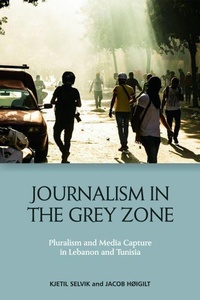
Journalism in the Grey Zone
Pluralism and Media Capture in Lebanon and Tunisia
Published on 21. February 2023
Book
Hardback
208 pages
978-1-3995-1581-8 (ISBN)
Description
Lebanon and Tunisia are two of the freest countries in the Middle East and North Africa, but elites in both countries seek to manipulate media organisations and individual journalists to shore up support for themselves and attack opponents. This book explores the political role of journalism in these hybrid settings where democratic and authoritarian practices co-exist- a growing trend all over the world. Through interviews with journalists in different positions and analyses of key events in recent years, Journalism in the Grey Zone explains the tensions that media instrumentalisation creates in the news media and how journalists navigate conflicting pressures from powerholders and a marginalised populace. Despite 'capture' of the media by political and economic actors, journalism remains a powerful and occasionally disruptive force.
Reviews / Votes
This book is a unique contribution based on interesting, primary analyses of the news apparatuses in two important Arab countries. It is valuable not only to scholars of Arab media, but also to researchers studying the realities of politically fragile states, or states transitioning from authoritarianism to democracy. -- Mohamad Hamas Elmasry, Doha Institute for Graduate Studies [A]n important resource for scholars of comparative politics and for anyone interested in media and politics in the Middle East and North Africa. It offers valuable insights into the consequences of media instrumentalization and raises crucial questions for media studies and journalism scholars. -- Buket Oztas, Furman University * International Journal of Communication *More details
Language
English
Place of publication
Edinburgh
United Kingdom
Target group
College/higher education
Product notice
sewn/stitched
Cloth over boards
Dimensions
Height: 234 mm
Width: 156 mm
Thickness: 14 mm
Weight
513 gr
ISBN-13
978-1-3995-1581-8 (9781399515818)
Copyright in bibliographic data and cover images is held by Nielsen Book Services Limited or by the publishers or by their respective licensors: all rights reserved.
Schweitzer Classification
Other editions
Additional editions
E-Book
02/2023
1st Edition
Edinburgh University Press
€112.99
Available for download
E-Book
02/2023
1st Edition
Edinburgh University Press
€112.99
Available for download
Persons
Kjetil Selvik is Research Professor in the research group on Peace, Conflict and Development at the Norwegian Institute of International Affairs. He is co-author with Stig Stenslie of Stability and Change in the Modern Middle East (I.B. Tauris, 2011) and co-editor with B.O. Utvik of Oil States in the New Middle East: Uprisings and Stability (Routledge, 2016). Jacob Hoigilt is Head of Research, Department of Culture Studies and Oriental Languages, and Professor of Arabic Language and Culture at the University of Oslo. He is the author of Comics in Contemporary Arab Culture: Politics, Language and Resistance (I. B. Tauris, 2019) and Islamist Rhetoric: Language and Culture in Contemporary Egypt (Routledge, 2011). He is also co-editor with Gunvor Mejdell of The Politics of Written Language in the Arab World (Brill, 2017).
Content
Acknowledgements | A Note on Transliteration
Introduction
Hybrid Politics and Media Instrumentalisation
Being a Journalist in the Grey Zone
Finding a Role: Tunisian Journalism after the Revolution
Navigating a Field of Tensions: Journalism and Politics in Lebanon
National Security and Free Speech in Tunisia
Elections and Media Capture
Protests and Disruptive Journalism
Conclusion
Appendix I: Interviews - Lebanon
Appendix II: Interviews - Tunisia
Index
Introduction
Hybrid Politics and Media Instrumentalisation
Being a Journalist in the Grey Zone
Finding a Role: Tunisian Journalism after the Revolution
Navigating a Field of Tensions: Journalism and Politics in Lebanon
National Security and Free Speech in Tunisia
Elections and Media Capture
Protests and Disruptive Journalism
Conclusion
Appendix I: Interviews - Lebanon
Appendix II: Interviews - Tunisia
Index