

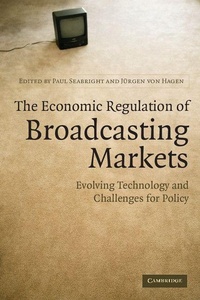
The Economic Regulation of Broadcasting Markets
Evolving Technology and Challenges for Policy
Published on 26. April 2007
Book
Paperback/Softback
368 pages
978-0-521-69634-0 (ISBN)
Description
New technology is revolutionizing broadcasting markets. As the cost of bandwidth processing and delivery fall, information-intensive services that once bore little economic relationship to each other are now increasingly related as substitutes or complements. Television, newspapers, telecoms and the internet compete ever more fiercely for audience attention. At the same time, digital encoding makes it possible to charge prices for content that had previously been broadcast for free. This is creating new markets where none existed before. How should public policy respond? Will competition lead to better services, higher quality and more consumer choice - or to a proliferation of low-quality channels? Will it lead to dominance of the market by a few powerful media conglomerates? Using the insights of modern microeconomics, this book provides a state-of-the-art analysis of these and other issues by investigating the power of regulation to shape and control broadcasting markets.
Reviews / Votes
'These essays are indispensable to anyone involved in either broadcasting policy or media strategy. They offer a rigorous analysis of the issues facing regulators and politicians in the face of the rapid evolution of both the technologies and the shape of broadcasting markets, and they set out the empirical evidence available now as well as highlighting some important research gaps. The book provides a truly impressive overview of our state of knowledge on the regulation of this important and sensitive industry.' Diane Coyle, Member of the Competition Commission and Visiting Professor at the University of Manchester 'This book provides an extensive survey of a number of topics relating to the broadcasting industry. On the empirical side, it contains comparative evidence on the EU, US and OECD countries, econometrics of mergers, technological issues. On a more theoretical side, it covers issues related to regulation and competition policy and their respective roles, vertical integration problem, and the difficult problem of two-sided market issues in the media industry. It is a major contribution to the analysis of a field that has become ever more important because of the convergence between media and telecommunication sectors. Both researchers and practitioners should read these analyses carefully.' Anne Perrot, Vice-President, French Competition CouncilMore details
Language
English
Place of publication
Cambridge
United Kingdom
Target group
Professional and scholarly
Product notice
Paperback (trade)
Illustrations
14 Tables, unspecified; 4 Line drawings, unspecified
Dimensions
Height: 229 mm
Width: 152 mm
Thickness: 20 mm
Weight
536 gr
ISBN-13
978-0-521-69634-0 (9780521696340)
Copyright in bibliographic data and cover images is held by Nielsen Book Services Limited or by the publishers or by their respective licensors: all rights reserved.
Schweitzer Classification
Other editions
Additional editions
Paul Seabright | Juergen von Hagen
The Economic Regulation of Broadcasting Markets
Evolving Technology and Challenges for Policy
E-Book
06/2007
1st Edition
Cambridge University Press
€32.49
Available for download
Paul Seabright | Juergen von Hagen
The Economic Regulation of Broadcasting Markets
Evolving Technology and Challenges for Policy
Book
04/2007
Cambridge University Press
€107.70
No shipping information available
Persons
Paul Seabright is Professor of Economics at the University of Toulouse. Juergen von Hagen is director of the Center for European Integration Studies in Bonn.
Content
Part I. Introduction: 1. The future of broadcasting regulation Juergen von Hagen and Paul Seabright; 2. Technological and regulatory developments in broadcasting: an overview Colin Rowat; Part II. Questions of Principle in Broadcasting Regulation: 3. Competition and market power in broadcasting: where are the rents? Paul Seabright and Helen Weeds; 4. Public service broadcasting and digitalisation Mark Armstrong and Helen Weeds; 5. Regulation for pluralism in broadcasting markets Michele Polo; 6. Regulation of advertising in broadcasting Simon Anderson; 7. Market definition in media markets: policy implications of indirect network externalities Elena Argentesi and Marc Ivaldi; Part III. Institutional Approaches in Various Jurisdictions: 8. Policy-making and policy trade-offs: competition, diversity, and localism and the Federal Communications Commission Peter Alexander and Keith Brown; 9. The European Union Pierre Bugues and Valerie Rabassa; 10. Competition versus sector-specific regulation in various European countries Einar Hope; Index.