

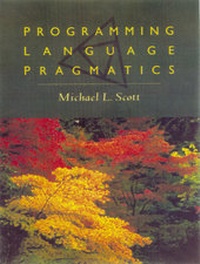
Programming Language Pragmatics
Published on 28. January 2004
Book
Hardback
700 pages
978-1-55860-442-1 (ISBN)
Description
Programming Language Pragmatics addresses the fundamental principles at work in the most important contemporary languages, highlights the critical relationship between language design and language implementation, and devotes special attention to issues of importance to the expert programmer. Thanks to its rigorous but accessible teaching style, you'll emerge better prepared to choose the best language for particular projects, to make more effective use of languages you already know, and to learn new languages quickly and completely.
Reviews / Votes
"Michael Scott's book could have been entitled: Why Programming Languages Work. It takes a fresh look at programming languages by bringing together ideas and techniques usually covered in disparate language design, compiler, computer architecture, and operating system courses. Its comprehensive and integrated presentation of language design and implementation illustrates and explains admirably the many deep and profitable connections among these fields." - Jim Larus, Microsoft ResearchMore details
Language
English
Place of publication
San Francisco
United States
Publishing group
Elsevier Science & Technology
Target group
College/higher education
Weight
1600 gr
ISBN-13
978-1-55860-442-1 (9781558604421)
Copyright in bibliographic data and cover images is held by Nielsen Book Services Limited or by the publishers or by their respective licensors: all rights reserved.
Schweitzer Classification
Other editions
New editions
Michael Scott
Programming Language Pragmatics
Book
11/2005
2nd Edition
Morgan Kaufmann
€55.70
Article exhausted; check for reprint
Person
Michael L. Scott is a professor and past Chair of the Computer Science Department at the University of Rochester. He is best known for work on synchronization and concurrent data structures: algorithms from his group appear in a wide variety of commercial and open-source systems. A Fellow of the ACM and the IEEE, he shared the 2006 Dijkstra Prize in Distributed Computing. In 2001 he received the University's Robert and Pamela Goergen Award for Distinguished Achievement and Artistry in Undergraduate Teaching.
Content
Preface1 Introduction2 Programming Language Syntax3 Names, Scopes, and Bindings4 Semantic Analysis5 Assembly-Level Computer Architecture6 Control Flow7 Data Types8 Subroutines and Control Abstraction9 Building a Runnable Program10 Data Abstraction and Object Orientation11 Nonimperative Programming Models: Functional and Logic Languages12 Concurrency13 Code ImprovementAppendices