

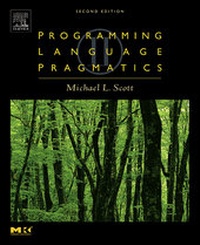
Programming Language Pragmatics
2nd Edition
Published on 21. November 2005
Book
Paperback/Softback
912 pages
978-0-12-633951-2 (ISBN)
Description
The innovative approach of the first edition of Programming Language Pragmatics provided students with an integrated view of programming language design and implementation, while offering a solid teaching text on timely language topics in a rigorous yet accessible style.
The new edition carries on these distinctive features as well as the signature tradition of illustrating the most recent developments in programming language design with a variety of modern programming languages.
The new edition carries on these distinctive features as well as the signature tradition of illustrating the most recent developments in programming language design with a variety of modern programming languages.
More details
Edition
2nd edition
Language
English
Place of publication
San Francisco
United States
Publishing group
Elsevier Science & Technology
Target group
College/higher education
Edition type
New edition
Dimensions
Height: 235 mm
Width: 191 mm
Weight
1524 gr
ISBN-13
978-0-12-633951-2 (9780126339512)
Copyright in bibliographic data and cover images is held by Nielsen Book Services Limited or by the publishers or by their respective licensors: all rights reserved.
Schweitzer Classification
Other editions
New editions
Michael Scott
Programming Language Pragmatics
Book
04/2009
3rd Edition
Morgan Kaufmann
€66.84
Article exhausted; check for reprint
Additional editions
Michael Scott
Programming Language Pragmatics
E-Book
11/2005
2nd Edition
Morgan Kaufmann
€54.95
Available for download
Previous edition
Michael Scott
Programming Language Pragmatics
Book
01/2004
Morgan Kaufmann
€81.89
Article exhausted; check for reprint
Person
Michael L. Scott is a professor and past Chair of the Computer Science Department at the University of Rochester. He is best known for work on synchronization and concurrent data structures: algorithms from his group appear in a wide variety of commercial and open-source systems. A Fellow of the ACM and the IEEE, he shared the 2006 Dijkstra Prize in Distributed Computing. In 2001 he received the University's Robert and Pamela Goergen Award for Distinguished Achievement and Artistry in Undergraduate Teaching.
Content
Part I Foundations1. Introduction 2. Programming Language Syntax3. Names, Scopes, and Bindings4. Semantic Analysis5. Target Machine ArchitecturePart II Core Issues in Language Design6. Control Flow 7. Data Types 8. Subroutines and Control Abstraction 9. Data Abstraction and Object Orientation Part III Alternative Programming Models 10. Functional Languages 11. Logic Languages 12. Concurrency13. ScriptingPart IV A Closer Look at Implementation 14. Building a Runnable Program 15. Code ImprovementAppendix A. Programming Languages MentionedAppendix B. Language Design and Language ImplementationAppendix C. Numbered ExamplesBibliographyIndex