

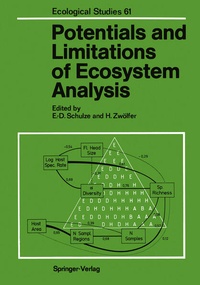
Potentials and Limitations of Ecosystem Analysis
Published on 20. November 2011
Book
Paperback/Softback
XII, 436 pages
978-3-642-71632-4 (ISBN)
Description
The identification of inputs and outputs is the first and probably most important step in testing and analyzing complex systems. Following accepted natural laws such as the conservation of mass and the principle of electroneutrality, the input/output analysis of the system, be it steady or in connection with perturbations will reveal the status dynamic, will identify whether changes are reversible or irreversible and whether changing the input will cause a hysteresis response. Moreover, measurements ofinput and output fluxes can indicate the storage capacity ofa system, its resilience to buffer or amplify variations of the external input, and it can identify structural changes. Therefore, to a certain extent, the input/output analysis can facilitate predictions about the ecosystem stability. The measurement of fluxes and the determination of inputs and outputs of eco systems are, in many aspects, analogous to measurements done by engineers when testing an electronic apparatus. The first step is the measurement ofthe input/output properties of the instrument as a whole, or ofvarious circuit boards, and the compari· son ofthese with the expected variations of the original design. Varying input and out· put can give valuable information about the stability and the regulatory properties of the device. Nevertheless, only the circuit as an entity has specific properties which cannot be anticipated if the individual components are investigated regardless oftheir position. Also, the instrument as a whole will have different input/output properties than its subcircuits.
More details
Series
Edition
Softcover reprint of the original 1st ed. 1987
Language
English
Place of publication
Berlin
Germany
Publishing group
Springer Berlin
Target group
Professional and scholarly
Research
Illustrations
XII, 436 p.
Dimensions
Height: 244 mm
Width: 170 mm
Thickness: 25 mm
Weight
774 gr
ISBN-13
978-3-642-71632-4 (9783642716324)
DOI
10.1007/978-3-642-71630-0
Schweitzer Classification
Other editions
Additional editions
Ernst-Detlef Schulze | Helmut Zwölfer
Potentials and Limitations of Ecosystem Analysis
E-Book
12/2012
Springer
€96.29
Available for download

Ernst-Detlef Schulze | Helmut Zwölfer
Potentials and Limitations of Ecosystem Analysis
Book
02/1987
Springer
€139.09
Article exhausted; check different version
Content
to the Problem of Ecosystem Analysis.- to the Problem of Ecosystem Analysis.- 1 Input/Output Analysis of Ecosystems.- Preface.- A. Stability, Elasticity, and Resilience of Terrestrial Ecosystems with Respect to Matter Balance.- B. Water and Carbon Fluxes in Ecosystems.- C. Environmental Transfer of Some Organic Micropollutants.- D. Simple and Diversified Crop Rotations - Approach and Insight into Agroecosystems.- 2 Processes and Functions at the Primary Producer Level.- Preface.- A. Plant Specialization to Environments of Different Resource Availability.- B. Control of Leaf Carbon Assimilation - Input of Chemical Energy into Ecosystems.- C. Plant Architecture and Resource Competition.- D. Responses to Water and Nutrients in Coniferous Ecosystems.- E. Physiological Ecology, Disturbance, and Ecosystem Recovery.- F. A Hierarchic Approach in Causal Ecosystem Analysis. The Calcifuge-Calcicole Problem in Alpine Grasslands.- G. Extinction and Naturalization of Plant Species as Related to Ecosystem Structure and Function.- H. Flowers as Food Sources and the Cost of Outcrossing.- 3 Processes and Functions at the Consumer Level.- Preface.- A. Species Richness, Species Packing, and Evolution in Insect-Plant Systems.- B. Niche Structure and Evolution in Ecosystems.- C. Predictability in Lake Ecosystems: the Role of Biotic Interactions.- D. Saline Lake Ecosystems.- E. Characteristics of Lotic Ecosystems and Consequences for Future Research Directions.- F. Experimental Analysis of Processes Between Species on Marine Tidal Flats.- G. On Methods of Analyzing Ecosystems: Lessons from the Analysis of Forest-Insect Systems.- Synthesis (With 1 Figure).- Spezies Index.