

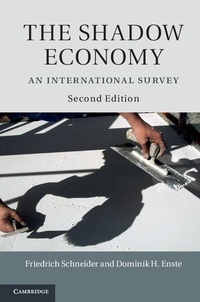
The Shadow Economy
An International Survey
2nd Edition
Published on 14. February 2013
Book
Hardback
226 pages
978-1-107-03484-6 (ISBN)
Description
Illicit work, social security fraud, economic crime and other shadow economy activities are fast becoming an international problem. This second edition uses new data to reassess currency demand and the model approach to estimate the size of the shadow economy in 151 developing, transition, and OECD countries. This updated edition argues that during the 2000s the average size of the shadow economy varied from 19 per cent of GDP for OECD countries, to 30 per cent for transition countries, to 45 per cent for developing countries. It examines the causes and consequences of this development using an integrated approach to explain deviant behaviour that combines findings from economic, sociological, and psychological research. The authors suggest that increasing taxation and social security contributions, rising state regulatory activities, and the decline of the tax morale are all driving forces behind this growth, and they propose a reform of state public institutions in order to improve the dynamics of the official economy.
Reviews / Votes
'This second edition (incorporating the most recent data) is highly recommended; it is THE book on the shadow economy.' Bruno S. Frey, Distinguished Professor of Behavioural Science, University of Warwick 'Shadow economy hides behind official labor and business. Boundaries between the official and unofficial economy are fuzzy and research scholars engage in lively debates about the validity of methods to estimate the size of shadow economy. This book provides an excellent theoretical frame to investigate shadow economy from a socio-economic perspective and highly relevant empirical data which allow (the reader) to draw practical conclusions for political interventions to combat growing economic crime.' Erich Kirchler, University of Vienna 'The authors ingeniously measure the non-measurable and remove the shadows from our economies. Great research, great book.' Hans-Werner Sinn, President, Ifo Institute for Economic Research 'The welfare of nations cannot be judged without understanding the size of the informal sector. This extremely valuable contribution provides a rigorous treatment of the subject and will become the standard reference book of the shadow economy.' Klaus F. Zimmermann, University of Bonn and Director of IZA, the Institute for the Study of LaborMore details
Edition
2nd Revised edition
Language
English
Place of publication
Cambridge
United Kingdom
Target group
Professional and scholarly
Edition type
Revised edition
Illustrations
30 Line drawings, unspecified
Dimensions
Height: 235 mm
Width: 157 mm
Thickness: 17 mm
Weight
485 gr
ISBN-13
978-1-107-03484-6 (9781107034846)
Copyright in bibliographic data and cover images is held by Nielsen Book Services Limited or by the publishers or by their respective licensors: all rights reserved.
Schweitzer Classification
Other editions
Additional editions
Book
04/2016
2nd Edition
Cambridge University Press
€48.60
Shipment within 15-20 days
E-Book
02/2013
Cambridge University Press
€21.99
Available for download
E-Book
01/2013
2nd Edition
Cambridge University Press
€26.49
Available for download
Previous edition
Book
05/2007
Cambridge University Press
€37.19
Article exhausted; check for reprint
Persons
Friedrich Schneider is Professor of Economics of the Johannes Kepler University of Linz, Austria. He was the European editor of Public Choice from 1991 to 2004 and he has published extensively in leading economic journals including The Quarterly Journal of Economics, The American Economic Review, The Economic Journal and Kyklos. Dominik H. Enste is Head of the Department of Institutional and Behavioral Economics at the Cologne Institute for Economic Research. He is also Professor of Economics and Ethical and Behavioral Economics at the University of Applied Science and Lecturer at the University of Cologne. His main research focuses on institutional and ethical economics/business ethics and behavioral economics. He has published several books and articles, in publications such as The Journal of Economic Literature and Constitutional Political Economy.
Content
1. The shadow economy: a challenge for economic and social policy; 2. Defining the shadow economy; 3. Methods to estimate the size of the shadow economy; 4. Size of shadow economies around the world; 5. The size of the shadow economy labour force; 6. An integrated approach to explain deviant behaviour; 7. Analysing the causes and measures of economic policy; 8. Effects of the increasing shadow economy; 9. The 'two-pillar strategy'; 10. Conclusion and outlook.