

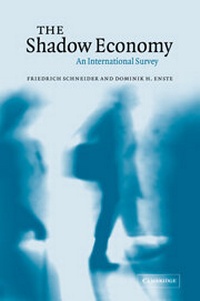
The Shadow Economy
An International Survey
Published on 31. May 2007
Book
Paperback/Softback
240 pages
978-0-521-89107-3 (ISBN)
Description
Illicit work, social security fraud, economic crime and other shadow economy activities are fast becoming an international problem. Friedrich Schneider and Dominik H. Enste use currency demand, physical input (electricity) method, and the model approach to estimate the size of the shadow economy in 76 developing, transition and OECD-countries. They argue that during the 1990s the average size of a shadow economy varied from 12 per cent of GDP for OECD, to 23 per cent for transition and to 39% for developing countries. They examine the causes and consequences of this development using an integrated approach explaining deviant behaviour, which combines the findings of economic, sociological and psychological research. The authors suggest that increasing taxation, social security contributions, rising state regulatory activities and the decline of the tax morale, are all driving forces behind this growth, especially in OECD-countries. They propose a reform of state institutions to improve the dynamics of the official economy.
Reviews / Votes
'The authors discuss in great depth the various approaches to measuring a phenomenon which at first seems to evade observation. Most importantly, they provide the best existing survey of the size and causes of the shadow economy. This will be, without a shadow of doubt, the standard treatment of the subject for many years to come.' Bruno S. Frey, University of Zurich and Netherlands Institute of Advanced Study 'This book is a valuable compendium of information and analysis on a problem that policy makers cannot afford to neglect.' Hans-Werner Sinn, University of Munich and President of the Ifo Institute for Economic Research 'The underground economy has continued to defy attempts by governments to eliminate it, by statistical offices to measure it in a convincing way, and by revenue administrations to tax it. To succeed, these attempts must be based on detailed understanding of this phenomenon. this book should much improve out understanding of the underground economy and will help policy makers to better cope with its consequences.' Vito Tanzi, Under Secretary of State in the Italian Ministry of Economy and FinanceMore details
Language
English
Place of publication
Cambridge
United Kingdom
Target group
Professional and scholarly
Product notice
Paperback (trade)
Illustrations
28 Tables, unspecified; 27 Line drawings, unspecified
Dimensions
Height: 228 mm
Width: 150 mm
Thickness: 14 mm
Weight
364 gr
ISBN-13
978-0-521-89107-3 (9780521891073)
Copyright in bibliographic data and cover images is held by Nielsen Book Services Limited or by the publishers or by their respective licensors: all rights reserved.
Schweitzer Classification
Other editions
New editions
Book
02/2013
2nd Edition
Cambridge University Press
€140.40
Shipment within 15-20 days
Persons
FRIEDRICH SCHNEIDER is Vice-President for Foreign Affairs of the Johannes Kepler University of Linz, Austria. DOMINIK H. ENSTE is Human Resources Manager for Gerling Insurance Company in Cologne, Germany. He has published several books and articles.
Content
List of figures; List of tables; Foreword Vito Tanzi; 1. The shadow economy: a challenge for economic and social policy; 2. Defining the shadow economy; 3. Methods to estimate the size of the shadow economy; 4. Size of shadow economies around the world; 5. The size of the shadow economy labour force; 6. An integrated approach to explain deviant behaviour; 7. Analysing the causes and measures of economic policy; 8. Effects of the increasing shadow economy; 9. The 'two-pillar strategy'; 10. Conclusion and outlook; List of references; Index.