

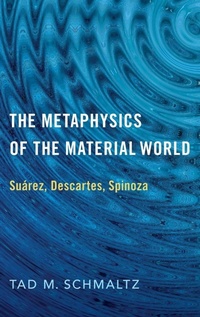
The Metaphysics of the Material World
Suarez, Descartes, Spinoza
Published on 7. January 2020
Book
Hardback
312 pages
978-0-19-007022-9 (ISBN)
Description
In The Metaphysics of the Material World, Tad M. Schmaltz traces a particular development of the metaphysics of the material world in early modern thought. The route Schmaltz follows derives from a critique of Spinoza in the work of Pierre Bayle. Bayle charged in particular that Spinoza's monistic conception of the material world founders on the account of extension and its "modes" and parts that he inherited from Descartes, and that Descartes in turn inherited from late scholasticism, and ultimately from Aristotle. After an initial discussion of Bayle's critique of Spinoza and its relation to Aristotle's distinction between substance and accident, this study starts with the original re-conceptualization of Aristotle's metaphysics of the material world that we find in the work of the early modern scholastic Suarez. What receives particular attention is Suarez's introduction of the "modal distinction" and his distinctive account of the Aristotelian accident of "continuous quantity." This examination of Suarez is followed by a treatment of the connections of his particular version of the scholastic conception of the material world to the very different conception that Descartes offered. Especially important is Descartes's view of the relation of extended substance both to its modes and to the parts that compose it. Finally, there is a consideration of what these developments in Suarez and Descartes have to teach us about Spinoza's monistic conception of the material world. Of special concern here is to draw on this historical narrative to provide a re-assessment of Bayle's critique of Spinoza.
Reviews / Votes
This is an incredibly rich book, full of important ideas about how to understand Suarez, Descartes, and Spinoza. It will be influential on scholars working on all three figures, and it makes an important contribution to the ongoing project of trying to understand seventeenth century philosophy better in the light of prior scholastic material."-Robert Pasnau, Department of Philosophy, University of Colorado This is a very strong, important addition to the literature. The literature on Descartes is huge and the literature on Spinoza is expanding at breakneck speed. But Tad Schmaltz offers something very distinctive: a consideration of their views on the metaphysics of body in relation to Francisco Suarez. While recent scholarship has taken Suarez into account in analysis of Descartes, the depth of Schmaltz' analysis is unusual and unearths novel, very interesting material...Furthermore, Schmaltz takes the interesting approach of coming to this material from Pierre Bayle's objections to Spinoza. His book offers in-depth and thoughtful analysis of the material, and its interest goes well beyond its contribution to the literature on the three figures in question: its treatment of the metaphysics of body contains ideas and insights that will be very useful in approaching other early modern thinkers. "
-Marleen Rozemond, Department of Philosophy, University of Toronto
More details
Language
English
Place of publication
New York
United States
Target group
Professional and scholarly
Dimensions
Height: 240 mm
Width: 161 mm
Thickness: 21 mm
Weight
634 gr
ISBN-13
978-0-19-007022-9 (9780190070229)
Copyright in bibliographic data and cover images is held by Nielsen Book Services Limited or by the publishers or by their respective licensors: all rights reserved.
Schweitzer Classification
Other editions
Additional editions
E-Book
11/2019
OUP eBook
€56.99
Available for download
E-Book
11/2019
OUP eBook
€56.99
Available for download
Person
Tad M. Schmaltz is Professor of Philosophy and James B. and Grace J. Nelson Fellow at the University of Michigan, Ann Arbor. He specializes in early modern philosophy, and is the author of Malebranche's Theory of the Soul (OUP 1996), Radical Cartesianism (2002), Descartes on Causation (OUP 2008), and Early Modern Cartesianisms (OUP 2017). In addition, he has edited or co-edited Receptions of Descartes (2005), Integrating History and Philosophy of Science (2012), Efficient Causation: A History (OUP 2014), The Historical Dictionary of Descartes and Cartesian Philosophy (2015), The Problem of Universals in Early Modern Philosophy (OUP 2017), and The Oxford Handbook of Descartes and Cartesianism (OUP 2019).
Content
Tables and Figures
Abbreviations
Acknowledgements
Prologue
1. Bayle's Narrative
1.1. Bayle's Aristotelian Critique of Spinoza
1.2. Aristotle's Metaphysics of the Material World
Part I: Suarez
2. Metaphysics and Material Modes
2.1. Analogical Metaphysics
2.2. Theory of Distinctions I
2.3. The Metaphysics of Material Modes
3. Quantity, Integral Parts and Boundaries
3.1. Quantity and Impenetrability I
3.2. Mereology and Integral Parts
3.3. Boundaries as Indivisible Constituents
Part II: Descartes
4. Metaphysical Themes from Suarez
4.1. Theory of Distinctions II
4.2. Quantity and Impenetrability II
4.3. The Metaphysics of Surfaces
5. Material Pluralism and Ordinary Bodies
5.1. The Synopsis and Bodies-Taken-In-General
5.2. Incorruptibility and the Vacuum
5.3. Ordinary Bodies, Human and Otherwise
Part III: Spinoza
6. Metaphysical Themes from Descartes
6.1. The Nature of Substance/Attributes
6.2. The Nature of Modes
6.3. From Extension to Motion-and-Rest
7. Material Monism and Bodily Parts
7.1. Modal Parts and Divisible Quantity
7.2. The Mereology of the Infinite Individual
7.3. Parts, Modes and Material Monism
Epilogue
Works cited
Index
Abbreviations
Acknowledgements
Prologue
1. Bayle's Narrative
1.1. Bayle's Aristotelian Critique of Spinoza
1.2. Aristotle's Metaphysics of the Material World
Part I: Suarez
2. Metaphysics and Material Modes
2.1. Analogical Metaphysics
2.2. Theory of Distinctions I
2.3. The Metaphysics of Material Modes
3. Quantity, Integral Parts and Boundaries
3.1. Quantity and Impenetrability I
3.2. Mereology and Integral Parts
3.3. Boundaries as Indivisible Constituents
Part II: Descartes
4. Metaphysical Themes from Suarez
4.1. Theory of Distinctions II
4.2. Quantity and Impenetrability II
4.3. The Metaphysics of Surfaces
5. Material Pluralism and Ordinary Bodies
5.1. The Synopsis and Bodies-Taken-In-General
5.2. Incorruptibility and the Vacuum
5.3. Ordinary Bodies, Human and Otherwise
Part III: Spinoza
6. Metaphysical Themes from Descartes
6.1. The Nature of Substance/Attributes
6.2. The Nature of Modes
6.3. From Extension to Motion-and-Rest
7. Material Monism and Bodily Parts
7.1. Modal Parts and Divisible Quantity
7.2. The Mereology of the Infinite Individual
7.3. Parts, Modes and Material Monism
Epilogue
Works cited
Index