

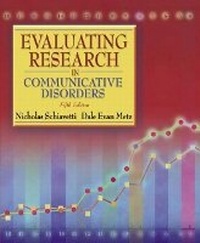
Evaluating Research in Communicative Disorders
5th Edition
Published on 9. June 2005
Book
Hardback
480 pages
978-0-205-44961-3 (ISBN)
Description
The Fifth Edition of Evaluating Research in Communicative Disorders explains and discusses how to read, understand, and evaluate research published in communicative sciences and disorders journals.
Organized into three parts, the careful organization of material aids understanding. Part I introduces the basic principles for evaluating research, Part II contains excerpts from journal articles, and Part III presents two complete articles and an evaluation checklist to guide the student in the evaluation process.
The text incorporates numerous examples from current research to illustrate and clarify points made throughout. The book is richly illustrated with tables and figures and includes many study questions to lead students through primary sources in the research literature.
New material can be found throughout this edition, particularly in the areas of research basis for evidence-based practice, effect size, levels of evidence, phases of clinical trials, and research integrity. Part II contains numerous updated research examples, keeping the text current & competitive.
Organized into three parts, the careful organization of material aids understanding. Part I introduces the basic principles for evaluating research, Part II contains excerpts from journal articles, and Part III presents two complete articles and an evaluation checklist to guide the student in the evaluation process.
The text incorporates numerous examples from current research to illustrate and clarify points made throughout. The book is richly illustrated with tables and figures and includes many study questions to lead students through primary sources in the research literature.
New material can be found throughout this edition, particularly in the areas of research basis for evidence-based practice, effect size, levels of evidence, phases of clinical trials, and research integrity. Part II contains numerous updated research examples, keeping the text current & competitive.
More details
Edition
5th edition
Language
English
Place of publication
United States
Publishing group
Pearson Education (US)
Target group
Professional and scholarly
Dimensions
Width: 240 mm
Thickness: 27 mm
Weight
957 gr
ISBN-13
978-0-205-44961-3 (9780205449613)
Copyright in bibliographic data and cover images is held by Nielsen Book Services Limited or by the publishers or by their respective licensors: all rights reserved.
Schweitzer Classification
Other editions
New editions
Nicholas E. Schiavetti | Dale Evan Metz | Robert F. Orlikoff
Evaluating Research in Communicative Disorders
United States Edition
Book
04/2010
6th Edition
Pearson
€133.91
Article exhausted; check for reprint
Previous edition
Nicholas E. Schiavetti | Dale Evan Metz
Evaluating Research in Communicative Disorders
Book
06/2003
4th Edition
Pearson
€86.95
Article exhausted; check for reprint
Content
Preface.
I. BASIC CONSIDERATIONS IN EVALUATING RESEARCH.
1. Introduction: The Consumer of Research in Communicative Disorders.
2. Research Strategies in Communicative Disorders.
3. Research Design in Communicative Disorders.
4. Measurement Issues in Communicative Disorders.
5. Evaluating Treatment Efficacy Research.
6. Organization and Analysis of Data.
II. EVALUATION OF THE COMPONENTS OF RESEARCH ARTICLE.
7. The Introduction Section of the Research Article.
8. The Method Section.
9. The Results Section.
10. The Discussion and Conclusions Section.
III. EVALUATION OF THE COMPLETE RESEARCH ARTICLE: TWO EXAMPLES.
Evaluation Checklist.
Example Article for Evaluation in Audiology.
Example Article for Evaluation in Speech-Language Pathology.
Author Index.
Subject Index.
I. BASIC CONSIDERATIONS IN EVALUATING RESEARCH.
1. Introduction: The Consumer of Research in Communicative Disorders.
2. Research Strategies in Communicative Disorders.
3. Research Design in Communicative Disorders.
4. Measurement Issues in Communicative Disorders.
5. Evaluating Treatment Efficacy Research.
6. Organization and Analysis of Data.
II. EVALUATION OF THE COMPONENTS OF RESEARCH ARTICLE.
7. The Introduction Section of the Research Article.
8. The Method Section.
9. The Results Section.
10. The Discussion and Conclusions Section.
III. EVALUATION OF THE COMPLETE RESEARCH ARTICLE: TWO EXAMPLES.
Evaluation Checklist.
Example Article for Evaluation in Audiology.
Example Article for Evaluation in Speech-Language Pathology.
Author Index.
Subject Index.