

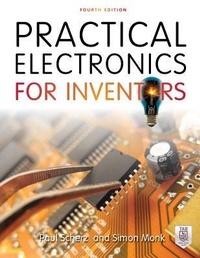
Practical Electronics for Inventors, Fourth Edition
4th Edition
Published on 16. April 2016
Book
Paperback/Softback
1056 pages
978-1-259-58754-2 (ISBN)
Description
Publisher's Note: Products purchased from Third Party sellers are not guaranteed by the publisher for quality, authenticity, or access to any online entitlements included with the product.
A Fully-Updated, No-Nonsense Guide to Electronics
Advance your electronics knowledge and gain the skills necessary to develop and construct your own functioning gadgets. Written by a pair of experienced engineers and dedicated hobbyists, Practical Electronics for Inventors, Fourth Edition, lays out the essentials and provides step-by-step instructions, schematics, and illustrations. Discover how to select the right components, design and build circuits, use microcontrollers and ICs, work with the latest software tools, and test and tweak your creations. This easy-to-follow book features new instruction on programmable logic, semiconductors, operational amplifiers, voltage regulators, power supplies, digital electronics, and more.
Practical Electronics for Inventors, Fourth Edition, covers:
Resistors, capacitors, inductors, and transformers
Diodes, transistors, and integrated circuits
Optoelectronics, solar cells, and phototransistors
Sensors, GPS modules, and touch screens
Op amps, regulators, and power supplies
Digital electronics, LCD displays, and logic gates
Microcontrollers and prototyping platforms
Combinational and sequential programmable logic
DC motors, RC servos, and stepper motors
Microphones, audio amps, and speakers
Modular electronics and prototypes
A Fully-Updated, No-Nonsense Guide to Electronics
Advance your electronics knowledge and gain the skills necessary to develop and construct your own functioning gadgets. Written by a pair of experienced engineers and dedicated hobbyists, Practical Electronics for Inventors, Fourth Edition, lays out the essentials and provides step-by-step instructions, schematics, and illustrations. Discover how to select the right components, design and build circuits, use microcontrollers and ICs, work with the latest software tools, and test and tweak your creations. This easy-to-follow book features new instruction on programmable logic, semiconductors, operational amplifiers, voltage regulators, power supplies, digital electronics, and more.
Practical Electronics for Inventors, Fourth Edition, covers:
Resistors, capacitors, inductors, and transformers
Diodes, transistors, and integrated circuits
Optoelectronics, solar cells, and phototransistors
Sensors, GPS modules, and touch screens
Op amps, regulators, and power supplies
Digital electronics, LCD displays, and logic gates
Microcontrollers and prototyping platforms
Combinational and sequential programmable logic
DC motors, RC servos, and stepper motors
Microphones, audio amps, and speakers
Modular electronics and prototypes
More details
Edition
4th edition
Language
English
Place of publication
OH
United States
Target group
College/higher education
Professional and scholarly
Illustrations
50 Illustrations
Dimensions
Height: 272 mm
Width: 215 mm
Thickness: 40 mm
Weight
2114 gr
ISBN-13
978-1-259-58754-2 (9781259587542)
Schweitzer Classification
Other editions
Additional editions

Paul Scherz | Simon Monk
Practical Electronics for Inventors, Fourth Edition
E-Book
04/2016
1st Edition
McGraw Hill LLC
€81.99
Available for download
Previous edition
Paul Scherz | Simon Monk
Practical Electronics for Inventors, Third Edition
Book
02/2013
3rd Edition
TAB Books Inc
€37.13
Article exhausted; check for reprint
Persons
Paul Scherz is a physicist/mechanical engineer who received his B.S. in physics from the University of Wisconsin. His area of interest in physics currently focuses on elementary particle interactions, or high energy physics, and he is working on a new theory on the photon problems with Nikolus Kauer (Ph.D. in high energy physics, Munich, Germany). Paul is an inventor/hobbyist in electronics, an area he grew to appreciate through his experience at the University's Department of Nuclear Engineering and Engineering Physics and the Department of Plasma Physics.