

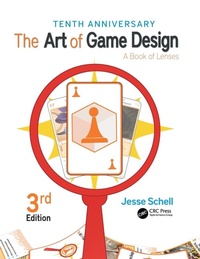
The Art of Game Design
A Book of Lenses, Third Edition
3rd Edition
Published on 12. August 2019
Book
Hardback
652 pages
978-1-138-63209-7 (ISBN)
Description
The Art of Game Design guides you through the design process step-by-step, helping you to develop new and innovative games that will be played again and again. It explains the fundamental principles of game design and demonstrates how tactics used in classic board, card and athletic games also work in top-quality video games.
Good game design happens when you view your game from as many perspectives as possible, and award-winning author Jesse Schell presents over 100 sets of questions to ask yourself as you build, play and change your game until you finalise your design.
This latest third edition includes examples from new VR and AR platforms as well as from modern games such as Uncharted 4 and The Last of Us, Free to Play games, hybrid games, transformational games, and more.
Whatever your role in video game development an understanding of the principles of game design will make you better at what you do. For over 10 years this book has provided inspiration and guidance to budding and experienced game designers - helping to make better games faster.
Good game design happens when you view your game from as many perspectives as possible, and award-winning author Jesse Schell presents over 100 sets of questions to ask yourself as you build, play and change your game until you finalise your design.
This latest third edition includes examples from new VR and AR platforms as well as from modern games such as Uncharted 4 and The Last of Us, Free to Play games, hybrid games, transformational games, and more.
Whatever your role in video game development an understanding of the principles of game design will make you better at what you do. For over 10 years this book has provided inspiration and guidance to budding and experienced game designers - helping to make better games faster.
More details
Edition
3rd edition
Language
English
Place of publication
London
United Kingdom
Publishing group
Taylor & Francis Ltd
Target group
College/higher education
Professional and scholarly
Further/Vocational Education and Professional Practice & Development
Illustrations
21 s/w Abbildungen, 241 farbige Abbildungen
241 Illustrations, color; 21 Illustrations, black and white
Dimensions
Height: 241 mm
Width: 196 mm
Thickness: 39 mm
Weight
1396 gr
ISBN-13
978-1-138-63209-7 (9781138632097)
Copyright in bibliographic data and cover images is held by Nielsen Book Services Limited or by the publishers or by their respective licensors: all rights reserved.
Schweitzer Classification
Other editions
Additional editions
Book
08/2019
3rd Edition
CRC Press
€74.50
Available immediately
E-Book
07/2019
3rd Edition
Routledge
€78.99
Available for download
E-Book
07/2019
3rd Edition
Routledge
€78.99
Available for download
Previous edition
Book
07/2017
2nd Edition
CRC Press
€222.84
Article exhausted; check for reprint
Person
Jesse Schell is professor of entertainment technology for Carnegie Mellon University's Entertainment Technology Center (ETC), a joint master's program between Carnegie Mellon's College of Fine Arts and School of Computer Science, where he teaches game design and leads several research projects. He is also CEO of Schell Games, LLC, an independent game studio in Pittsburgh. Formerly he was creative director of the Walt Disney Imagineering Virtual Reality Studio and chairman of the International Game Developers Association (IGDA). Schell worked as a designer, programmer, and manager on several projects for Disney theme parks and DisneyQuest. He received his undergraduate degree from Rensselaer Polytechnic Institute and master's degree in information networking from Carnegie Mellon. In 2004, he was named as one of the World's 100 Top Young Innovators by MIT's Technology Review.
Content
Ch 1 In the Beginning, There Is the Designer. Ch 2 The Designer Creates an Experience. Ch 3 The Experience Takes Place in a Venue. Ch 4 The Experience Rises Out of a Game. Ch 5 The Game Consists of Elements. Ch 6 Ch 7 The Elements Support a Theme. Ch 8 The Game Begins with an Idea. Ch 9 The Game Improves through Iteration. Ch 10 The Game Is Made for a Player. Ch 11 The Experience Is in the Player's Mind. Ch 12 The Player's Mind Is Driven by the Player's Motivation. Ch 13 Some Elements Are Game Mechanics. Ch 14 Game Mechanics Must Be in Balance. Ch 15 Game Mechanics Support Puzzles. Ch 16 Players Play Games through an Interface. Ch 17 Experiences Can Be Judged by Their Interest Curves. Ch 18 One Kind of Experience Is the Story. Ch 19 Story and Game Structures Can Be Artfully Merged with Indirect Control. Ch 20 Stories and Games Take Place in Worlds. Ch 21 Worlds Contain Characters. Ch 22 Worlds Contain Spaces. Ch 23 The Look and Feel of a World Is Defined by Its Aesthetics. Ch 24 Some Games Are Played with Other Players. Ch 25 Other Players Sometimes Form Communities. Ch 26 The Designer Usually Works with a Team. Ch 27 The Team Sometimes Communicates through Documents. Ch 28 Good Games Are Created through Playtesting. Ch 29 The Team Builds a Game with Technology. Ch 30 Your Game Will Probably Have a Client. Ch 31 The Designer Gives the Client a Pitch. Ch 32 The Designer and Client Want the Game to Make a Profit. Games Ch 33 Transform Their Players. Designers Have Certain Responsibilities. Ch 34 Each Designer Has a Purpose.