

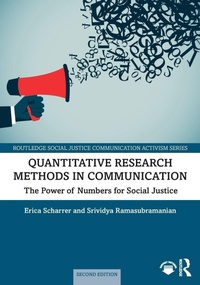
Quantitative Research Methods in Communication
The Power of Numbers for Social Justice
2nd Edition
Published on 17. April 2025
Book
Paperback/Softback
380 pages
978-1-032-59987-8 (ISBN)
Description
This fully updated second edition offers an advanced introduction to quantitative methods that focuses on why and how to conduct research that contributes to social justice.
Providing both inspiration and step-by-step guidance on how to conceive, design, and carry out a quantitative study, the book shows how research can be used to work toward a more just and equitable world. The authors provide a detailed guide to quantitative methods and statistical analysis, showing how researchers can engage with social justice issues in systematic, rigorous, ethical, and meaningful ways. This new edition includes a new chapter on writing literature reviews and better aligns with the stages of quantitative research as well as the changing technologies that are available for researchers to both study and use in their work. It includes updated real-world case studies, interviews with scholar-activists, and definitions of key concepts as well as a deeper focus on ethics, social media, computational social sciences, data analytics, and data visualization techniques.
Attuned to questions of access, equity, justice, diversity, and inclusion, this textbook is ideal for graduate and advanced undergraduate courses in research methods for communication and the social sciences. It will also be of interest to researchers who wish to engage with the transformation of structures, practices, and understandings in society through community and civic engagement and policy formation.
Online resources for instructors include a test bank, PowerPoint slides, sample dataset, and YouTube tutorials. They are available online at www.routledge.com/9781032599878.
Providing both inspiration and step-by-step guidance on how to conceive, design, and carry out a quantitative study, the book shows how research can be used to work toward a more just and equitable world. The authors provide a detailed guide to quantitative methods and statistical analysis, showing how researchers can engage with social justice issues in systematic, rigorous, ethical, and meaningful ways. This new edition includes a new chapter on writing literature reviews and better aligns with the stages of quantitative research as well as the changing technologies that are available for researchers to both study and use in their work. It includes updated real-world case studies, interviews with scholar-activists, and definitions of key concepts as well as a deeper focus on ethics, social media, computational social sciences, data analytics, and data visualization techniques.
Attuned to questions of access, equity, justice, diversity, and inclusion, this textbook is ideal for graduate and advanced undergraduate courses in research methods for communication and the social sciences. It will also be of interest to researchers who wish to engage with the transformation of structures, practices, and understandings in society through community and civic engagement and policy formation.
Online resources for instructors include a test bank, PowerPoint slides, sample dataset, and YouTube tutorials. They are available online at www.routledge.com/9781032599878.
Reviews / Votes
"This volume provides clear and thoughtful guidance on conducting social science research that is inclusive and aware of the importance of social justice. This updated edition now includes instruction on writing literature reviews, analysis using both SPSS and R, and computational approaches. This is essential reading for both students and more seasoned scholars alike."Mary Beth Oliver, Pennsylvania State University, USA
"Social justice issues arise at every stage of research, from the initial literature review through to critically harnessing the power of numbers and then, communicating the results for social good. Scharrer and Ramasubramanian provide the essential guide that both novice and expert researchers need."
Sonia Livingstone, London School of Economics and Political Science, UK
More details
Series
Edition
2nd edition
Language
English
Place of publication
London
United Kingdom
Publishing group
Taylor & Francis Ltd
Target group
College/higher education
Postgraduate, Undergraduate Advanced, and Undergraduate Core
Illustrations
82 s/w Abbildungen, 50 s/w Photographien bzw. Rasterbilder, 32 s/w Zeichnungen
32 Line drawings, black and white; 50 Halftones, black and white; 82 Illustrations, black and white
Dimensions
Height: 254 mm
Width: 178 mm
Thickness: 22 mm
Weight
761 gr
ISBN-13
978-1-032-59987-8 (9781032599878)
Copyright in bibliographic data and cover images is held by Nielsen Book Services Limited or by the publishers or by their respective licensors: all rights reserved.
Schweitzer Classification
Other editions
Additional editions
Erica Scharrer | Srividya Ramasubramanian
Quantitative Research Methods in Communication
The Power of Numbers for Social Justice
E-Book
04/2025
2nd Edition
Routledge
€90.99
Available for download
Erica Scharrer | Srividya Ramasubramanian
Quantitative Research Methods in Communication
The Power of Numbers for Social Justice
E-Book
04/2025
2nd Edition
Routledge
€90.99
Available for download
Erica Scharrer | Srividya Ramasubramanian
Quantitative Research Methods in Communication
The Power of Numbers for Social Justice
Book
04/2025
2nd Edition
Routledge
€205.20
Shipment within 10-20 days
Previous edition
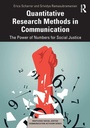
Erica Scharrer | Srividya Ramasubramanian
Quantitative Research Methods in Communication
The Power of Numbers for Social Justice
Book
05/2021
1st Edition
Routledge
€57.00
Article exhausted; check for reprint
Persons
Erica Scharrer is Professor of Communication at the University of Massachusetts Amherst, USA. She is also the editor of Children, Media, and Technology: Access, Equity, Diversity, and Inclusion (Routledge, 2025). In recent years, she received the Distinguished Community Engagement Award in Research at UMass and became a fellow of the International Communication Association.
Srividya Ramasubramanian is Newhouse Professor and Endowed Chair at Syracuse University, USA. She is also the director of CODE^SHIFT (Collaboratory for Data Equity, Social Healing, Inclusive Futures, and Transformation), Media Rise, and the Difficult Dialogues Project. She is editor-in-chief of Communication Monographs, fellow of the International Communication Association, and honored as a Distinguished Scholar by the National Communication Association.
Srividya Ramasubramanian is Newhouse Professor and Endowed Chair at Syracuse University, USA. She is also the director of CODE^SHIFT (Collaboratory for Data Equity, Social Healing, Inclusive Futures, and Transformation), Media Rise, and the Difficult Dialogues Project. She is editor-in-chief of Communication Monographs, fellow of the International Communication Association, and honored as a Distinguished Scholar by the National Communication Association.
Content
1. Foundations and Definitions 2. Reading and Writing about the Research Literature 3. Ethical Considerations 4. Meaning in/and Measurement 5. Sampling and Representation 6. Soliciting Opinions through Survey Research 7. Studying Responses through Experimental Methods 8. Examining Communication Content in Content Analysis Research 9. Calculations and Complexity 10. Mixed Methods: Triangulating with Qualitative Research 11. Community Partnerships and Participatory Research 12. Using Research in Action: Publication, Public Engagement, and Policymaking Appendices: Statistical Analysis Guide: Introduction to SPSS and R