

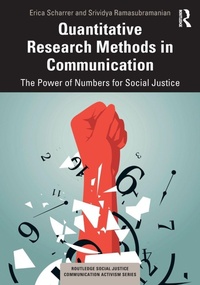
Quantitative Research Methods in Communication
The Power of Numbers for Social Justice
1st Edition
Published on 14. May 2021
Book
Paperback/Softback
362 pages
978-0-367-54785-1 (ISBN)
Description
This textbook is an advanced introduction to quantitative methods for students in communication and allied social science disciplines that focuses on why and how to conduct research that contributes to social justice.
Today's researchers are inspired by the potential for scholarship to make a difference for society, to push toward more just and equitable ends, and to engage in dialogue with members of the public so that they can make decisions about how to navigate the social, cultural, and political world equipped with accurate, fair, and up-to-date knowledge. This book illustrates the mechanics and the meaning behind quantitative research methods by illustrating each step in the research design process with research addressing questions of social justice. It provides practical guidance for researchers who wish to engage in the transformation of structures, practices, and understandings in society through community and civic engagement and policy formation. It contains step-by-step guidance in quantitative methods-from conceptualization through all the stages of execution of a study, including providing a detailed guide for statistical analysis-and demonstrates how researchers can engage with social justice issues in systematic, rigorous, ethical, and meaningful ways.
This text serves as a core or supplementary textbook for graduate and advanced undergraduate courses in research methods for communication and social sciences and fills a gap for a methods text that is responsive to the desire of scholars to conduct socially impactful research.
Today's researchers are inspired by the potential for scholarship to make a difference for society, to push toward more just and equitable ends, and to engage in dialogue with members of the public so that they can make decisions about how to navigate the social, cultural, and political world equipped with accurate, fair, and up-to-date knowledge. This book illustrates the mechanics and the meaning behind quantitative research methods by illustrating each step in the research design process with research addressing questions of social justice. It provides practical guidance for researchers who wish to engage in the transformation of structures, practices, and understandings in society through community and civic engagement and policy formation. It contains step-by-step guidance in quantitative methods-from conceptualization through all the stages of execution of a study, including providing a detailed guide for statistical analysis-and demonstrates how researchers can engage with social justice issues in systematic, rigorous, ethical, and meaningful ways.
This text serves as a core or supplementary textbook for graduate and advanced undergraduate courses in research methods for communication and social sciences and fills a gap for a methods text that is responsive to the desire of scholars to conduct socially impactful research.
Reviews / Votes
"Research on issues of social justice could not be more timely, urgent, and fundamental. This volume provides clear and thoughtful guidance on how we can use and learn from social science research to utilize the power of numbers for social good. This volume takes the reader through every stage of the research process, including design, data collection, data analysis, and community-based scholarship. Undoubtedly this book will be foundational for scholars and students who want to use their research for social justice." -Mary Beth Oliver, Bellisario Professor of Media Studies, Penn State University, and President Elect, International Communication Association"This isn't your father's methods text, and that's a good thing. If you're focused on social justice and suspicious of quantitative methods, this book will show you how quantitative, mixed, and qualitative methods can-and should-all be marshalled to address the important questions we face today. This is an introduction to quantitative research design and execution that successfully engages with societal problems without sacrificing any of the nuance and precision expected from a first-rate textbook." -Larry Gross, Professor, University of Southern California
"This is not just another stats book! Scholarly yet accessible and practical, Scharrer and Ramasubramanian critique the misuse of numbers and, more importantly, show us how to harness the power of numbers for social justice. This is a book that many in our field have been waiting for." -Sonia Livingstone, London School of Economics and Political Science
"In covering the nuts and bolts of quantitative research methods while showing why and how research matters for society, this book is a tremendously valuable resource for students and scholars in Communication and across the social sciences."-Dana Mastro, Associate Dean of the College of Creative Studies and Professor of Communication, University of California, Santa Barbara
More details
Series
Language
English
Place of publication
London
United Kingdom
Publishing group
Taylor & Francis Ltd
Target group
College/higher education
Postgraduate, Undergraduate Advanced, and Undergraduate Core
Illustrations
3 s/w Tabellen, 26 s/w Zeichnungen, 143 s/w Photographien bzw. Rasterbilder, 169 s/w Abbildungen
3 Tables, black and white; 26 Line drawings, black and white; 143 Halftones, black and white; 169 Illustrations, black and white
Dimensions
Height: 254 mm
Width: 178 mm
Thickness: 21 mm
Weight
724 gr
ISBN-13
978-0-367-54785-1 (9780367547851)
Copyright in bibliographic data and cover images is held by Nielsen Book Services Limited or by the publishers or by their respective licensors: all rights reserved.
Schweitzer Classification
Other editions
New editions
Erica Scharrer | Srividya Ramasubramanian
Quantitative Research Methods in Communication
The Power of Numbers for Social Justice
Book
04/2025
2nd Edition
Routledge
€96.10
Shipment within 10-20 days
Additional editions
Erica Scharrer | Srividya Ramasubramanian
Quantitative Research Methods in Communication
The Power of Numbers for Social Justice
Book
05/2021
1st Edition
Routledge
€179.51
Article exhausted; check for reprint
Persons
Erica Scharrer (PhD, Syracuse University) is Professor and Chair of the Department of Communication at the University of Massachusetts Amherst. She is co-author of three additional books, including Media and the American Child, and editor of the Media Effects/Media Psychology volume of the International Encyclopedia of Media Studies. Her research on the topics of media content, opinions of media, media effects, and media literacy has appeared in a number of journals.
Srividya Ramasubramanian (PhD, Penn State University) is Presidential Impact Fellow, Professor of Communication, Affiliated Professor of Women's and Gender Studies, and Director of the Difficult Dialogues Project at Texas A&M University. Her research focuses on critical media effects, diversity, anti-racism, prejudice reduction, media literacy, and social justice and has been published in several journals, books, and popular press outlets. She is also Executive Director of Media Rise, a nonprofit for meaningful media for social justice.
Srividya Ramasubramanian (PhD, Penn State University) is Presidential Impact Fellow, Professor of Communication, Affiliated Professor of Women's and Gender Studies, and Director of the Difficult Dialogues Project at Texas A&M University. Her research focuses on critical media effects, diversity, anti-racism, prejudice reduction, media literacy, and social justice and has been published in several journals, books, and popular press outlets. She is also Executive Director of Media Rise, a nonprofit for meaningful media for social justice.
Content
1. Foundations and Definitions 2. Ethical Considerations 3. Operationalization and Otherness 4. Sampling and Representation 5. Soliciting Opinions Through Survey Research 6. Studying Responses through Experimental Methods 7. Examining Communication Content in Content Analysis Research 8. Calculations and Complexity 9. Statistical Analysis: From Principles to Practice 10. Mixing Methods: Triangulating with Qualitative Research 11. Community Partnerships and Partitipatory Research 12. Communicating Research for Publication, Policy, and the Public