

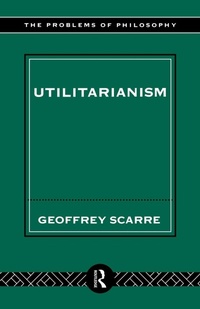
Utilitarianism
1st Edition
Published on 30. May 1996
Book
Paperback/Softback
234 pages
978-0-415-12197-2 (ISBN)
Description
Surveying the historical development and the present condition of utilitarian ethics, Geoffrey Scarre examines the major philosophers from Lao Tzu in the fifth century BC to Richard Hare in the twentieth.
Utilitarianism traces the 'doctrine of utility' from the moralists of the ancient world, through the Enlightenment and Victorian utilitarianism up to the lively debate of the present day. Utilitarianism today faces challenges on several fronts: it cannot warrant the drawing of adequate protective boundaries around the essential interests of individuals, and it does not allow them the space to pursue the personal concerns which give meaning to their lives. Geoffrey Scarre considers these and other charges, and concludes that whilst utilitarianism may not be a faultless moral doctrine, its positions are relevant, and significant today.
Written with undergraduates in mind, this is an ideal course book for those studying and those teaching moral philosophy.
Utilitarianism traces the 'doctrine of utility' from the moralists of the ancient world, through the Enlightenment and Victorian utilitarianism up to the lively debate of the present day. Utilitarianism today faces challenges on several fronts: it cannot warrant the drawing of adequate protective boundaries around the essential interests of individuals, and it does not allow them the space to pursue the personal concerns which give meaning to their lives. Geoffrey Scarre considers these and other charges, and concludes that whilst utilitarianism may not be a faultless moral doctrine, its positions are relevant, and significant today.
Written with undergraduates in mind, this is an ideal course book for those studying and those teaching moral philosophy.
Reviews / Votes
'This is an excellent introduction to and survey of utilitarianism, and important current in contemporary ethical theory.' - Philosophia, The Philosophical Quarterly of Israel, 27, 3-4 Nov.1999More details
Series
Language
English
Place of publication
London
United Kingdom
Publishing group
Taylor & Francis Ltd
Target group
College/higher education
Postgraduate
Dimensions
Height: 216 mm
Width: 140 mm
Thickness: 13 mm
Weight
303 gr
ISBN-13
978-0-415-12197-2 (9780415121972)
Copyright in bibliographic data and cover images is held by Nielsen Book Services Limited or by the publishers or by their respective licensors: all rights reserved.
Schweitzer Classification
Other editions
Additional editions
Person
Geoffrey Scarre is Lecturer in Philosophy at the University of Durham. He is the author of Logic and Reality in the Philosophy of John Stuart Mill and the editor of Children. Parents and Politics.
Content
Preface -- I Introduction: The Character of the Theory -- II Four Ancient Moralists -- 1 MoTzu -- 2 Jesus -- 3 Aristotle -- 4 Epir:urus -- III Utilitarianism and Enlightenment -- I Chastellux and Helvetius -- 2 Hutcheson -- 3 Hume -- 4 Priestley and Paley -- 5 Godwin -- 6 Bentham -- IV John Stuart Mill -- I Early years -- 2 James Mill -- 3 The importance of character -- 4 Higher and lower pleasures -- 5 The 'proof of utility' -- 6 Utility and justice -- V Some Later Developments -- I Intuitional utilitarianism: Sidgwick -- 2 Ideal Utilitarianism: Moore and Rashdall -- 3 Rule-utilitarianism -- VI Happiness and Other Ends -- I Preference and happiness -- 2 Dominant- and inclusive-end conceptions of happiness -- 3 Problems about multiple ends -- 4 Two contrasting responses -- VII Maximisation, Fairness and Respect for Persons -- I Is utilitarian justice just? -- 2 Panem et circenses -- 3 'Whoever debases others is debasing himself' -- 4 But should the consequences count? -- 5 Limitations of the self-respect argument -- 6 Archangels, proles and the natural man -- VIII Utilitarianism and Personality -- I Does utilitarian morality demand too much? -- 2 The hard line: utilitarians should be saints -- 3 A softer line: utilitarians may be human -- 4 Maximisation and alienation -- 5 Non-alienating direct utilitarianism -- Notes -- Bibliography -- Index.