

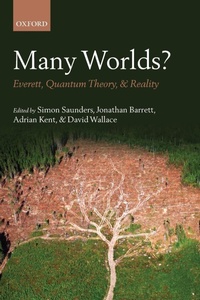
Many Worlds?
Everett, Quantum Theory, & Reality
Published on 7. June 2012
Book
Paperback/Softback
636 pages
978-0-19-965550-2 (ISBN)
Description
What does realism about the quantum state imply? What follows when quantum theory is applied without restriction, if need be, to the whole universe? These are the questions which an illustrious team of philosophers and physicists debate in this volume. All the contributors are agreed on realism, and on the need, or the aspiration, for a theory that unites micro- and macroworlds, at least in principle. But the further claim argued by some is that if you allow the Schroedinger equation unrestricted application, supposing the quantum state to be something physically real, then this universe is one of countlessly many others, constantly branching in time, all of which are real. The result is the many worlds theory, also known as the Everett interpretation of quantum mechanics.
The contrary claim sees this picture of many worlds as in no sense inherent in quantum mechanics, even when the latter is allowed unrestricted scope and even given that the quantum state itself is something physically real. For this picture of branching worlds fails to make physical sense, let alone common sense, even on its own terms. The status of these worlds, what they are made of, is never adequately explained. Ordinary ideas about time and identity over time become hopelessly compromised. The concept of probability itself is brought into question. This picture of many branching worlds is inchoate, it is a vision, an error. There are realist alternatives to many worlds, some even that preserve the Schroedinger equation unchanged.
Twenty specially written essays, accompanied by commentaries and discussions, examine these claims and counterclaims in depth. They focus first on the question of ontology, the existence of worlds (Part 1 and 2), second on the interpretation of probability (Parts 3 and 4), and third on alternatives or additions to many worlds (Parts 5 and 6). The introduction offers a helpful guide to the arguments for the Everett interpretation, particularly as they have been formulated in the last two decades.
The contrary claim sees this picture of many worlds as in no sense inherent in quantum mechanics, even when the latter is allowed unrestricted scope and even given that the quantum state itself is something physically real. For this picture of branching worlds fails to make physical sense, let alone common sense, even on its own terms. The status of these worlds, what they are made of, is never adequately explained. Ordinary ideas about time and identity over time become hopelessly compromised. The concept of probability itself is brought into question. This picture of many branching worlds is inchoate, it is a vision, an error. There are realist alternatives to many worlds, some even that preserve the Schroedinger equation unchanged.
Twenty specially written essays, accompanied by commentaries and discussions, examine these claims and counterclaims in depth. They focus first on the question of ontology, the existence of worlds (Part 1 and 2), second on the interpretation of probability (Parts 3 and 4), and third on alternatives or additions to many worlds (Parts 5 and 6). The introduction offers a helpful guide to the arguments for the Everett interpretation, particularly as they have been formulated in the last two decades.
Reviews / Votes
This book provides arguably the most vivid and comprehensive treatment of both state-of-the art developments within and criticism of the Everett interpretation. * Guido Bacciagaluppi, Metascience *More details
Language
English
Place of publication
Oxford
United Kingdom
Target group
College/higher education
Academics teaching and researching in the field of philosophy - especially philosophy of physics, metaphysics, philosophy of science, epistemology, decision theory, and probability theory. Academics teaching and researching in the field of physics - especially quantum mechanics, quantum information, quantum field theory, string theory and cosmology. Also historians of science.
Dimensions
Height: 234 mm
Width: 156 mm
Thickness: 34 mm
Weight
951 gr
ISBN-13
978-0-19-965550-2 (9780199655502)
Copyright in bibliographic data and cover images is held by Nielsen Book Services Limited or by the publishers or by their respective licensors: all rights reserved.
Schweitzer Classification
Other editions
Additional editions
Book
06/2010
1st Edition
Oxford University Press
€192.80
Shipment within 15-20 days
Persons
Simon Saunders is Professor of Philosophy at the University of Oxford.
Jon Barrett is a Research Fellow in the Physics department at the University of Bristol
Adrian Kent is a Reader in Quantum Physics at the University of Cambridge
David Wallace is a lecturer in Philosophy of Physics at the University of Oxford
Jon Barrett is a Research Fellow in the Physics department at the University of Bristol
Adrian Kent is a Reader in Quantum Physics at the University of Cambridge
David Wallace is a lecturer in Philosophy of Physics at the University of Oxford
Content
1. WHY MANY WORLDS?; 2. PROBLEMS WITH ONTOLOGY; 3. PROBABILITY IN THE EVERETT INTERPRETATION; 4. CRITICAL REPLIES; 5. ALTERNATIVES TO MANY WORLDS; 6. NOT ONLY MANY WORLDS