

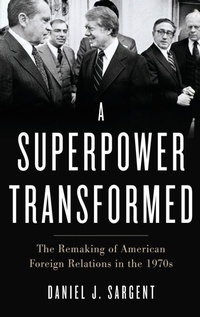
A Superpower Transformed
The Remaking of American Foreign Relations in the 1970s
Published on 8. January 2015
Book
Hardback
452 pages
978-0-19-539547-1 (ISBN)
Description
A Superpower Transformed explores the predicament of American foreign policy in the 1970s. This was a phase when the dilemmas of an emerging post-Cold War era buffeted the United States even as the makers of American foreign policy struggled for stability in an enduring Cold War. Clashing imperatives made the 1970s a difficult phase. Amidst conflicting pressures, leaders struggled to devise strategic frameworks to guide the exercise of American power in the world. 1970s-era choices nonetheless proved consequential. The Nixon administration's efforts to stabilize a faltering Pax Americana faltered, but Nixon's choices ultimately helped the champions of human rights to wrest control of American foreign policy away from the practitioners of amoral realpolitik. So too did Nixon's efforts to reverse the decline of American economic power help to open the doors to financial globalization, which accelerated quickly in the years following the 1971-73 collapse of the Bretton Woods international monetary system.
Choices proved consequential, but American decision makers remained the captives of unmasterable circumstances, as the oil crisis of 1973-74 made clear. Coinciding with Watergate, the oil crisis plunged the world economy into disarray. It also pushed American decision makers to begin to devise new strategies to manage-or mitigate-the consequences of economic globalization. Henry Kissinger, who led this effort, was less successful in his attempts to terms with a human rights movement that flourished in the mid-1970s. Not until the inauguration of the Carter administration would American decision makers embrace human rights promotion as a central task for foreign policy. Carter's efforts to devise a post-Cold War foreign policy nonetheless faltered, confounded in the last years of 1970s by the resurgence of Soviet-American hostilities. While the Cold War resurged, the new forces of globalization and human rights that mobilized in the 1970s left the United States a superpower transformed.
Choices proved consequential, but American decision makers remained the captives of unmasterable circumstances, as the oil crisis of 1973-74 made clear. Coinciding with Watergate, the oil crisis plunged the world economy into disarray. It also pushed American decision makers to begin to devise new strategies to manage-or mitigate-the consequences of economic globalization. Henry Kissinger, who led this effort, was less successful in his attempts to terms with a human rights movement that flourished in the mid-1970s. Not until the inauguration of the Carter administration would American decision makers embrace human rights promotion as a central task for foreign policy. Carter's efforts to devise a post-Cold War foreign policy nonetheless faltered, confounded in the last years of 1970s by the resurgence of Soviet-American hostilities. While the Cold War resurged, the new forces of globalization and human rights that mobilized in the 1970s left the United States a superpower transformed.
Reviews / Votes
Daniel Sargent's comprehensive assessment of Nixon, Ford, and Carter foreign policies integrates geopolitical, economic, and human rights issues with such skill that it now must be the starting point for all future scholarship on that era. A major accomplishment by a talented young historian. * John Lewis Gaddis, Yale University * Daniel Sargent's new book goes a long way toward illuminating the course of the Cold War and the U.S. engagement with globalization. Deeply researched and wonderfully well written, A Superpower Transformed blends world politics and international economics to explain the momentous changes in 1970s U.S. foreign relations. This is a brilliant contribution to our understanding of America's place in the world today. * Thomas ("Tim") Borstelmann, author of The 1970s: A New Global History from Civil Rights to Economic Inequality * Daniel Sargent's book shows how the 'Cold War order' imploded during the 1970s, as rapid globalization shaped a new era of unpredictability, fragmentation, and improvised policies. With its deep research, fresh interpretations, beautiful writing, and tight focus on questions of how power is exercised, A Superpower Transformed is a work of major importance. * Emily S. Rosenberg, author of Transnational Currents in a Shrinking World, 1870-1945 * Ambitious in its design, capacious in its coverage, this eloquent and nuanced analysis will be essential reading for anyone who wants to understand the origins of the contemporary era. * Matthew J. Connelly, Columbia University * will likely have a long-lasting impact on our understanding of the role of the United States in the 1970s. Daniel J. Sargent writes vividly and makes many of the complicated issues he discusses clearer with helpful charts, tables, and graphs. Sargent's book is also highly relevant today, as it demonstrates the challenges of policy making in turbulent and changing times. * Sarah B. Snyder, American Historical Review *More details
Language
English
Place of publication
New York
United States
Target group
College/higher education
Professional and scholarly
Dimensions
Height: 240 mm
Width: 161 mm
Thickness: 29 mm
Weight
840 gr
ISBN-13
978-0-19-539547-1 (9780195395471)
Copyright in bibliographic data and cover images is held by Nielsen Book Services Limited or by the publishers or by their respective licensors: all rights reserved.
Schweitzer Classification
Other editions
Additional editions
Book
04/2017
Oxford University Press Inc
€46.70
Shipment within 15-20 days
E-Book
12/2014
1st Edition
OUP eBook
€16.99
Available for download
E-Book
12/2014
1st Edition
OUP eBook
€16.99
Available for download
Person
Assistant Professor of History, University of California, Berkeley. Co-editor of The Shock of the Global: The International History of the 1970s (Harvard University Press, forthcoming, 2009).
Content
Acknowledgments ; Intro ; Ch 1 Pax Americana ; Part I Reaching Backward ; Ch 2 In Pursuit of Primacy ; Ch 3 Geopolitics and Humanitarianism ; Ch 4 The Dollar in Decline ; Ch 5 Oil Shocked ; Part II Stumbling Forward ; Ch 6 Managing Interdependence ; Ch 7 Human Rights and Detente ; Ch 8 World Olrder Politics ; Ch 9 The Revenge of Geopolitics ; Conclusion ; Notes ; Bibliography ; Index