

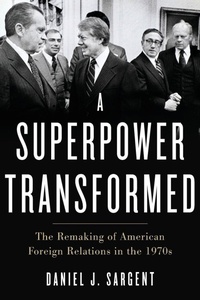
A Superpower Transformed
The Remaking of American Foreign Relations in the 1970s
Published on 27. April 2017
Book
Paperback/Softback
456 pages
978-0-19-067216-4 (ISBN)
Description
During the 1970s, American foreign policy faced a predicament of clashing imperatives-US decision makers, already struggling to maintain stability and devise strategic frameworks to guide the exercise of American power during the Cold War, found themselves hampered by the emergence of dilemmas that would come to a head in the post-Cold War era. Their choices proved to be of enormous consequence for the development of American foreign policy in the final decades of the twentieth century and beyond.
In A Superpower Transformed, Daniel J. Sargent chronicles how policymakers across three administrations worked to manage complex international changes in a tumultuous era. Drawing on many newly-released archival documents and interviews with key figures, including President Jimmy Carter and Dr. Zbigniew Brzezinski, Sargent explores the collision of geopolitics and globalization that defined the decade. From the Nixon administration's efforts to stabilize a faltering Pax Americana; to Henry Kissinger's attempts to devise new strategies to manage or mitigate the consequences of economic globalization after the oil crisis of 1973-74; to the Carter administration's embrace of human rights promotion as a central task for foreign policy, Sargent explores the challenges that afflicted US policymakers in the 1970s, offering new insights into the complexities that emerged as the new forces of globalization and human rights transformed the United States as a superpower.
A sweeping reinterpretation of a pivotal era, A Superpower Transformed is a must-read for anyone interested in U.S. foreign relations, American politics, globalization, economic policy, human rights, and contemporary American history.
In A Superpower Transformed, Daniel J. Sargent chronicles how policymakers across three administrations worked to manage complex international changes in a tumultuous era. Drawing on many newly-released archival documents and interviews with key figures, including President Jimmy Carter and Dr. Zbigniew Brzezinski, Sargent explores the collision of geopolitics and globalization that defined the decade. From the Nixon administration's efforts to stabilize a faltering Pax Americana; to Henry Kissinger's attempts to devise new strategies to manage or mitigate the consequences of economic globalization after the oil crisis of 1973-74; to the Carter administration's embrace of human rights promotion as a central task for foreign policy, Sargent explores the challenges that afflicted US policymakers in the 1970s, offering new insights into the complexities that emerged as the new forces of globalization and human rights transformed the United States as a superpower.
A sweeping reinterpretation of a pivotal era, A Superpower Transformed is a must-read for anyone interested in U.S. foreign relations, American politics, globalization, economic policy, human rights, and contemporary American history.
Reviews / Votes
Deeply researched and well-written, Sargent's analysis contributes to the argument that the seventies was a crucial era in which the chaotic and challenging contemporary world emerged, and in which the 'sole superpower' is powerful, yet unable to succeed consistently. * Choice* Daniel Sargent's comprehensive assessment of Nixon, Ford, and Carter foreign policies integrates geopolitical, economic, and human rights issues with such skill that it now must be the starting point for all future scholarship on that era. A major accomplishment by a talented young historian. * John Lewis Gaddis, Yale University * Daniel Sargent's new book goes a long way toward illuminating the course of the Cold War and the U.S. engagement with globalization. Deeply researched and wonderfully well written, A Superpower Transformed blends world politics and international economics to explain the momentous changes in 1970s U.S. foreign relations. This is a brilliant contribution to our understanding of America's place in the world today. * Thomas ("Tim") Borstelmann, author of The 1970s: A New Global History from Civil Rights to Economic Inequality * Daniel Sargent's book shows how the 'Cold War order' imploded during the 1970s, as rapid globalization shaped a new era of unpredictability, fragmentation, and improvised policies. With its deep research, fresh interpretations, beautiful writing, and tight focus on questions of how power is exercised, A Superpower Transformed is a work of major importance. * Emily S. Rosenberg, author of Transnational Currents in a Shrinking World, 1870-1945 * Ambitious in its design, capacious in its coverage, this eloquent and nuanced analysis will be essential reading for anyone who wants to understand the origins of the contemporary era. * Matthew J. Connelly, Columbia University * Sargent's book is also highly relevant today, as it demonstrates the challenges of policy making in turbulent and changing times. * The Journal of American History * Sargent writes eloquently, comprehensively, and persuasively about the limits of power in a pluralizing, chaotic, interdependent world."-American Historical Review
More details
Language
English
Place of publication
New York
United States
Target group
College/higher education
Illustrations
19 illus.
Dimensions
Height: 234 mm
Width: 156 mm
Thickness: 27 mm
Weight
764 gr
ISBN-13
978-0-19-067216-4 (9780190672164)
Copyright in bibliographic data and cover images is held by Nielsen Book Services Limited or by the publishers or by their respective licensors: all rights reserved.
Schweitzer Classification
Other editions
Additional editions
Book
01/2015
Oxford University Press Inc
€53.30
Shipment within 15-20 days
E-Book
12/2014
1st Edition
OUP eBook
€16.99
Available for download
Person
Daniel J. Sargent is Assistant Professor of History, University of California, Berkeley. He is the co-editor of The Shock of the Global: The International History of the 1970s.
Content
Acknowledgments
Introduction
1. Pax Americana
Part I. Reaching Backward
2. In Pursuit of Primacy
3. Geopolitics and Humanitarianism
4. The Dollar in Decline
5. Oil Shocked
Part II Stumbling Forward
6. Managing Interdependence
7. Human Rights and Detente
8. World Order Politics
9. The Revenge of Geopolitics
Conclusion
Notes
Bibliography
Index
Introduction
1. Pax Americana
Part I. Reaching Backward
2. In Pursuit of Primacy
3. Geopolitics and Humanitarianism
4. The Dollar in Decline
5. Oil Shocked
Part II Stumbling Forward
6. Managing Interdependence
7. Human Rights and Detente
8. World Order Politics
9. The Revenge of Geopolitics
Conclusion
Notes
Bibliography
Index