

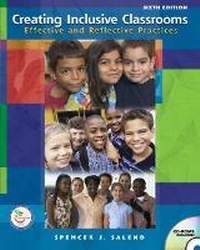
Creating Inclusive Classrooms
Effective and Reflective Practices
6th Edition
Published on 25. April 2007
Book
Paperback/Softback
696 pages
978-0-13-227235-3 (ISBN)
Description
For courses in Inclusion or Mainstreaming, Educating Students with Disabilities in General Education Classrooms, Introduction to Special Education, Methods courses in Special Education, and courses on Collaboration and Differentiating Instruction.
From one of the most respected authors in the field, comes the sixth edition of this best-selling, accessible and practical text for Inclusion courses. Rich in K-12 classroom-based examples, CD-ROM video examples, and case studies of effective inclusive educational practices, this non-categorical text addresses the latest information on inclusion in today's schools. Four principles of effective instruction provide a framework for the text 1.) all learners and equal access 2.) individual strengths and challenges and diversity 3.) reflective practices and differentiated instruction 4.) and community and collaboration. These principles, woven throughout the chapters, demonstrate that inclusion is not just a government mandate but a principled philosophy of reflective and effective teaching for individualizing the educational system for all students. By incorporating the themes of diversity, collaboration, technology, and effective and reflective classroom practices into each chapter, the book is consistent with professional standards for preparing teachers to work in today's diverse classrooms. Additionally, this text is the only one on the market that devotes four whole chapters to the topic of Differentiated Instruction. Creating Inclusive Classrooms: Effective and Reflective Practices, Sixth Edition, is written to help readers become effective and reflective practitioners who are able to think critically about their own values, beliefs, and practices, and to refine professional practices to facilitate the creation of inclusive classrooms that support the learning of all students.
From one of the most respected authors in the field, comes the sixth edition of this best-selling, accessible and practical text for Inclusion courses. Rich in K-12 classroom-based examples, CD-ROM video examples, and case studies of effective inclusive educational practices, this non-categorical text addresses the latest information on inclusion in today's schools. Four principles of effective instruction provide a framework for the text 1.) all learners and equal access 2.) individual strengths and challenges and diversity 3.) reflective practices and differentiated instruction 4.) and community and collaboration. These principles, woven throughout the chapters, demonstrate that inclusion is not just a government mandate but a principled philosophy of reflective and effective teaching for individualizing the educational system for all students. By incorporating the themes of diversity, collaboration, technology, and effective and reflective classroom practices into each chapter, the book is consistent with professional standards for preparing teachers to work in today's diverse classrooms. Additionally, this text is the only one on the market that devotes four whole chapters to the topic of Differentiated Instruction. Creating Inclusive Classrooms: Effective and Reflective Practices, Sixth Edition, is written to help readers become effective and reflective practitioners who are able to think critically about their own values, beliefs, and practices, and to refine professional practices to facilitate the creation of inclusive classrooms that support the learning of all students.
More details
Edition
6th edition
Language
English
Place of publication
United States
Publishing group
Pearson Education (US)
Target group
Professional and scholarly
Dimensions
Height: 254 mm
Width: 203 mm
Weight
1266 gr
ISBN-13
978-0-13-227235-3 (9780132272353)
Copyright in bibliographic data and cover images is held by Nielsen Book Services Limited or by the publishers or by their respective licensors: all rights reserved.
Schweitzer Classification
Other editions
New editions
Spencer J. Salend
Creating Inclusive Classrooms
Effective and Reflective Practices: International Edition
Book
03/2010
7th Edition
Pearson
€136.17
Article is exhausted; no reprint
Previous edition
Book
06/2004
5th Edition
Pearson
€61.89
Article exhausted; check for reprint
Content
Part I: Understanding the Foundations and Fundamentals of Inclusion
Chapter 1
Understanding Inclusion
Chapter 2
Understanding the Diverse Educational Strengths and Challenges of Students with Disabilities
Chapter 3
Understanding the Diverse Educational Strengths and Challenges of Students Who Challenge Schools
Part II: Creating an Inclusive Environment That Supports Learning for All Students
Chapter 4
Creating Collaborative Relationships and Fostering Communication
Chapter 5
Creating an Environment That Fosters Acceptance and Friendship
Chapter 6
Creating Successful Transitions to Inclusive Settings
Chapter 7
Creating a Classroom Environment That Promotes Positive Behavior
Part III: Differentiating Instruction for All Students
Chapter 8
Differentiating Instruction for Diverse Learners
Chapter 9
Differentiating Large- and Small-Group Instruction
Chapter 10
Differentiating Reading, Writing, and Spelling Instruction
Chapter 11
Differentiating Mathematics, Science, and Social Studies Instruction
Part IV: Evaluating Individual and Programmatic Progress
Chapter 12
Evaluating Student Progress and the Effectiveness of Your Inclusion Program
Summary
Glossary.
References.
Name Index.
Subject Index.
Chapter 1
Understanding Inclusion
Chapter 2
Understanding the Diverse Educational Strengths and Challenges of Students with Disabilities
Chapter 3
Understanding the Diverse Educational Strengths and Challenges of Students Who Challenge Schools
Part II: Creating an Inclusive Environment That Supports Learning for All Students
Chapter 4
Creating Collaborative Relationships and Fostering Communication
Chapter 5
Creating an Environment That Fosters Acceptance and Friendship
Chapter 6
Creating Successful Transitions to Inclusive Settings
Chapter 7
Creating a Classroom Environment That Promotes Positive Behavior
Part III: Differentiating Instruction for All Students
Chapter 8
Differentiating Instruction for Diverse Learners
Chapter 9
Differentiating Large- and Small-Group Instruction
Chapter 10
Differentiating Reading, Writing, and Spelling Instruction
Chapter 11
Differentiating Mathematics, Science, and Social Studies Instruction
Part IV: Evaluating Individual and Programmatic Progress
Chapter 12
Evaluating Student Progress and the Effectiveness of Your Inclusion Program
Summary
Glossary.
References.
Name Index.
Subject Index.