

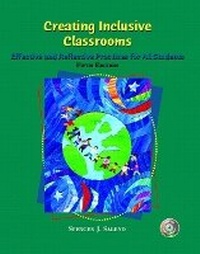
Creating Inclusive Classrooms
Effective and Reflective Practices for All Students
5th Edition
Published on 24. June 2004
Book
Paperback/Softback
640 pages
978-0-13-140813-5 (ISBN)
Description
For courses in Inclusion and/or Mainstreaming.
Rich in K-12 classroom-based narrative and with accompanying video cases highlighting best inclusive practices, this text shows prospective teachers how to become effective and reflective practitioners who can create engaging classrooms for all students. Coverage incorporates all of the core information expected of an inclusion text, then goes beyond the basics to address issues around such "higher-level" topics as gender, race, ethnicity, language, socioeconomics, and family structures. The author advocates a framework of four basic tenets-equal access for all learners, individual strengths and needs, reflective practice and differentiated instruction, and, community and collaboration-which are integrated into every chapter. This framework clearly demonstrates that inclusion is more than a government mandate; it's a principled philosophy for teaching all children.
Rich in K-12 classroom-based narrative and with accompanying video cases highlighting best inclusive practices, this text shows prospective teachers how to become effective and reflective practitioners who can create engaging classrooms for all students. Coverage incorporates all of the core information expected of an inclusion text, then goes beyond the basics to address issues around such "higher-level" topics as gender, race, ethnicity, language, socioeconomics, and family structures. The author advocates a framework of four basic tenets-equal access for all learners, individual strengths and needs, reflective practice and differentiated instruction, and, community and collaboration-which are integrated into every chapter. This framework clearly demonstrates that inclusion is more than a government mandate; it's a principled philosophy for teaching all children.
More details
Edition
5th edition
Language
English
Place of publication
United States
Publishing group
Pearson Education (US)
Target group
Professional and scholarly
Dimensions
Height: 251 mm
Width: 206 mm
Thickness: 23 mm
Weight
1141 gr
ISBN-13
978-0-13-140813-5 (9780131408135)
Copyright in bibliographic data and cover images is held by Nielsen Book Services Limited or by the publishers or by their respective licensors: all rights reserved.
Schweitzer Classification
Other editions
New editions
Book
04/2007
6th Edition
Pearson
€61.89
Article exhausted; check for reprint
Previous edition
Book
07/2000
4th Edition
Pearson
€49.64
Article exhausted; check for reprint
Content
Part I: UNDERSTANDING THE FOUNDATIONS AND FUNDAMENTALS OF INCLUSION.
1. Understanding Inclusion.
2. Understanding the Diverse Educational Strengths and Needs of Students with Disabilities.
3. Understanding the Diverse Educational Strengths and Needs of Learners with Who Challenge Schools.
Part II: CREATING AN INCLUSIVE ENVIRONMENT THAT SUPPORTS LEARNING FOR ALL STUDENTS.
4. Creating Collaborative Relationships and Fostering Communication.
5. Creating an Environment That Fosters Acceptance and Friendships.
6. Creating Successful Transitions to Inclusive Settings.
7. Creating a Classroom Environment That Promotes Positive Behavior.
Part III: DIFFERENTIATING INSTRUCTION FOR ALL STUDENTS.
8. Differentiating Instruction for Diverse Learners.
9. Differentiating Large- and Small-Group Instruction.
10. Differentiating Reading, Writing, and Spelling Instruction.
11. Differentiating Mathematics, Science, and Social Studies Instruction.
Part IV: EVALUATING INDIVIDUAL AND PROGRAMMATIC PROGRESS.
12. Evaluating Student Progress and the Effectiveness of Your Inclusion Program.
References. Name Index. Subject Index.
1. Understanding Inclusion.
2. Understanding the Diverse Educational Strengths and Needs of Students with Disabilities.
3. Understanding the Diverse Educational Strengths and Needs of Learners with Who Challenge Schools.
Part II: CREATING AN INCLUSIVE ENVIRONMENT THAT SUPPORTS LEARNING FOR ALL STUDENTS.
4. Creating Collaborative Relationships and Fostering Communication.
5. Creating an Environment That Fosters Acceptance and Friendships.
6. Creating Successful Transitions to Inclusive Settings.
7. Creating a Classroom Environment That Promotes Positive Behavior.
Part III: DIFFERENTIATING INSTRUCTION FOR ALL STUDENTS.
8. Differentiating Instruction for Diverse Learners.
9. Differentiating Large- and Small-Group Instruction.
10. Differentiating Reading, Writing, and Spelling Instruction.
11. Differentiating Mathematics, Science, and Social Studies Instruction.
Part IV: EVALUATING INDIVIDUAL AND PROGRAMMATIC PROGRESS.
12. Evaluating Student Progress and the Effectiveness of Your Inclusion Program.
References. Name Index. Subject Index.