

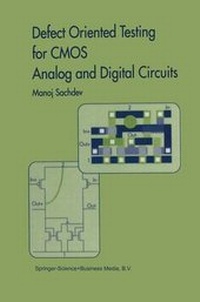
Defect Oriented Testing for CMOS Analog and Digital Circuits
Published on 31. December 1997
Book
Hardback
XIV, 308 pages
978-0-7923-8083-2 (ISBN)
Description
Defect oriented testing is expected to play a significant role in coming generations of technology. Smaller feature sizes and larger die sizes will make ICs more sensitive to defects that can not be modeled by traditional fault modeling approaches. Furthermore, with increased level of integration, an IC may contain diverse building blocks. Such blocks include, digital logic, PLAs, volatile and non-volatile memories, and analog interfaces. For such diverse building blocks, traditional fault modeling and test approaches will become increasingly inadequate.
Defect oriented testing methods have come a long way from a mere interesting academic exercise to a hard industrial reality. Many factors have contributed to its industrial acceptance. Traditional approaches of testing modern integrated circuits (ICs) have been found to be inadequate in terms of quality and economics of test. In a globally competitive semiconductor market place, overall product quality and economics have become very important objectives. In addition, electronic systems are becoming increasingly complex and demand components of highest possible quality. Testing, in general and, defect oriented testing, in particular, help in realizing these objectives.
Defect Oriented Testing for CMOS Analog and Digital Circuits is the first book to provide a complete overview of the subject. It is essential reading for all design and test professionals as well as researchers and students working in the field.
`A strength of this book is its breadth. Types of designs considered include analog and digital circuits, programmable logic arrays, and memories. Having a fault model does not automatically provide a test. Sometimes, design for testability hardware is necessary. Many design for testability ideas, supported by experimental evidence, are included.'
... from the Foreword by Vishwani D. Agrawal
Defect oriented testing methods have come a long way from a mere interesting academic exercise to a hard industrial reality. Many factors have contributed to its industrial acceptance. Traditional approaches of testing modern integrated circuits (ICs) have been found to be inadequate in terms of quality and economics of test. In a globally competitive semiconductor market place, overall product quality and economics have become very important objectives. In addition, electronic systems are becoming increasingly complex and demand components of highest possible quality. Testing, in general and, defect oriented testing, in particular, help in realizing these objectives.
Defect Oriented Testing for CMOS Analog and Digital Circuits is the first book to provide a complete overview of the subject. It is essential reading for all design and test professionals as well as researchers and students working in the field.
`A strength of this book is its breadth. Types of designs considered include analog and digital circuits, programmable logic arrays, and memories. Having a fault model does not automatically provide a test. Sometimes, design for testability hardware is necessary. Many design for testability ideas, supported by experimental evidence, are included.'
... from the Foreword by Vishwani D. Agrawal
More details
Series
Edition
1999
Language
English
Place of publication
NY
United States
Target group
College/higher education
Professional and scholarly
Illustrations
78
78 s/w Abbildungen
index
Dimensions
Height: 24 cm
Width: 16 cm
Weight
667 gr
ISBN-13
978-0-7923-8083-2 (9780792380832)
DOI
10.1007/978-1-4757-4926-7
Schweitzer Classification
Other editions
New editions
Manoj Sachdev | José Pineda de Gyvez
Defect-Oriented Testing for Nano-Metric CMOS VLSI Circuits
Book
06/2007
2nd Edition
Springer
€213.99
Shipment within 5-7 days
Additional editions
E-Book
06/2013
Springer
€85.59
Available for download
Content
Foreword. Prface. 1. Introduction. 2. Digital CMOS Fault Modeling and Inductive Fault Analysis. 3. Defects in Logic Circuits and Their Test Implications. 4. Testing Defects in Sequential Circuits. 5. Defect Oriented RAM Testing and Current Testable RAMs. 6. Testing Defects in Programmable Logic Circuits. 7. Defect Oriented Analog Testing. 8. Conclusion. Index.