

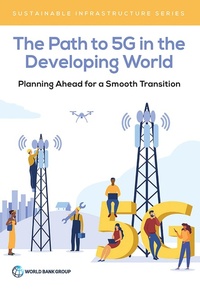
The Path to 5G in the Developing World
Planning Ahead for a Smooth Transition to the Fifth Generation of Mobile Technology
Published on 3. July 2024
Book
Paperback/Softback
200 pages
978-1-4648-1604-8 (ISBN)
Description
The global race for 5G has seen countries riding a new wave of wireless technology. 5G is the next-generation mobile communication technology that enables a different level of performance and innovative applications from the 4G mobile communication that is currently in use by most people in the world. It is anticipated for a global commercial launch by 2020. For some countries, 5G services may seem to be in a distant future, for others, it's the initiation into the Fourth Industrial Revolution. With estimated economic value of 12.3 trillion dollars in global economic output and the addition of 20 million jobs to the global economy by 2035, 5G has the potential for immense impact on job creation, productivity, and competitiveness. When fully implemented, the disruptive potential of 5G threatens to make irreversible the digital divide between early and late adopters. Should countries that have yet to turn off 3G services be concerned? Emerging markets have unique characteristics that set them apart from frontier economies: rapid growth in mobile connectivity, nascent markets for fixed infrastructure, and a younger population. These factors are poised to increase adoption of mobile broadband and demand for better connection and services. In other words, 5G may be a powerful force that will help countries leapfrog technologies and accelerate towards meeting their Sustainable Development Goals (SDGs).If then, what are the necessary steps for developing countries to successfully ride the 5G wave at the opportune moment? The potential dual nature of the impact of 5G on developing countries calls for an accurate diagnosis on its implications. This report explores the latest innovation in wireless technology, the tremendous opportunities that could be reaped from adopting 5G, the costs and challenges associated with 5G, and policy considerations for developing countries to most effectively deploy and utilize the 5G network.
More details
Series
Language
English
Place of publication
Washington
United States
Target group
Professional and scholarly
Product notice
Paperback (trade)
Unsewn / adhesive bound
Dimensions
Height: 251 mm
Width: 173 mm
Thickness: 10 mm
Weight
336 gr
ISBN-13
978-1-4648-1604-8 (9781464816048)
Copyright in bibliographic data and cover images is held by Nielsen Book Services Limited or by the publishers or by their respective licensors: all rights reserved.
Schweitzer Classification
Persons
The World Bank came into formal existence in 1945 following the international ratification of the Bretton Woods agreements. It is a vital source of financial and technical assistance to developing countries around the world. The organization's activities are focused on education, health, agriculture and rural development, environmental protection, establishing and enforcing regulations, infrastructure development, governance and legal institutions development. The World Bank is made up of two unique development institutions owned by its 185 Member Countries. The International Bank for Reconstruction and Development (IBRD) focuses on middle income and creditworthy poor countries and the International Development Association (IDA), which focuses on the poorest countries in the world.