

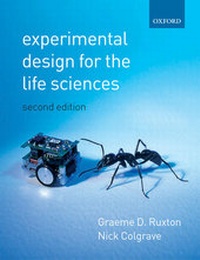
Experimental Design for the Life Sciences
2nd Edition
Published on 15. March 2006
Book
Paperback/Softback
184 pages
978-0-19-928511-2 (ISBN)
Description
At the core of good research lies the careful design of experiments. Yet all too often a successful design comes only after a painful trial-and-error process, wasting valuable time and valuable resources. Experimental Design for the Life Sciences teaches the reader how to effectively design experiments, to ensure that today's students are equipped with the skills they need to be the researchers of tomorrow. With a refreshingly approachable and articulate style, the book explains the essential elements of experimental design in clear, practical terms, so that the reader can grasp and apply even the most challenging concepts, including power analysis and pseudoreplication. Emphasising throughout the inter-relatedness of experimental design, statistics, and ethical considerations, the book ensures that the reader really understands experimental design in the broader context of biological research, using examples drawn from a range of fields across the biosciences to show to the student how the theory is applied in active research.Above all, Experimental Design for the Life Sciences shows how good experimental design is about clear thinking and biological understanding, not mathematical or statistical complexity - putting it at the heart of any biosciences student's education.
Online Resource Centre: The companion web site features: For lecturers: * Figures from the book available to download, to facilitate lecture preparation For students and lecturers: * Discussion forum, promoting the discussion of experimental design in real research, to stimulate active learning on the part of the student.
Online Resource Centre: The companion web site features: For lecturers: * Figures from the book available to download, to facilitate lecture preparation For students and lecturers: * Discussion forum, promoting the discussion of experimental design in real research, to stimulate active learning on the part of the student.
Reviews / Votes
At last a text which clearly and comprehensively takes the student through the mechanisms of sound practice and the pitfalls of less sound experimental design in the biological sciences. Although aimed directly at the undergraduate life sciences student it would also be useful to those studying both above and below this level. Journal of Biological Education, Autumn 2006 This is an excellent book for learning how to approach the design of experimental and, indeed, observational work. It avoids the usual inclusion of statistical detail that turns many students off while retaining all the key issues that are necessary for planning studies that produce good science. I commend this book to all those who struggle to get students to think seriously about designing good scientific studies. Higher Education Academy, Bioscience e-Journal, June 2006.More details
Edition
2nd Revised edition
Language
English
Place of publication
Oxford
United Kingdom
Target group
College/higher education
Undergraduate students in the life sciences taking courses in experimental design, data analysis, quantitative methods, or scientific methodology. The book will also appeal to more experienced scientists who need a succinct reference guide to experimental design.
Edition type
Revised edition
Illustrations
40 line drawings
Dimensions
Height: 246 mm
Width: 189 mm
Thickness: 10 mm
Weight
363 gr
ISBN-13
978-0-19-928511-2 (9780199285112)
Copyright in bibliographic data and cover images is held by Nielsen Book Services Limited or by the publishers or by their respective licensors: all rights reserved.
Schweitzer Classification
Other editions
New editions
Graeme D. Ruxton | Nick Colegrave
Experimental Design for the Life Sciences
Book
11/2010
3rd Edition
Oxford University Press
€30.96
Article is exhausted; no reprint
Previous edition
Graeme D. Ruxton
Experimental Design for the Life Sciences
Book
03/2003
Oxford University Press
€21.03
Article exhausted; check for reprint
Persons
Content
PREFACE - HOW TO USE THIS BOOK; 1. Why care about design?; 2. Starting with a well defined question; 3. Between-individual variation, replication and sampling; 4. Different experimental designs; 5. Taking measurements; 6. Final thoughts; BIBLIOGRAPHY