

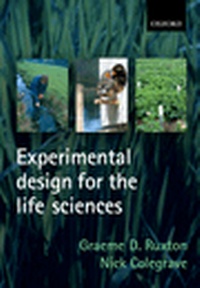
Experimental Design for the Life Sciences
Published on 1. March 2003
Book
Paperback/Softback
132 pages
978-0-19-925232-9 (ISBN)
Description
This book aims to teach the reader how to design effective experiments. The overwhelming majority of life scientists design experiments. However they tend to approach design in an informal ad hoc way, improving their techniques in the light of experience. This book aims to provide the junior scientist a with a reader-friendly way to learn how to design effective experiments without going through a painful trial and error process. For more experienced scientists, the text should also function to stimulate them to think about the way they design experiments, and perhaps lead them to design more effective experiments in future. Concepts, such as power analysis and pseudoreplication, that many experienced scientists consider to be mystifying or difficult, are explained in clear and practical terms. The emphasis throughout is to demonstrate that good experimental design is about clear thinking and biological understanding, not mathematical or statistical complexity. Companion Web Site All the figures from the book will be available to download free from the companion web site at www oup.com/uk/best.textbooks/biology/ruxtoncolegrave
Reviews / Votes
...an invaluable introduction to statistical analysis of data...I would recommend this text to those embarking on PhD studies as it emphasises the need for planning before an experiment is performed. Biologist (2004) 51 (3) ... this would be a good book with which to coax mathophobic students into good habits. This book is equation free and takes a very, very gentle approach. TRENDS in Ecology and Evolution They approach each topic logically, and with excellent examples and case studies ... An important aspect of this book is the inclusion of key definitions ... I enjoyed reading this book, appreciated the unique approach, and have recommended it to my students as supplementary reading. Experimental Design for the Life Sciences has found a permanent place in my library of experimental design material. BioScience It may well prove to be the most useful textbook in biology for years. Trond Amundsen, Norwegian University of Science and Technology It's this determination to make this vital topic available to all that sets this book apart. This, along with the simplicity of the structure and the very reasonable price means that this should be seen as a vital must-by in this topic area. TEG NEWSMore details
Language
English
Place of publication
Oxford
United Kingdom
Target group
College/higher education
Illustrations
num. fig.
numerous figures
ISBN-13
978-0-19-925232-9 (9780199252329)
Copyright in bibliographic data and cover images is held by Nielsen Book Services Limited or by the publishers or by their respective licensors: all rights reserved.
Schweitzer Classification
Other editions
New editions
Graeme D. Ruxton
Experimental Design for the Life Sciences
Book
03/2006
2nd Edition
Oxford University Press
€24.77
Article exhausted; check for reprint
Persons
Content
Preface - How to use this book; 1. Why care about design?; 2. Starting with a well defined question; 3. Between-individual variation, replication and sampling; 4. Different experimental designs; 5. Taking measurements; 6. Final thoughts; Bibliography