

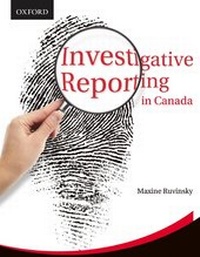
Investigative Reporting in Canada
Published on 6. December 2007
Book
Paperback/Softback
324 pages
978-0-19-542381-5 (ISBN)
Description
This book explores investigative reporting in Canada through a series of thirteen case studies.
Part I, Tracking the Truth presents eight case studies of the classis "crusading" variety, stories meant 'to comfort the afflicted and afflict the comfortable,' to use an-often-quoted phrase. This kind of investigation tries to alert the public and ultimately so outrage the collective conscience to force remedial action to right the wrong, now no longer shrouded from public view. The section opens with the investigation of missing women from the Vancouver's downtown eastside. Three environmental stories follow that challenge the widespread acceptance of environmental degradation as "normal." The last four stories in this section deal with thorny issues that expose shifts in public opinion: the federal government's ongoing efforts to control public protest; telemarketing fraud; the increasing corporate influence on the work of academics; and the bureaucratic red tap that precludes the adoption of wards of the state.
Part II Documenting the Truth demonstrates why computer assisted reporting is the latest advance in the techniques of investigative journalism. These five case studies show how spreadsheet and database programs are being used by investigative journalists to make possible stories were once impossible because of the sheer weight of the number crunching involved.
Part III Talking Journalism features interviews with four prominent journalists: Cecil Rosner, David McKie, Elaine Dewar, and Juliane Sher.
Part I, Tracking the Truth presents eight case studies of the classis "crusading" variety, stories meant 'to comfort the afflicted and afflict the comfortable,' to use an-often-quoted phrase. This kind of investigation tries to alert the public and ultimately so outrage the collective conscience to force remedial action to right the wrong, now no longer shrouded from public view. The section opens with the investigation of missing women from the Vancouver's downtown eastside. Three environmental stories follow that challenge the widespread acceptance of environmental degradation as "normal." The last four stories in this section deal with thorny issues that expose shifts in public opinion: the federal government's ongoing efforts to control public protest; telemarketing fraud; the increasing corporate influence on the work of academics; and the bureaucratic red tap that precludes the adoption of wards of the state.
Part II Documenting the Truth demonstrates why computer assisted reporting is the latest advance in the techniques of investigative journalism. These five case studies show how spreadsheet and database programs are being used by investigative journalists to make possible stories were once impossible because of the sheer weight of the number crunching involved.
Part III Talking Journalism features interviews with four prominent journalists: Cecil Rosner, David McKie, Elaine Dewar, and Juliane Sher.
More details
Language
English
Place of publication
Toronto
Canada
Target group
Professional and scholarly
Dimensions
Height: 230 mm
Width: 178 mm
Thickness: 20 mm
Weight
657 gr
ISBN-13
978-0-19-542381-5 (9780195423815)
Copyright in bibliographic data and cover images is held by Nielsen Book Services Limited or by the publishers or by their respective licensors: all rights reserved.
Schweitzer Classification
Person
Maxine Ruvinsky is a former journalist and professor of journalism. She is the author of two other Oxford University Press textbooks: Practical Grammar, 3e, 2014; and Reporting for the Media, Canadian Edition, 2011
Content
INTRODUCTION; PART ONE: TRACKING THE TRUTH: THE LITERATURE OF EXPOSURE; PART TWO: DOCUMENTING THE TRUTH: COMPUTER ASSISTED REPORTING; PART THREE: TALKING INVESTIGATIVE JOURNALISM; APPENDICES; REFERENCES; INDEX