

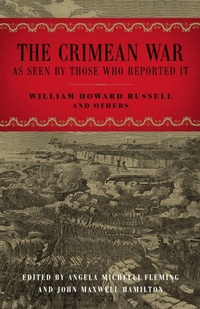
The Crimean War
As Seen by Those Who Reported It
Will be published approx. on 30. May 2009
Book
Hardback
240 pages
978-0-8071-3445-0 (ISBN)
Description
Armed with only a telescope, a watch, and a notebook he retrieved from a dead soldier, William Howard Russell spent twenty-two months reporting from the trenches for the Times of London during the Crimean War. A novice in a new field of journalism -- war reporting -- when he first set off for Crimea in 1854, the young Irishman returned home a veteran of three bloody battles, having survived the siege of Sebastopol and watched a colleague die of cholera. Russell's fine eye for detail electrified readers, and his remarkably colourful and hugely significant accounts of battles provided those at home -- for the first time ever -- with a realistic picture of the brutality of war. The Crimean War, originally published in 1856 under the title The Complete History of the Russian War, presents a selection of Russell's dispatches -- as well as those of other embedded reporters -- providing a ground-eye view of the conflict as depicted in British newspapers.
Fought on the southern tip of the Crimea from 1853 to 1856, the Crimean War raged on far longer than either side expected -- largely because of mismanagement and disease: more soldiers died from cholera, typhus, typhoid, dysentery, and scurvy than battle wounds. Russell's biting criticisms of incompetent military authorities and an antiquated military system contributed to the collapse of the contemporary ruling party in Britain. In his reports, Russell wrote extensively about inept medical care for the wounded, which he termed ""human barbarity."" Thanks to compelling accounts by Russell and others, authorities allowed Florence Nightingale to enter the war zone and nurse troops back to health.
The Crimean War contains reports from military men who acted as part-time reporters, articles by professional journalists, and letters from others at the front that newspapers back home later published. Rapidly pulled together by American publisher John G. Wells, the volume presents a fascinating contemporary analysis of the war by those on the ground.
This reissue offers a new introduction by Angela Michelli Fleming and John Maxwell Hamilton that places these reports in context and highlights the critical role they played during a pivotal point in European history. The first first-hand accounts of the realities of war, these dispatches set the tone for future independent war reporting.
Fought on the southern tip of the Crimea from 1853 to 1856, the Crimean War raged on far longer than either side expected -- largely because of mismanagement and disease: more soldiers died from cholera, typhus, typhoid, dysentery, and scurvy than battle wounds. Russell's biting criticisms of incompetent military authorities and an antiquated military system contributed to the collapse of the contemporary ruling party in Britain. In his reports, Russell wrote extensively about inept medical care for the wounded, which he termed ""human barbarity."" Thanks to compelling accounts by Russell and others, authorities allowed Florence Nightingale to enter the war zone and nurse troops back to health.
The Crimean War contains reports from military men who acted as part-time reporters, articles by professional journalists, and letters from others at the front that newspapers back home later published. Rapidly pulled together by American publisher John G. Wells, the volume presents a fascinating contemporary analysis of the war by those on the ground.
This reissue offers a new introduction by Angela Michelli Fleming and John Maxwell Hamilton that places these reports in context and highlights the critical role they played during a pivotal point in European history. The first first-hand accounts of the realities of war, these dispatches set the tone for future independent war reporting.
More details
Series
Language
English
Place of publication
Baton Rouge
United States
Target group
Professional and scholarly
Product notice
sewn/stitched
Cloth over boards
With dust jacket
Dimensions
Height: 223 mm
Width: 144 mm
Thickness: 25 mm
Weight
428 gr
ISBN-13
978-0-8071-3445-0 (9780807134450)
Copyright in bibliographic data and cover images is held by Nielsen Book Services Limited or by the publishers or by their respective licensors: all rights reserved.
Schweitzer Classification
Persons
Angela Michelli Fleming, an award-winning history student at LSU, works as a research assistant in the Manship School of Mass Communication.
John Maxwell Hamilton, a longtime public radio commentator, has reported in the United States and abroad for ABC Radio, the Christian Science Monitor, and others. He is dean and LSU Foundation Hopkins P. Breazeale Professor at the Manship School of Mass Communication at Louisiana State University and the author or coauthor of five books.
John Maxwell Hamilton, a longtime public radio commentator, has reported in the United States and abroad for ABC Radio, the Christian Science Monitor, and others. He is dean and LSU Foundation Hopkins P. Breazeale Professor at the Manship School of Mass Communication at Louisiana State University and the author or coauthor of five books.