

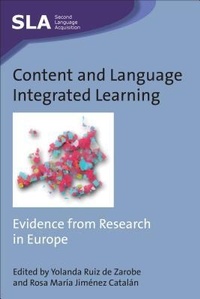
Content and Language Integrated Learning
Evidence from Research in Europe
Will be published approx. on 11. May 2009
Book
Hardback
256 pages
978-1-84769-166-8 (ISBN)
Description
This book contributes to the growth of interest in Content and Language Integrated Learning (CLIL), an approach to second/foreign language learning that requires the use of the target language to learn content. Within the framework of European strategies to promote multilingualism, CLIL has begun to be used extensively in a variety of language learning contexts, and at different educational systems and language programmes. This book brings together critical analyses on theoretical and implementation issues of Content and Language Integrated Learning, and empirical studies on the effectiveness of this type of instruction on learners' language competence. The basic theoretical assumption behind this book is that through successful use of the language to learn content, learners will develop their language proficiency more effectively while they learn the academic content specified in the curricula.
Reviews / Votes
This volume promises to become a landmark in the evolution of CLIL in Europe. The authors provide a wealth of research evidence on all aspects of language learning in CLIL programs. Their findings will reassure CLIL educators about the benefits of CLIL and at the same time provoke valuable discussion about the next steps to be taken in developing even more effective forms of CLIL. Research does not have all the answers, but it can certainly stimulate reflection and discussion as stakeholders seek answers to challenging issues in CLIL and this book will definitely catalyze valuable discussions. -- Fred Genesee, Professor, Department of Psychology, McGill University, Montreal (Canada) This book is a very timely contribution to our understanding of CLIL. It offers valuable insights about theoretical and implementation issues and a much needed research-based account of the effects of Content and Language Integrated Learning. The volume is also a very welcome addition to studies on the acquisition of second language phonetics, lexicon, grammar and discourse in foreign language contexts. -- Jasone Cenoz, Professor of Education, University of the Basque Country, Spain Content and Language Integrated Learning: Evidence from Research in Europe is a key step in establishing an evidence-base for CLIL. In this book, the authors examine the processes and outcomes of CLIL practice. They reflect on shared current concerns in the language teaching sphere about the potential of CLIL in supporting, or otherwise challenging, language learning practice. Although there is 'no CLIL blueprint ready for export', the contexts described here, and the findings of research and enquiry, are relevant to those working in other settings where language and authentic content are combined in the curriculum. -- David Marsh, University of Jyvaeskylae, Finland De Zarobe and Catalan have edited the work of 18 contributors into an anthology of critical research studies of L2 acquisition in CLIL and non-CLIL settings that provide data to support some aspects of CLIL, challenge others, and suggest ideas for future studies. -- Linda Kay Davis, Austin Peay State University * The Modern Language Journal 95 (2011) *More details
Series
Language
English
Place of publication
Bristol
United Kingdom
Publishing group
Channel View Publications Ltd
Target group
College/higher education
Professional and scholarly
Product notice
sewn/stitched
Cloth over boards
Dimensions
Height: 234 mm
Width: 156 mm
Thickness: 19 mm
Weight
511 gr
ISBN-13
978-1-84769-166-8 (9781847691668)
Copyright in bibliographic data and cover images is held by Nielsen Book Services Limited or by the publishers or by their respective licensors: all rights reserved.
Schweitzer Classification
Other editions
Additional editions
Yolanda Ruiz de Zarobe | Rosa Maria Jimenez Catalan
Content and Language Integrated Learning
Evidence from Research in Europe
Book
05/2009
Multilingual Matters
€48.40
Shipment within 10-20 days
Complete work / Part of the work

David Singleton | Simone E. Pfenninger
Second Language Acquisition Collection 3 (Vols 41-60)
Book
Multilingual Matters
€1,032.48
The article will not be published
Persons
Yolanda Ruiz de Zarobe received her PhD in Linguistics from the University of the Basque Country (Spain). She is Associate Professor of Language and Linguistics at the University of the Basque Country, Spain. Her research interests are second and third language acquisition. Her recent publications have focused on the acquisition of morphosyntactic aspects of English as a third language, multilingualism, and issues related to Content and Language Integrated Learning.
Rosa Maria Jimenez Catalan is Associate Professor of Applied Linguistics at the University of La Rioja. She has a PH.D in English Philology Studies and is the author of articles and books on English second language learning and teaching. Her current research interests include vocabulary acquisition and teaching and the analysis of the effect of gender and type of instruction on vocabulary development in English as a foreign language.
Rosa Maria Jimenez Catalan is Associate Professor of Applied Linguistics at the University of La Rioja. She has a PH.D in English Philology Studies and is the author of articles and books on English second language learning and teaching. Her current research interests include vocabulary acquisition and teaching and the analysis of the effect of gender and type of instruction on vocabulary development in English as a foreign language.
Content
Foreword - David Marsh
Introduction - Yolanda Ruiz de Zarobe and Rosa Maria Jimenez Catalan
Part 1. Theoretical and Implementation Issues of Content and Language Integrated Learning
Chapter 1. Spanish CLIL: Research and Official Actions - Almudena Fernandez Fontecha
Chapter 2. Effective CLIL Programmes - Teresa Naves
Chapter 3. Developing Theories of Practices in CLIL: CLIL as Postmethod Pedagogies? - Rolf Wiesemes
Part 2. Studies in Content and Language Integrated Learning
Chapter 4. Testing the Effectiveness of CLIL in Foreign Language Contexts: The Assessment of English Pronunciation - Francisco Gallardo del Puerto, Esther Gomez Lacabex and Maria Luisa Garcia Lecumberri
Chapter 5. The Receptive Vocabulary of EFL Learners in Two Instructional Contexts: CLIL vs. Non-CLIL Instruction - Rosa Maria Jimenez Catalan and Yolanda Ruiz de Zarobe
Chapter 6. Young Learners' L2 Word Association Responses in Two Different Learning Contexts - Soraya Moreno Espinosa
Chapter 7. The Role of Spanish L1 in the Vocabulary Use of CLIL and Non-CLIL EFL Learners - Maria del Pilar Agustin Llach
Chapter 8. Themes, and Vocabulary in CLIL and Non-CLIL Instruction - Julieta Ojeda Alba
Chapter 9. Tense and Agreement Morphology in the Interlanguage of Basque/Spanish Bilinguals: CLIL vs. Non-CLIL - Izaskun Villareal Olaizola and Maria del Pilar Garcia Mayo
Chapter 10. The Acquisition of English Syntax by CLIL Learners in the Basque Country - Maria Martinez Adrian and M. Junkal Gutierrez Mangado
Chapter 11. Communicative Competence and the CLIL Lesson - Christiane Dalton-Puffer
Chapter 12. CLIL in Social Science Classrooms: Analysis of Spoken and Written Productions - Rachel Whittaker and Ana Llinares
Introduction - Yolanda Ruiz de Zarobe and Rosa Maria Jimenez Catalan
Part 1. Theoretical and Implementation Issues of Content and Language Integrated Learning
Chapter 1. Spanish CLIL: Research and Official Actions - Almudena Fernandez Fontecha
Chapter 2. Effective CLIL Programmes - Teresa Naves
Chapter 3. Developing Theories of Practices in CLIL: CLIL as Postmethod Pedagogies? - Rolf Wiesemes
Part 2. Studies in Content and Language Integrated Learning
Chapter 4. Testing the Effectiveness of CLIL in Foreign Language Contexts: The Assessment of English Pronunciation - Francisco Gallardo del Puerto, Esther Gomez Lacabex and Maria Luisa Garcia Lecumberri
Chapter 5. The Receptive Vocabulary of EFL Learners in Two Instructional Contexts: CLIL vs. Non-CLIL Instruction - Rosa Maria Jimenez Catalan and Yolanda Ruiz de Zarobe
Chapter 6. Young Learners' L2 Word Association Responses in Two Different Learning Contexts - Soraya Moreno Espinosa
Chapter 7. The Role of Spanish L1 in the Vocabulary Use of CLIL and Non-CLIL EFL Learners - Maria del Pilar Agustin Llach
Chapter 8. Themes, and Vocabulary in CLIL and Non-CLIL Instruction - Julieta Ojeda Alba
Chapter 9. Tense and Agreement Morphology in the Interlanguage of Basque/Spanish Bilinguals: CLIL vs. Non-CLIL - Izaskun Villareal Olaizola and Maria del Pilar Garcia Mayo
Chapter 10. The Acquisition of English Syntax by CLIL Learners in the Basque Country - Maria Martinez Adrian and M. Junkal Gutierrez Mangado
Chapter 11. Communicative Competence and the CLIL Lesson - Christiane Dalton-Puffer
Chapter 12. CLIL in Social Science Classrooms: Analysis of Spoken and Written Productions - Rachel Whittaker and Ana Llinares