

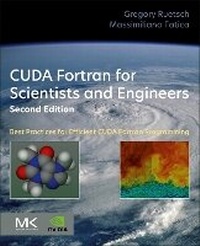
CUDA Fortran for Scientists and Engineers
Best Practices for Efficient CUDA Fortran Programming
2nd Edition
Published on 16. July 2024
Book
Paperback/Softback
350 pages
978-0-443-21977-1 (ISBN)
Description
CUDA Fortran for Scientists and Engineers: Best Practices for Efficient CUDA Fortran Programming shows how high-performance application developers can leverage the power of GPUs using Fortran, the familiar language of scientific computing and supercomputer performance benchmarking. The authors presume no prior parallel computing experience, and cover the basics along with best practices for efficient GPU computing using CUDA Fortran. In order to add CUDA Fortran to existing Fortran codes, they explain how to understand the target GPU architecture, identify computationally-intensive parts of the code, and modify the code to manage the data and parallelism and optimize performance - all in Fortran, without having to rewrite in another language.
Each concept is illustrated with actual examples so you can immediately evaluate the performance of your code in comparison.
This second edition provides much needed updates on how to efficiently program GPUs in CUDA Fortran. It can be used either as a tutorial on GPU programming in CUDA Fortran as well as a reference text.
Each concept is illustrated with actual examples so you can immediately evaluate the performance of your code in comparison.
This second edition provides much needed updates on how to efficiently program GPUs in CUDA Fortran. It can be used either as a tutorial on GPU programming in CUDA Fortran as well as a reference text.
More details
Edition
2nd edition
Language
English
Place of publication
San Francisco
United States
Publishing group
Elsevier Science & Technology
Target group
Professional and scholarly
Product notice
Paperback (trade)
Dimensions
Height: 235 mm
Width: 191 mm
Thickness: 23 mm
Weight
746 gr
ISBN-13
978-0-443-21977-1 (9780443219771)
Copyright in bibliographic data and cover images is held by Nielsen Book Services Limited or by the publishers or by their respective licensors: all rights reserved.
Schweitzer Classification
Other editions
Additional editions
Gregory Ruetsch | Massimiliano Fatica
CUDA Fortran for Scientists and Engineers
Best Practices for Efficient CUDA Fortran Programming
E-Book
07/2024
2nd Edition
Morgan Kaufmann
€113.00
Available for download
Previous edition
Gregory Ruetsch | Massimiliano Fatica
CUDA Fortran for Scientists and Engineers
Best Practices for Efficient CUDA Fortran Programming
Book
10/2013
Morgan Kaufmann
€63.13
Shipment within 15-20 days
Persons
Greg Ruetsch is a Senior Applied Engineer at NVIDIA, where he works on CUDA Fortran and performance optimization of HPC codes. He holds a Bachelor's degree in mechanical and aerospace engineering from Rutgers University and a Ph.D. in applied mathematics from Brown University. Prior to joining NVIDIA, he has held research positions at Stanford University's Center for Turbulence Research and Sun Microsystems Laboratories. Massimiliano Fatica is the Director of the HPC Benchmarking Group at NVIDIA where he works in the area of GPU computing (high-performance computing and clusters). He holds a laurea in Aeronautical Engineering and a PhD in Theoretical and Applied Mechanics from the University of Rome "La Sapienza?. Prior to joining NVIDIA, he was a research staff member at Stanford University where he worked at the Center for Turbulence Research and Center for Integrated Turbulent Simulations on applications for the Stanford Streaming Supercomputer.
Content
PART I: CUDA Fortran Programming
1. Introduction
2. Correctness, Accuracy, and Debugging
3. Performance Measurements and Metrics
4. Synchronization
5. Optimization
6. Multi-GPU Programming
7. Porting Tips and Techniques
8. Interfacing with CUDA C, OpenACC, and CUDA Libraries
PART II Case Studies
9. Monte Carlo Method
10. Finite Difference Method
11. Applications of the Fast Fourier TransformRay Tracing
1. Introduction
2. Correctness, Accuracy, and Debugging
3. Performance Measurements and Metrics
4. Synchronization
5. Optimization
6. Multi-GPU Programming
7. Porting Tips and Techniques
8. Interfacing with CUDA C, OpenACC, and CUDA Libraries
PART II Case Studies
9. Monte Carlo Method
10. Finite Difference Method
11. Applications of the Fast Fourier TransformRay Tracing