

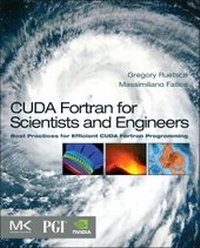
CUDA Fortran for Scientists and Engineers
Best Practices for Efficient CUDA Fortran Programming
Published on 24. October 2013
Book
Paperback/Softback
338 pages
978-0-12-416970-8 (ISBN)
Description
CUDA Fortran for Scientists and Engineers shows how high-performance application developers can leverage the power of GPUs using Fortran, the familiar language of scientific computing and supercomputer performance benchmarking. The authors presume no prior parallel computing experience, and cover the basics along with best practices for efficient GPU computing using CUDA Fortran.
To help you add CUDA Fortran to existing Fortran codes, the book explains how to understand the target GPU architecture, identify computationally intensive parts of the code, and modify the code to manage the data and parallelism and optimize performance. All of this is done in Fortran, without having to rewrite in another language. Each concept is illustrated with actual examples so you can immediately evaluate the performance of your code in comparison.
To help you add CUDA Fortran to existing Fortran codes, the book explains how to understand the target GPU architecture, identify computationally intensive parts of the code, and modify the code to manage the data and parallelism and optimize performance. All of this is done in Fortran, without having to rewrite in another language. Each concept is illustrated with actual examples so you can immediately evaluate the performance of your code in comparison.
Reviews / Votes
"This book is written for the Fortran programmer who wants to do real work on GPUs, not just stunts or demonstrations. The book has many examples, and includes introductory material on GPU programming as well as advanced topics such as data optimization, instruction optimization and multiple GPU programming. Placing the performance measurement chapter before performance optimization is key, since measurement drives the tuning and optimization process. All Fortran programmers interested in GPU programming should read this book." --Michael Wolfe, PGI Compiler EngineerMore details
Language
English
Place of publication
San Francisco
United States
Publishing group
Elsevier Science & Technology
Target group
Professional and scholarly
Professional scientists and engineers whose research codes are in Fortran; students studying parallel programming using Fortran.
Dimensions
Height: 235 mm
Width: 191 mm
Weight
700 gr
ISBN-13
978-0-12-416970-8 (9780124169708)
Copyright in bibliographic data and cover images is held by Nielsen Book Services Limited or by the publishers or by their respective licensors: all rights reserved.
Schweitzer Classification
Other editions
New editions
Gregory Ruetsch | Massimiliano Fatica
CUDA Fortran for Scientists and Engineers
Best Practices for Efficient CUDA Fortran Programming
Book
07/2024
2nd Edition
Morgan Kaufmann
€122.50
Shipment within 15-20 days
Additional editions
Gregory Ruetsch | Massimiliano Fatica
CUDA Fortran for Scientists and Engineers
Best Practices for Efficient CUDA Fortran Programming
E-Book
09/2013
1st Edition
Morgan Kaufmann
€39.95
Available for download
Persons
Greg Ruetsch is a Senior Applied Engineer at NVIDIA, where he works on CUDA Fortran and performance optimization of HPC codes. He holds a Bachelor's degree in mechanical and aerospace engineering from Rutgers University and a Ph.D. in applied mathematics from Brown University. Prior to joining NVIDIA, he has held research positions at Stanford University's Center for Turbulence Research and Sun Microsystems Laboratories. Massimiliano Fatica is the Director of the HPC Benchmarking Group at NVIDIA where he works in the area of GPU computing (high-performance computing and clusters). He holds a laurea in Aeronautical Engineering and a PhD in Theoretical and Applied Mechanics from the University of Rome "La Sapienza?. Prior to joining NVIDIA, he was a research staff member at Stanford University where he worked at the Center for Turbulence Research and Center for Integrated Turbulent Simulations on applications for the Stanford Streaming Supercomputer.
Content
I CUDA Fortran Programming 1. Introduction 2. Performance Measurement and Metrics 3. Optimization 4. Multi-GPU ProgrammingII Case Studies 5. Monte Carlo Method 6. Finite Difference Method 7. Applications of Fast Fourier TransformIII Appendices A. Tesla Specifications B. System and Environment Management C. Calling CUDA C from CUDA Fortran D. Source Code