

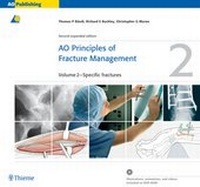
AO Principles of Fracture Management
Vol. 1: Principles, Vol. 2: Specific fractures
2nd Edition
Published on 21. February 2007
Book
Hardback
1112 pages
978-3-13-117442-0 (ISBN)
Description
Hear the authors discuss AO Principles of Fracture Management.
Volume 1 focuses on the basic knowledge and the principles of fracture management, covering biomechanics, tools for preoperative planning, soft-tissue management, different methods of reduction and fixation, and implants. This volume also addresses new issues pertaining to internal/external fixation, damage-control surgery, minimally invasive surgery, and biotechnology.
Volume 2 presents the management of specific fractures in different anatomic areas. A separate chapter is devoted to each area to discuss the assessment of injuries, surgical anatomy, preoperative planning, surgical treatment, and postoperative care. The authors also highlight common pitfalls and complications.
There are now more than 2,000 high-quality illustrations that vividly demonstrate key concepts of management. The accompanying DVD provides the entire text from the books and instructional AO teaching videos that demonstrate techniques and reinforce important teaching points. Electronic bookmarks and keyword search functions simplify navigation of the DVD. Links to abstracts and references on the Internet enable the user to fully utilize the wealth of information provided in this multimedia resource.
AO Principles of Fracture Management is an essential resource for orthopaedists, trauma surgeons, and residents in these specialties.
Volume 1 focuses on the basic knowledge and the principles of fracture management, covering biomechanics, tools for preoperative planning, soft-tissue management, different methods of reduction and fixation, and implants. This volume also addresses new issues pertaining to internal/external fixation, damage-control surgery, minimally invasive surgery, and biotechnology.
Volume 2 presents the management of specific fractures in different anatomic areas. A separate chapter is devoted to each area to discuss the assessment of injuries, surgical anatomy, preoperative planning, surgical treatment, and postoperative care. The authors also highlight common pitfalls and complications.
There are now more than 2,000 high-quality illustrations that vividly demonstrate key concepts of management. The accompanying DVD provides the entire text from the books and instructional AO teaching videos that demonstrate techniques and reinforce important teaching points. Electronic bookmarks and keyword search functions simplify navigation of the DVD. Links to abstracts and references on the Internet enable the user to fully utilize the wealth of information provided in this multimedia resource.
AO Principles of Fracture Management is an essential resource for orthopaedists, trauma surgeons, and residents in these specialties.
Reviews / Votes
The AO Foundation's expanded second edition of AO Principles of Fracture Management has proved hugely successful and even better than the first edition...Overall, both volumes are well written and organized. A 3-page abbreviations section appears at the beginning of each volume and a beautiful glossary at the end. The index is easy to use, and the bold page references allow quick identification of relevant illustrations. Each chapter is concise and of appropriate length. The text is large and the font easy to read. A particularly unique feature is that important teaching points and pearls are separately highlighted in blue text and clearly identified with a bullet. Furthermore, each chapter contains an appropriate number of high-quality, detailed color illustrations, figures, or algorithms (2,100 total) that are easy to comprehend and that adequately complement the subject material. In summary, AO Principles of Fracture Management is a timely and dramatic upgrade from its predecessor. Both volumes have been extensively rewritten and expanded and together should serve as an invaluable learning tool and reference for residents, trauma fellows, and practicing orthopaedists...Highly recommend[ed]...for any orthopaedic surgeon caring for the patient with trauma.--JAMAPraise for the critically acclaimed first edition: "Provides all the core content and background information of the AO course in a format that is easy to refer to...superbly organized and well illustrated...As a course manual alone, this book is invaluable, but the combination of the book, the CD-ROMs, and the web access makes it one of the most revolutionary and innovative textbooks currently available...an excellent source of information...A superb work...I strongly recommend it to anyone involved in orthopaedic traumatology, from the resident to the established specialist."--Journal of Bone and Joint Surgery
More details
Other editions
New editions
Richard Buckley | Christopher G. Moran | Theerachai Apivatthakakul
AO Principles of Fracture Management
Vol. 1: Principles, Vol. 2: Specific fractures
Book
12/2017
3rd Edition
Thieme
€419.99
Article exhausted; check different version
Previous edition

Thomas P. Ruedi | Richard Buckley | Christopher Moran
Ao Principles of Fracture Management, Books and DVD
Book
02/2007
2nd Edition
Thieme Publishers
€607.14
Article exhausted; check for reprint
Persons
Content
Contents
Volume 1:
1 AO philosophy and basic principles
1.1 AO philosophy and evolution
1.2 Biology and biomechanics in bone healing
1.3 Implants and materials in fracture fixation
1.4 Introduction to biotechnology
1.5 Fracture classification
1.6 Soft-tissue injury: pathophysiology, evaluation, and classification
2 Decision making and planning
2.1 The patient and the injury: decision making in trauma surgery
2.2 Diaphyseal fractures: principles
2.3 Articular fractures: principles
2.4 Preoperative planning
3 Reduction, approaches, and fixation techniques
3.1 Reduction and approaches
3.2 Techniques of absolute stability
3.3 Techniques of relative stability
4 General topics
4.1 Polytrauma: pathophysiology, priorities, and management
4.2 Open fractures
4.3 Soft-tissue loss: principles of management
4.4 Pediatric fractures
4.5 Antibiotic prophylaxis
4.6 Thromboembolic prophylaxis
4.7 Postoperative management: general considerations
4.8 Osteoporosis
5 Complications
5.1 Malunion
5.2 Aseptic nonunion
5.3 Acute infection
5.4 Chronic infection and infected nonunion
Volume 2:
6 Specific fractures
6.1 Scapula and clavicle
6.2 Humerus
6.3 Forearm and hand
6.4 Pelvic ring
6.5 Acetabulum
6.6 Femur
6.7 Patella
6.8 Tibia
6.9 Malleoli
6.10 Foot
6.11 Spine
Volume 1:
1 AO philosophy and basic principles
1.1 AO philosophy and evolution
1.2 Biology and biomechanics in bone healing
1.3 Implants and materials in fracture fixation
1.4 Introduction to biotechnology
1.5 Fracture classification
1.6 Soft-tissue injury: pathophysiology, evaluation, and classification
2 Decision making and planning
2.1 The patient and the injury: decision making in trauma surgery
2.2 Diaphyseal fractures: principles
2.3 Articular fractures: principles
2.4 Preoperative planning
3 Reduction, approaches, and fixation techniques
3.1 Reduction and approaches
3.2 Techniques of absolute stability
3.3 Techniques of relative stability
4 General topics
4.1 Polytrauma: pathophysiology, priorities, and management
4.2 Open fractures
4.3 Soft-tissue loss: principles of management
4.4 Pediatric fractures
4.5 Antibiotic prophylaxis
4.6 Thromboembolic prophylaxis
4.7 Postoperative management: general considerations
4.8 Osteoporosis
5 Complications
5.1 Malunion
5.2 Aseptic nonunion
5.3 Acute infection
5.4 Chronic infection and infected nonunion
Volume 2:
6 Specific fractures
6.1 Scapula and clavicle
6.2 Humerus
6.3 Forearm and hand
6.4 Pelvic ring
6.5 Acetabulum
6.6 Femur
6.7 Patella
6.8 Tibia
6.9 Malleoli
6.10 Foot
6.11 Spine