

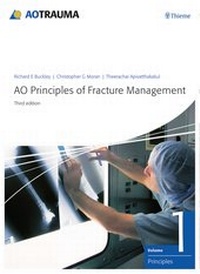
AO Principles of Fracture Management
Vol. 1: Principles, Vol. 2: Specific fractures
3rd Edition
Published on 13. December 2017
Book
Hardback
1120 pages
978-3-13-242309-1 (ISBN)
Description
The AO Principles of Fracture Management has served many generations of surgeons around the world as the source of knowledge and essential reference in the field of orthopedic trauma surgery. The fundamental principles of fracture surgery have not changed in 60 years, but the biological and clinical knowledge, as well as technological advancements have extended new possibilities in surgical treatment and offered surgeons the opportunity to explore new ways of applying the AO principles.
The new third edition of this book has been expanded to include new knowledge and explore state-of-the-art technology. It also addresses pressing challenges that face orthopedic surgeons today, such as the exponential rise in fragility fractures resulting from demographic changes and an aging population. The book aims to help surgeons to successfully rise to such challenges.
Key features include:
Contributions from more than 50 highly renowned surgeons, scientists, and medical professionals
More than 2,100 high-quality illustrations and images, as well as access to over 250 video presentations
New chapters on periprosthetic fractures, knee dislocations, fragility fractures and orthogeriatric care and additional information on operating room setup and planning
Immediate access to AO's continually evolving range of online educational offerings via QR codes for mobile devices including animations, webcasts, webinars, lectures, AO Surgery Reference, AOSTART and more
AOTrauma is pleased to bring you a new expanded, comprehensive, and updated edition of the AO Principles of Fracture Management for residents, fellows, course participants and faculty, Trauma and Orthopedic surgeons, and operating room personnel.
More details
Language
English
Place of publication
Stuttgart
Germany
Target group
Professional and scholarly
Ärzte
Edition type
New edition
Illustrations
2500 Abbildungen
Beilage: Videos - 2500 Illustrations, unspecified
Dimensions
Height: 28 cm
Width: 21 cm
Weight
4264 gr
ISBN-13
978-3-13-242309-1 (9783132423091)
Schweitzer Classification
Other editions
Additional editions
Richard Buckley | Christopher G. Moran | Theerachai Apivatthakakul
AO Principles of Fracture Management
Vol. 1: Principles, Vol. 2: Specific fractures
E-Book
12/2017
3rd Edition
Thieme
€499.99
Available for download
Richard Buckley | Christopher G. Moran | Theerachai Apivatthakakul
AO Principles of Fracture Management
Vol. 1: Principles, Vol. 2: Specific fractures
Book
12/2017
3rd Edition
Thieme
€500.00
Shipment within 5-7 days

Richard Buckley | Christopher G. Moran | Theerachai Apivatthakakul
AO Principles of Fracture Management
Vol. 1: Principles, Vol. 2: Specific fractures
E-Book
12/2017
3rd Edition
Thieme
€499.99
Available for download
Previous edition

Thomas Rüedi | Richard E. Buckley | Christopher G. Moran
AO Principles of Fracture Management
Vol. 1: Principles, Vol. 2: Specific fractures
Book
02/2007
2nd Edition
Thieme
€399.99
Article exhausted; check for reprint
Content
Volume 1-Principles
AO philosophy and basic principles
1.1 AO philosophy and evolution
1.2 Biology and biomechanics in bone healing
1.3 Implants and biotechnology
1.4 Fracture classification
1.5 Soft-tissue injury: pathophysiology, evaluation, and classification
Decision making and planning
2.1 The patient and the injury: decision making in trauma surgery
2.2 Diaphyseal fractures: principles
2.3 Articular fractures: principles
2.4 Preoperative planning
Reduction, approaches, and fixation techniques
Reduction and approaches
3.1.1 Surgical reduction
3.1.2 Approaches and intraoperative handling of soft tissues
3.1.3 Minimally invasive osteosynthesis
Techniques of absolute stability
3.2.1 Screws
3.2.2 Plates
3.2.3 Tension band principle
Techniques of relative stability
3.3.1 Intramedullary nailing
3.3.2 Bridge plating
3.3.3 External fixator
3.3.4 Locking plates
General topics
4.1 Polytrauma: pathophysiology, priorities, and management
4.2 Open fractures
4.3 Soft-tissue loss: principles of management
4.4 Pediatric fractures
4.5 Antibiotic prophylaxis
4.6 Thromboembolic prophylaxis
4.7 Postoperative management: general considerations
4.8 Fragility fractures and orthogeriatric care
4.9 Imaging and radiation hazards
Complications
5.1 Malunion
5.2 Aseptic nonunion
5.3 Acute infection
5.4 Chronic infection and infected nonunion
Volume 2-Specific fractures
Scapula and clavicle
6.1.1 Scapula
6.1.2 Clavicle
Humerus
6.2.1 Humerus, proximal
6.2.2 Humerus, shaft
6.2.3 Humerus, distal
Forearm and hand
6.3.1 Proximal forearm and complex elbow injuries
6.3.2 Forearm, shaft
6.3.3 Distal radius and wrist
6.3.4 Hand
Pelvis and acetabelum
6.4 Pelvic ring
6.5 Acetabulum
Femur and periprosthetic fractures
6.6.1 Femur, proximal
6.6.2 Femur, shaft (including subtrochanteric fractures)
6.6.3 Femur, distal
6.6.4 Periprosthetic fractures
Knee
6.7.1 Patella
6.7.2 Knee dislocations
Tibia
6.8.1 Tibia, proximal
6.8.2 Tibia, shaft
6.8.3 Tibia, distal intraarticular (pilon)
Malleoli and foot
6.9 Malleoli
6.10.1 Hindfoot-calcaneus and talus
6.10.2 Midfoot and forefoot
AO philosophy and basic principles
1.1 AO philosophy and evolution
1.2 Biology and biomechanics in bone healing
1.3 Implants and biotechnology
1.4 Fracture classification
1.5 Soft-tissue injury: pathophysiology, evaluation, and classification
Decision making and planning
2.1 The patient and the injury: decision making in trauma surgery
2.2 Diaphyseal fractures: principles
2.3 Articular fractures: principles
2.4 Preoperative planning
Reduction, approaches, and fixation techniques
Reduction and approaches
3.1.1 Surgical reduction
3.1.2 Approaches and intraoperative handling of soft tissues
3.1.3 Minimally invasive osteosynthesis
Techniques of absolute stability
3.2.1 Screws
3.2.2 Plates
3.2.3 Tension band principle
Techniques of relative stability
3.3.1 Intramedullary nailing
3.3.2 Bridge plating
3.3.3 External fixator
3.3.4 Locking plates
General topics
4.1 Polytrauma: pathophysiology, priorities, and management
4.2 Open fractures
4.3 Soft-tissue loss: principles of management
4.4 Pediatric fractures
4.5 Antibiotic prophylaxis
4.6 Thromboembolic prophylaxis
4.7 Postoperative management: general considerations
4.8 Fragility fractures and orthogeriatric care
4.9 Imaging and radiation hazards
Complications
5.1 Malunion
5.2 Aseptic nonunion
5.3 Acute infection
5.4 Chronic infection and infected nonunion
Volume 2-Specific fractures
Scapula and clavicle
6.1.1 Scapula
6.1.2 Clavicle
Humerus
6.2.1 Humerus, proximal
6.2.2 Humerus, shaft
6.2.3 Humerus, distal
Forearm and hand
6.3.1 Proximal forearm and complex elbow injuries
6.3.2 Forearm, shaft
6.3.3 Distal radius and wrist
6.3.4 Hand
Pelvis and acetabelum
6.4 Pelvic ring
6.5 Acetabulum
Femur and periprosthetic fractures
6.6.1 Femur, proximal
6.6.2 Femur, shaft (including subtrochanteric fractures)
6.6.3 Femur, distal
6.6.4 Periprosthetic fractures
Knee
6.7.1 Patella
6.7.2 Knee dislocations
Tibia
6.8.1 Tibia, proximal
6.8.2 Tibia, shaft
6.8.3 Tibia, distal intraarticular (pilon)
Malleoli and foot
6.9 Malleoli
6.10.1 Hindfoot-calcaneus and talus
6.10.2 Midfoot and forefoot