

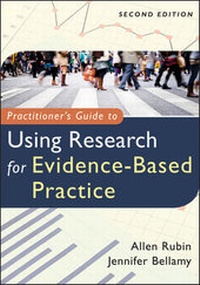
Practitioner's Guide to Using Research for Evidence-Based Practice
2nd Edition
Published on 7. September 2012
Book
Paperback/Softback
388 pages
978-1-118-13671-3 (ISBN)
Description
Written by a proven author and top scholar in research methods, Practitioner's Guide to Using Research for Evidence-Based Practice gives essential and practical guidance on how to integrate research appraisal into evidence-based practice endeavors to ensure best client care. This practitioner-oriented book provides readers across the helping professions with the step-by-step skills they need to effectively appraise and use research as part of the evidence-based practice process. Readers will have the ability to integrate evidence-based treatments that improve the delivery of care and optimize treatment success as a result.
Reviews / Votes
"I believe that clinicians of all experience levels would do well to read this book. While some of the topics may be familiar to recent graduates, a review of the techniques for critically assessing research can never be anything but beneficial. Rubin's use of personal examples from his own clinical work brings the area into the real world. In addition, readers should find his inclusion of synopses, key chapter concepts, and exercises useful and informative." (PsycCritiques, August 2008)More details
Other editions
New editions
Book
06/2022
3rd Edition
Wiley
€72.00
Shipment within 15-20 days
Previous edition
Book
12/2007
1st Edition
Wiley
€65.90
Article exhausted; check for reprint
Persons
ALLEN RUBIN, PhD, holds the Bert Kruger Smith Centennial Professorship in the School of Social Work at The University of Texas at Austin, where he has been a faculty member since 1979. He is internationally known for his many publications pertaining to research and EBP.
JENNIFER BELLAMY, PhD, is an Assistant Professor at the School of Social Service Administration at The University of Chicago, where she has been a faculty member since 2008. She has numerous publications in the area of EBP in social work.
JENNIFER BELLAMY, PhD, is an Assistant Professor at the School of Social Service Administration at The University of Chicago, where she has been a faculty member since 2008. She has numerous publications in the area of EBP in social work.
Content
PART I OVERVIEW OF EVIDENCE-BASED PRACTICE
Chapter 1 INTRODUCTION TO EVIDENCE-BASED PRACTICE
Chapter 2 STEPS IN THE EBP PROCESS
Chapter 3 RESEARCH HIERARCHIES: WHICH TYPES OF RESEARCH ARE BEST FOR WHICH QUESTIONS?
PART II CRITICALLY APPRAISING STUDIES FOR EBP QUESTIONS ABOUT INTERVENTION EFFECTIVENESS
Chapter 4 CRITERIA FOR INFERRING EFFECTIVENESS: HOW DO WE KNOW WHAT WORKS?
Chapter 5 CRITICALLY APPRAISING EXPERIMENTS
Chapter 6 CRITICALLY APPRAISING QUASI-EXPERIMENTS: NONEQUIVALENT COMPARISON GROUPS DESIGNS
Chapter 7 CRITICALLY APPRAISING QUASI-EXPERIMENTS: TIME-SERIES DESIGNS AND SINGLE-CASE DESIGNS
Chapter 8 CRITICALLY APPRAISING SYSTEMATIC REVIEWS AND META-ANALYSES
PART III CRITICALLY APPRAISING STUDIES FOR ALTERNATIVE EBP QUESTIONS
Chapter 9 CRITICALLY APPRAISING NONEXPERIMENTAL QUANTITATIVE STUDIES
Chapter 10 CRITICALLY APPRAISING QUALITATIVE STUDIES
PART IV ASSESSING CLIENTS AND MONITORING THEIR PROGRESS
Chapter 11 CRITICALLY APPRAISING AND SELECTING ASSESSMENT INSTRUMENTS
Chapter 12 MONITORING CLIENT PROGRESS
APPENDIX A Illustrative Answers to Selected Review Exercises
APPENDIX B What You Do and Don't Need to Know about Statistics When Critically Appraising Studies
Glossary
References
Chapter 1 INTRODUCTION TO EVIDENCE-BASED PRACTICE
Chapter 2 STEPS IN THE EBP PROCESS
Chapter 3 RESEARCH HIERARCHIES: WHICH TYPES OF RESEARCH ARE BEST FOR WHICH QUESTIONS?
PART II CRITICALLY APPRAISING STUDIES FOR EBP QUESTIONS ABOUT INTERVENTION EFFECTIVENESS
Chapter 4 CRITERIA FOR INFERRING EFFECTIVENESS: HOW DO WE KNOW WHAT WORKS?
Chapter 5 CRITICALLY APPRAISING EXPERIMENTS
Chapter 6 CRITICALLY APPRAISING QUASI-EXPERIMENTS: NONEQUIVALENT COMPARISON GROUPS DESIGNS
Chapter 7 CRITICALLY APPRAISING QUASI-EXPERIMENTS: TIME-SERIES DESIGNS AND SINGLE-CASE DESIGNS
Chapter 8 CRITICALLY APPRAISING SYSTEMATIC REVIEWS AND META-ANALYSES
PART III CRITICALLY APPRAISING STUDIES FOR ALTERNATIVE EBP QUESTIONS
Chapter 9 CRITICALLY APPRAISING NONEXPERIMENTAL QUANTITATIVE STUDIES
Chapter 10 CRITICALLY APPRAISING QUALITATIVE STUDIES
PART IV ASSESSING CLIENTS AND MONITORING THEIR PROGRESS
Chapter 11 CRITICALLY APPRAISING AND SELECTING ASSESSMENT INSTRUMENTS
Chapter 12 MONITORING CLIENT PROGRESS
APPENDIX A Illustrative Answers to Selected Review Exercises
APPENDIX B What You Do and Don't Need to Know about Statistics When Critically Appraising Studies
Glossary
References