


Practitioner's Guide to Using Research for Evidence-Based Practice
1st Edition
Published on 11. December 2007
Book
Hardback
360 pages
978-0-470-13665-2 (ISBN)
Description
Praise for Practitioner's Guide to Using Research for Evidence-Based Practice
"An extraordinary and important book. Its approach to evidence-based practice is very sound, realistic, and generous to the complexities of everyday practice. It provides an excellent practitioner's desk book to those who want to implement evidence-based practice. Reading and using this book is a must."
-Haluk Soydan, PhD, University of Southern California, School of Social Work
"This book is informative to old-timers like me, and I would imagine to those new to the research enterprise and evidence-based practice. Allen Rubin has done it again! Another fine contribution to research and the advancement of evidence-based practice."
-Kevin Corcoran, PhD, JD, Portland State University, School of Social Work
"This book has the potential to change practice in the helping professions. Rather than focusing on how to conduct research, Practitioner's Guide to Using Research for Evidence-Based Practice instead shows readers how to understand the literature.In particular, Rubin's generous use of humor and the inclusion of simple, practice-relevant examples make this book a pleasure to read."
-Aron Shlonsky, PhD, University of Toronto, Faculty of Social Work
"I particularly like the integration of research methods and EBP; this is the book's major innovation in my mind as it allows readers to see the connections between research and practice. Rubin also succeeds by taking very complex EBP principles and explaining them in practical terms."
-Jeffrey M. Jenson, PhD, University of Denver, Graduate School of Social Work
An accessible and intelligent guide that provides readers with the step-by-step skills they need to effectively appraise and use research as part of the evidence-based practice process
Practitioner's Guide to Using Research for Evidence-Based Practice gives essential and practical guidance on how to integrate research appraisal into evidence-based practice endeavors to ensure the best client care.
Written by a top scholar, this reader-friendly book presents you with the knowledge you need about various research designs and methods so that when engaging in the evidence-based practice (EBP) process you can:
*
Determine which interventions, programs, policies, and assessment tools are supported by the best evidence
*
Find and critically appraise qualitative and quantitative research studies in seeking evidence to answer different kinds of EBP questions
*
Measure treatment progress and outcomes
Practitioner's Guide to Using Research for Evidence-Based Practice is an important, new book that will show you how to easily appraise and integrate research supporting evidence-based treatments that improve the delivery of care and optimize treatment success.
"An extraordinary and important book. Its approach to evidence-based practice is very sound, realistic, and generous to the complexities of everyday practice. It provides an excellent practitioner's desk book to those who want to implement evidence-based practice. Reading and using this book is a must."
-Haluk Soydan, PhD, University of Southern California, School of Social Work
"This book is informative to old-timers like me, and I would imagine to those new to the research enterprise and evidence-based practice. Allen Rubin has done it again! Another fine contribution to research and the advancement of evidence-based practice."
-Kevin Corcoran, PhD, JD, Portland State University, School of Social Work
"This book has the potential to change practice in the helping professions. Rather than focusing on how to conduct research, Practitioner's Guide to Using Research for Evidence-Based Practice instead shows readers how to understand the literature.In particular, Rubin's generous use of humor and the inclusion of simple, practice-relevant examples make this book a pleasure to read."
-Aron Shlonsky, PhD, University of Toronto, Faculty of Social Work
"I particularly like the integration of research methods and EBP; this is the book's major innovation in my mind as it allows readers to see the connections between research and practice. Rubin also succeeds by taking very complex EBP principles and explaining them in practical terms."
-Jeffrey M. Jenson, PhD, University of Denver, Graduate School of Social Work
An accessible and intelligent guide that provides readers with the step-by-step skills they need to effectively appraise and use research as part of the evidence-based practice process
Practitioner's Guide to Using Research for Evidence-Based Practice gives essential and practical guidance on how to integrate research appraisal into evidence-based practice endeavors to ensure the best client care.
Written by a top scholar, this reader-friendly book presents you with the knowledge you need about various research designs and methods so that when engaging in the evidence-based practice (EBP) process you can:
*
Determine which interventions, programs, policies, and assessment tools are supported by the best evidence
*
Find and critically appraise qualitative and quantitative research studies in seeking evidence to answer different kinds of EBP questions
*
Measure treatment progress and outcomes
Practitioner's Guide to Using Research for Evidence-Based Practice is an important, new book that will show you how to easily appraise and integrate research supporting evidence-based treatments that improve the delivery of care and optimize treatment success.
Reviews / Votes
"I believe that clinicians of all experience levels would do well to read this book. While some of the topics may be familiar to recent graduates, a review of the techniques for critically assessing research can never be anything but beneficial. Rubin's use of personal examples from his own clinical work brings the area into the real world. In addition, readers should find his inclusion of synopses, key chapter concepts, and exercises useful and informative." ( PsycCritiques , August 2008)More details
Edition
1., Auflage
Language
English
Place of publication
Chichester
United Kingdom
Publishing group
John Wiley and Sons Ltd
Target group
Professional and scholarly
Illustrations
Illustrations
Dimensions
Height: 25.4 cm
Width: 18.5 cm
Thickness: 31 mm
Weight
771 gr
ISBN-13
978-0-470-13665-2 (9780470136652)
Schweitzer Classification
Other editions
New editions
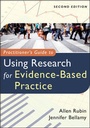
Allen Rubin | Jennifer Bellamy
Practitioner's Guide to Using Research for Evidence-Based Practice
Book
09/2012
2nd Edition
Wiley
Unfortunately, price unknown
Article exhausted; check for reprint
Additional editions
E-Book
01/2011
Wiley
€51.99
Available for download
E-Book
06/2008
Wiley
€51.99
Available for download
Person
ALLEN RUBIN, PhD, teaches in the School of Social Work at the University of Texas, Austin. He is world-renowned for his work in research methods and clinical practice and served as president of the Society of Social Work and Research from 1998-2000. He is the recipient of the Council on Social Work Education 2007 Significant Lifetime Achievement in Social Work Education Award.
Content
Preface
Part 1 - Overview of Evidence-Based Practice
Ch 1 - Introduction to Evidence-Based Practice
Ch 2 - Steps in the EBP Process
Ch 3 - Research Hierarchies
Part 2 - Critically Appraising Studies for EBP Questions About Intervention Effectiveness
Ch 4 - Criteria for Inferring Effectiveness
Ch 5 - Critically Appraising Experiments
Ch 6 - Critically Appraising Quasi-Experiments: Nonequivalent Comparison Groups Designs
Ch 7 - Critically Appraising Quasi-Experiments: Time-Series Designs and Single-Case Designs
Ch 8 - Critically Appraising Systematic Reviews and Meta-Analyses
Part 3 - Critically Appraising Studies for Alternative EBP Questions
Ch 9 - Critically Appraising Non-Experimental Quantitative Studies
Ch 10 - Critically Appraising Qualitative Studies
Part 4 - Assessing Clients and Monitoring Their Progress
Ch 11 - Critically Appraising and Selecting Assessment Instruments
Ch 12 - Monitoring Client Progress
Appendix A Critical Appraisals of Study Synopses at the End of Chapter 4
Appendix B Critical Appraisals of Study Synopses at the End of Chapter 5
Appendix C Critical Appraisals of Study Synopses at the End of Chapter 6
Appendix D Critical Appraisals of Study Synopses at the End of Chapter 7
Appendix E Critical Appraisals of Study Synopses at the End of Chapter 8
Appendix F Critical Appraisals of Study Synopses at the End of Chapter 9
Appendix G Critical Appraisals of Study Synopses at the End of Chapter 10
Appendix H Critical Appraisals of Study Synopses at the End of Chapter 11
Glossary
References
Index
Part 1 - Overview of Evidence-Based Practice
Ch 1 - Introduction to Evidence-Based Practice
Ch 2 - Steps in the EBP Process
Ch 3 - Research Hierarchies
Part 2 - Critically Appraising Studies for EBP Questions About Intervention Effectiveness
Ch 4 - Criteria for Inferring Effectiveness
Ch 5 - Critically Appraising Experiments
Ch 6 - Critically Appraising Quasi-Experiments: Nonequivalent Comparison Groups Designs
Ch 7 - Critically Appraising Quasi-Experiments: Time-Series Designs and Single-Case Designs
Ch 8 - Critically Appraising Systematic Reviews and Meta-Analyses
Part 3 - Critically Appraising Studies for Alternative EBP Questions
Ch 9 - Critically Appraising Non-Experimental Quantitative Studies
Ch 10 - Critically Appraising Qualitative Studies
Part 4 - Assessing Clients and Monitoring Their Progress
Ch 11 - Critically Appraising and Selecting Assessment Instruments
Ch 12 - Monitoring Client Progress
Appendix A Critical Appraisals of Study Synopses at the End of Chapter 4
Appendix B Critical Appraisals of Study Synopses at the End of Chapter 5
Appendix C Critical Appraisals of Study Synopses at the End of Chapter 6
Appendix D Critical Appraisals of Study Synopses at the End of Chapter 7
Appendix E Critical Appraisals of Study Synopses at the End of Chapter 8
Appendix F Critical Appraisals of Study Synopses at the End of Chapter 9
Appendix G Critical Appraisals of Study Synopses at the End of Chapter 10
Appendix H Critical Appraisals of Study Synopses at the End of Chapter 11
Glossary
References
Index