

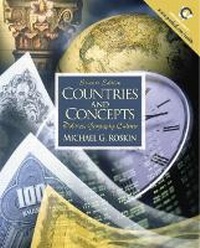
Countries and Concepts
Politics, Geography, Culture
7th Edition
Published on 2. August 2000
Book
Paperback/Softback
524 pages
978-0-13-086758-2 (ISBN)
Description
For undergraduate Political Science courses including Introduction to Comparative Politics, Introduction to European Politics, and Introduction to Politics.
Introduces the concepts and vocabulary of Comparative Politics through a country-by-country analysis and recent case studies. By demonstrating that political life is universal and comparable, the text also proves that no country is really alien, but rather that all countries are understandable.
Introduces the concepts and vocabulary of Comparative Politics through a country-by-country analysis and recent case studies. By demonstrating that political life is universal and comparable, the text also proves that no country is really alien, but rather that all countries are understandable.
More details
Edition
7th edition
Language
English
Place of publication
United States
Publishing group
Pearson Education (US)
Target group
Professional and scholarly
Dimensions
Height: 233 mm
Width: 190 mm
Thickness: 17 mm
Weight
828 gr
ISBN-13
978-0-13-086758-2 (9780130867582)
Copyright in bibliographic data and cover images is held by Nielsen Book Services Limited or by the publishers or by their respective licensors: all rights reserved.
Schweitzer Classification
Other editions
New editions
Book
08/2003
8th Edition
Pearson
€44.56
Article exhausted; check for reprint
Previous edition

Book
08/1997
6th Edition
Pearson Education (US)
€44.56
Article exhausted; check for reprint
Content
1. The Concept of Country.
I. GREAT BRITAIN.
2. The Impact of the Past.
3. Britain: The Key Institutions.
4. British Political Culture.
5. Britain: Patterns of Interaction.
6. What Britons Quarrel About.
II. FRANCE.
7. France: The Impact of the Past.
8. France: The Key Institutions.
9. French Political Culture.
10. France: Patterns of Interaction.
11. What the French Quarrel About.
III. GERMANY.
12. Germany: The Impact of the Past.
13. Germany: The Key Institutions.
14. German Political Culture.
15. Germany: Patterns of Interaction.
16. What Germans Quarrel About.
IV. RUSSIA.
17. Russia: The Impact of the Past.
18. Russia: The Key Institutions.
19. Russian Political Culture.
20. Russia: Patterns of Interaction.
21. What Russians Quarrel About.
V. JAPAN.
22. Japan: The Impact of the Past.
23. Japan: The Key Institutions.
24. Japanese Political Culture.
25. Japan: Patterns of Interaction.
26. What Japanese Quarrel About.
VI. THE THIRD WORLD.
27. China.
28. Brazil.
29. South Africa.
30. Iran.
31. Lessons of Nine Countries.
I. GREAT BRITAIN.
2. The Impact of the Past.
3. Britain: The Key Institutions.
4. British Political Culture.
5. Britain: Patterns of Interaction.
6. What Britons Quarrel About.
II. FRANCE.
7. France: The Impact of the Past.
8. France: The Key Institutions.
9. French Political Culture.
10. France: Patterns of Interaction.
11. What the French Quarrel About.
III. GERMANY.
12. Germany: The Impact of the Past.
13. Germany: The Key Institutions.
14. German Political Culture.
15. Germany: Patterns of Interaction.
16. What Germans Quarrel About.
IV. RUSSIA.
17. Russia: The Impact of the Past.
18. Russia: The Key Institutions.
19. Russian Political Culture.
20. Russia: Patterns of Interaction.
21. What Russians Quarrel About.
V. JAPAN.
22. Japan: The Impact of the Past.
23. Japan: The Key Institutions.
24. Japanese Political Culture.
25. Japan: Patterns of Interaction.
26. What Japanese Quarrel About.
VI. THE THIRD WORLD.
27. China.
28. Brazil.
29. South Africa.
30. Iran.
31. Lessons of Nine Countries.