

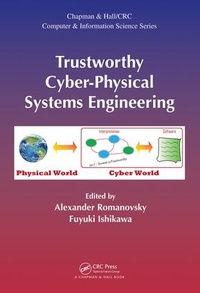
Trustworthy Cyber-Physical Systems Engineering
1st Edition
Will be published approx. on 28. September 2016
Book
Hardback
462 pages
978-1-4987-4245-0 (ISBN)
Description
From the Foreword
"Getting CPS dependability right is essential to forming a solid foundation for a world that increasingly depends on such systems. This book represents the cutting edge of what we know about rigorous ways to ensure that our CPS designs are trustworthy. I recommend it to anyone who wants to get a deep look at these concepts that will form a cornerstone for future CPS designs."
--Phil Koopman, Carnegie Mellon University, Pittsburgh, Pennsylvania, USA
Trustworthy Cyber-Physical Systems Engineering provides practitioners and researchers with a comprehensive introduction to the area of trustworthy Cyber Physical Systems (CPS) engineering. Topics in this book cover questions such as
What does having a trustworthy CPS actually mean for something as pervasive as a global-scale CPS?
How does CPS trustworthiness map onto existing knowledge, and where do we need to know more?
How can we mathematically prove timeliness, correctness, and other essential properties for systems that may be adaptive and even self-healing?
How can we better represent the physical reality underlying real-world numeric quantities in the computing system?
How can we establish, reason about, and ensure trust between CPS components that are designed, installed, maintained, and operated by different organizations, and which may never have really been intended to work together?
Featuring contributions from leading international experts, the book contains sixteen self-contained chapters that analyze the challenges in developing trustworthy CPS, and identify important issues in developing engineering methods for CPS.
The book addresses various issues contributing to trustworthiness complemented by contributions on TCSP roadmapping, taxonomy, and standardization, as well as experience in deploying advanced system engineering methods in industry. Specific approaches to ensuring trustworthiness, namely, proof and refinement, are covered, as well as engineering methods for dealing with hybrid aspects.
"Getting CPS dependability right is essential to forming a solid foundation for a world that increasingly depends on such systems. This book represents the cutting edge of what we know about rigorous ways to ensure that our CPS designs are trustworthy. I recommend it to anyone who wants to get a deep look at these concepts that will form a cornerstone for future CPS designs."
--Phil Koopman, Carnegie Mellon University, Pittsburgh, Pennsylvania, USA
Trustworthy Cyber-Physical Systems Engineering provides practitioners and researchers with a comprehensive introduction to the area of trustworthy Cyber Physical Systems (CPS) engineering. Topics in this book cover questions such as
What does having a trustworthy CPS actually mean for something as pervasive as a global-scale CPS?
How does CPS trustworthiness map onto existing knowledge, and where do we need to know more?
How can we mathematically prove timeliness, correctness, and other essential properties for systems that may be adaptive and even self-healing?
How can we better represent the physical reality underlying real-world numeric quantities in the computing system?
How can we establish, reason about, and ensure trust between CPS components that are designed, installed, maintained, and operated by different organizations, and which may never have really been intended to work together?
Featuring contributions from leading international experts, the book contains sixteen self-contained chapters that analyze the challenges in developing trustworthy CPS, and identify important issues in developing engineering methods for CPS.
The book addresses various issues contributing to trustworthiness complemented by contributions on TCSP roadmapping, taxonomy, and standardization, as well as experience in deploying advanced system engineering methods in industry. Specific approaches to ensuring trustworthiness, namely, proof and refinement, are covered, as well as engineering methods for dealing with hybrid aspects.
More details
Series
Language
English
Place of publication
Oxford
United States
Publishing group
Taylor & Francis Inc
Target group
College/higher education
Professional and scholarly
This book is intended for researchers and students in systems engineering, computer engineering, and software engineering.
Illustrations
98 s/w Abbildungen, 20 s/w Tabellen
20 Tables, black and white; 98 Illustrations, black and white
Dimensions
Height: 254 mm
Width: 178 mm
Weight
1094 gr
ISBN-13
978-1-4987-4245-0 (9781498742450)
Copyright in bibliographic data and cover images is held by Nielsen Book Services Limited or by the publishers or by their respective licensors: all rights reserved.
Schweitzer Classification
Other editions
Additional editions
Alexander Romanovsky | Fuyuki Ishikawa
Trustworthy Cyber-Physical Systems Engineering
Book
06/2020
1st Edition
Chapman & Hall/CRC
€67.80
Shipment within 15-20 days
Alexander Romanovsky | Fuyuki Ishikawa
Trustworthy Cyber-Physical Systems Engineering
E-Book
10/2016
Chapman & Hall/CRC
€62.99
Available for download
Alexander Romanovsky | Fuyuki Ishikawa
Trustworthy Cyber-Physical Systems Engineering
E-Book
10/2016
Chapman & Hall/CRC
€63.49
Available for download
Persons
Alexander Romanovsky is a professor in the School of Computing Science at Newcastle University, UK.
Fuyuki Ishikawa is an associate professor in the Digital Content and Media Sciences Research Division at the National Institute of Informatics, Japan.
Fuyuki Ishikawa is an associate professor in the Digital Content and Media Sciences Research Division at the National Institute of Informatics, Japan.
Content
Concepts Of Dependable Cyber-Physical Systems Engineering: Model-Based Approaches. Pathways To Dependable Cyber-Physical Systems Engineering. A Rigorous Definition Of Cyber-Physical Systems. A Generic Model For System Substitution Incremental Proof-Based Development For Resilient Distributed Systems. Formalizing Goal-Oriented Developmentof Resilient Cps. Formal Reasoning About Resilient Cps. Collaborative Modeling And Simulation For Cyber-Physical Systems. Verifying Trustworthy Cyber-Physical Systems Using Closed-Loop Modeling. Stop And Go Adaptive Cruise Control: A Case Study Of Automotive Cyber-Physical Systems. Model-Based Analysis Of Energy Consumption Behavior. A Formal Dsl For Multicore System Management. New Standards For Trustworthy Cyber-Physical Systems. Measurement-Based Identification Of Infrastructures For Trustworthy Cyber-Physical Systems. Mdd-Based Design, Configuration, And Monitoring Of Resilient Cps. Education Of Scientific Approaches To Trustworthy Systems For Industry: After 10 Years.