

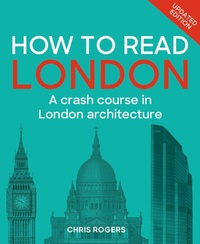
How to Read London
A crash course in London architecture
Will be published approx. on 28. January 2027
Book
Paperback/Softback
256 pages
978-1-80570-617-5 (ISBN)
Description
The original and definitive pocket guide to London's architecture.
First published in 2017, this new edition is fully revised and updated, featuring five brand-new entries, refreshed chapter introductions, and redesigned maps that reflect the city's continually evolving architectural landscape.
Spanning more than 2,000 years of settlement, London's built environment is the product of a uniquely organic evolution. Unlike Haussmann's Paris, the city was never shaped by a single ruler or grand political vision; instead, private ownership and commercial enterprise left their mark on its streets and neighbourhoods. The graceful squares and crescents of the West End embody the Classical townscape of 1600-1830, while medieval, Tudor, and Victorian districts-often tied to trade, class, or guild-retain their distinctive identities, particularly in the City and East End.
From its reconstruction after the Great Fire of 1666 to its rise as a centre of commerce, culture, finance, and law, London has constantly adapted to meet the needs of each era. How to Read London reveals, through its buildings and streetscapes, how the city's domestic, civic, and commercial architecture has transformed over centuries-from imperial capital to global metropolis.
First published in 2017, this new edition is fully revised and updated, featuring five brand-new entries, refreshed chapter introductions, and redesigned maps that reflect the city's continually evolving architectural landscape.
Spanning more than 2,000 years of settlement, London's built environment is the product of a uniquely organic evolution. Unlike Haussmann's Paris, the city was never shaped by a single ruler or grand political vision; instead, private ownership and commercial enterprise left their mark on its streets and neighbourhoods. The graceful squares and crescents of the West End embody the Classical townscape of 1600-1830, while medieval, Tudor, and Victorian districts-often tied to trade, class, or guild-retain their distinctive identities, particularly in the City and East End.
From its reconstruction after the Great Fire of 1666 to its rise as a centre of commerce, culture, finance, and law, London has constantly adapted to meet the needs of each era. How to Read London reveals, through its buildings and streetscapes, how the city's domestic, civic, and commercial architecture has transformed over centuries-from imperial capital to global metropolis.
Reviews / Votes
"A superbly illustrated crash course on metropolitan architecture." * This England * "The perfect companion for anyone who walks the capital, or anyone interested in London's architectural history." * The London Society * "How to Read London comes in handy. It's divided into seven time periods, with nifty diagrams, clear explanations of what you're seeing and details of dates, architects and engineers." * Daily Telegraph *More details
Series
Edition
Revised Edition
Language
English
Place of publication
United Kingdom
Publishing group
Quarto Publishing PLC
Edition type
Revised edition
Product notice
Paperback (trade)
Dimensions
Height: 165 mm
Width: 135 mm
Thickness: 15 mm
Weight
440 gr
ISBN-13
978-1-80570-617-5 (9781805706175)
Copyright in bibliographic data and cover images is held by Nielsen Book Services Limited or by the publishers or by their respective licensors: all rights reserved.
Schweitzer Classification
Other editions
Previous edition
Book
04/2017
Ivy Press
€16.50
Shipment within 3-4 weeks
Person
Chris Rogers writes on architecture and visual culture, informed by twenty years of investigation, research and conversations with practitioners. He creates and leads architectural tours, often working closely with architects, and is the author of The Power of Process: The Architecture of Michael Pearson (2010) and How to Read Paris (2016).